
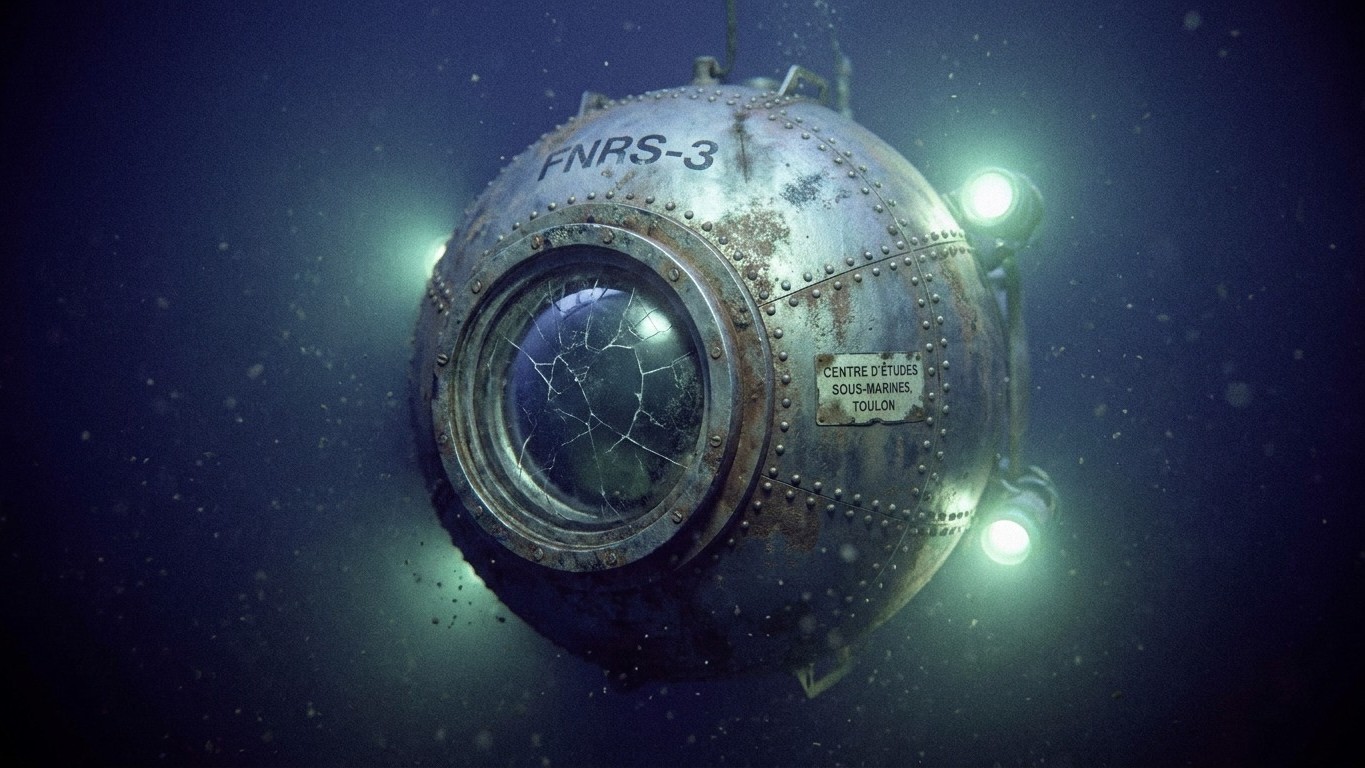
A dry detonation seemed to ripple the steel hull, somewhere beyond 9,000 meters depth in the Pacific. On January 23, 1960, aboard the bathyscaphe Trieste, Swiss engineer Jacques Piccard and US Navy lieutenant Don Walsh heard their outer porthole crack under the immense pressure. They did not ascend. They pressed on toward what would become, for fifty-two years, the deepest point ever reached by humans: the floor of the Mariana Trench, nearly 11,000 meters beneath the sea surface.
Key takeaways
- A porthole cracks at 9,000 meters, yet the two divers push forward without hesitation
- The physical reasoning that justifies this apparently suicidal decision
- What they discover on the floor forever changes our understanding of abyssal life
Nine metric tons of iron balls to pierce the abyss
The Trieste does not descend grâce to powerful engines. It sinks, quite simply, ballast-weighted by a mass measured to the gram. Twenty thousand pounds, or nine metric tons, of magnetic iron balls were placed aboard as ballast, both to speed the descent and to enable the ascent, since the extreme water pressures at great depths cannot accommodate air-filled ballast tanks. The principle is as simple as it is ingenious: electromagnets hold the balls, and the slightest electrical failure automatically releases the ballast, sending the craft back toward the surface.
Piccard and Walsh sit inside a tiny metal sphere. The crew is housed within a steel sphere a little over two meters in diameter, its walls more than five inches thick, roughly 13 centimeters. A shape chosen because it distributes stresses evenly, a detail that matters when the pressure at the bottom of the Mariana Trench reaches about 16,000 pounds per square inch, or roughly 110 megapascals—more than a thousand times the pressure at sea level. The descent takes almost five hours. After a descent of nearly five hours, the Trieste reaches the Challenger Deep, at about 36,000 feet below sea level, on January 23, 1960.
A gunshot at 9,000 meters
It is en route that everything could have stopped. Around 30,000 feet into the descent, a dull thud, like a rifle shot, echoes through the cabin: one of the outer Plexiglas panes has cracked under the extreme cold and pressure. The crack does not breach the inner hull, but it leaves a lasting mark on one of the exterior Plexiglas panels. Walsh and Piccard, whose father designed the craft, decide to press on.
Their reasoning can be summed up in a single, chillingly logical sentence: if the Trieste had suffered a catastrophic failure, the two men would already have been crushed by the ocean’s pressure. being alive to hear the crack is proof that the hull held. This leap of faith in physics, rather than prudence, speaks to the mindset of the expedition dubbed Project Nekton: you push forward as long as the instruments do not lie.
Twenty minutes in a cloud of sediment
At 1:00 PM, the Trieste settles on the bottom, at 10,916 meters. The touch with the ocean floor instantly raises an opaque veil. Ironically, Walsh and Piccard hardly see much when they touch the bottom: a wide cloud of sediment particles envelops the craft, preventing any further observation. The long-awaited landscape narrows to a hazy halo illuminated by the spotlights.
Yet, within this murk, a single detail is enough to topple a scientific theory decades old. The dive punctures the azoic theory of the deep, which claimed that life could not exist under such pressure: upon touching down, Piccard spots a fish in the viewport. Other life forms cross their path during these twenty suspended minutes. One, then two red shrimp swim by, and, illuminated by a mercury lamp, a 30-centimeter-long flatfish of an unknown species salutes them. They stay on the floor for about twenty minutes, long enough to verify the instruments and to etch this brief visit into history.
Fifty-two years of abyssal silence
To ascend, no engine is required either: simply shed the iron ballast, ton after ton, into the darkness of the trench. The ascent takes several hours. The two explorers surface at 4:56 PM, after a dive lasting 8 hours 33 minutes, during which, in frigid temperatures, they had time to study the water and its main properties, including radioactivity and temperature.
What stands out in retrospect is the void that followed this feat. No one repeats the experiment at such depth for decades. It would take until 2012 and the solo vessel Deepsea Challenger for a new craft to descend there again, followed in 2020 by the Chinese submersible Fendouzhe, and then by four expeditions of the DSV Limiting Factor between 2019 and 2022. In other words, the Challenger Deep kept its secret longer than the Moon waited for its first visitors. Today, only a handful of explorers can claim to have touched this floor, and each of them owes it, in one way or another, to that steel sphere from 1960 that endured despite its cracked porthole.
Sources: libnanews.com | slate.fr
