
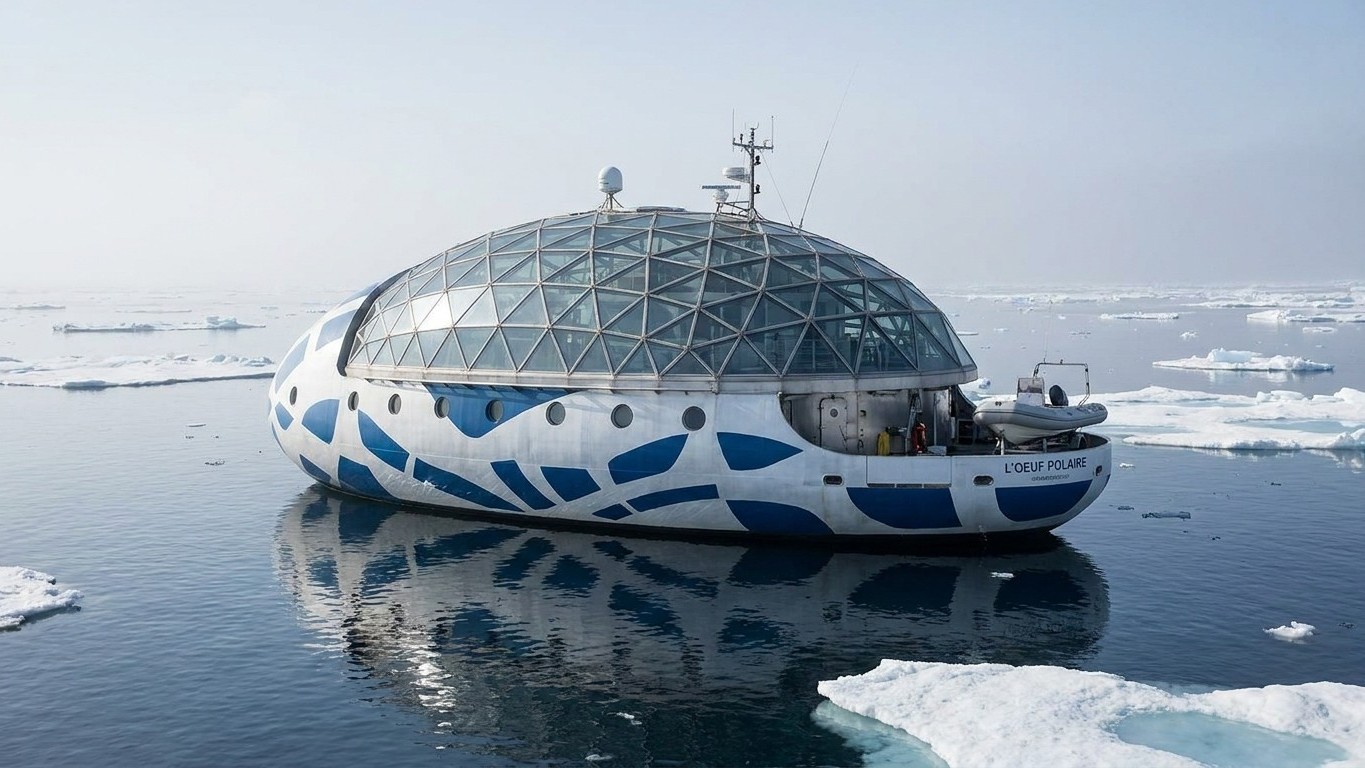
Twenty million euros. That is the price of a vessel capable of allowing itself to be voluntarily trapped by polar ice, without ever fearing to be crushed. Launched in Cherbourg, the Tara Polar Station is anything but a conventional icebreaker: its survival in the Arctic does not rely on the thickness of its steel nor on the power of its engines, but on the very shape of its hull, designed to be lifted by the ice rather than crushed by it.
Key takeaways
- A vessel designed to be lifted by the ice rather than resisting it by force
- An olive-shaped aluminum hull conceived by engineers inspired by polar nature
- Eighteen months of drift planned with no possibility of return, like a floating scientific base
An Olive-Shaped Hull Rather Than Armor
The principle rests on a simple image, shared by one of the yard’s engineers during a technical briefing: the ice will form around the hull and the ship will not be crushed by the pressure of the ice but will rise onto the ice. Concretely, when the ice tightens around the hull, the pressure has nowhere to go but upward, and the vessel is lifted rather than compressed. A manager at the Normandy yard summarized the mechanics in almost banal terms: imagine being trapped between two ice plates pressing against each other, until, suddenly, the structure rises and ends up perched on the ice, while still maintaining access to the scientific instruments thanks to its protruding part.
This architecture, conceived by naval architect Olivier Petit in collaboration with the Mauric bureau, deliberately breaks with the conventions of the traditional oceanographic ship. Tara Polar Station has an oval shape (26 m by 16 m), and is built around a moonpool allowing sampling directly in the water beneath the ice. The visual result even surprises onlookers at the port: rather than a slender hull of an icebreaker, one finds a rounded mass, almost a metallic saucer resting on the water. The comparison is not incidental: its shape resembles more a metallic igloo than a classic research vessel, with a geodesic superstructure intended to mimic the facets of ice itself.
Thick Aluminum, But Not an Ice-Resistant Armor
Contrary to intuition, it is not the robustness of the metal that protects the vessel. Its hull remains aluminum, a material reputed to be lighter than steel but markedly less resistant to pure crushing. The hull is made from 20-millimeter-thick aluminum plates, a thickness greater than the average for conventional ships, yet it would be insufficient against the raw pressure of the ice without the hull’s particular geometry. It is indeed the shape, not the material, that does all the work: its oval aluminum hull makes the structure rise when the ice compresses, rather than crush it.
The ship was classified under the strictest maritime standards for this type of use. Built to commercial shipping standards and the Polar Code, the vessel is rated Ice Class 1A Super. Its reinforced aluminum hull must withstand temperatures down to -52°C, and the mechanical stresses exerted by ice several tens of centimeters thick. Inside, thermal insulation does the rest: it keeps the interior at a comfortable temperature even when the outside thermometer plummets.
Eighteen Months Adrift, with No Possibility of Return
The operation of the ship is as radical as its form. Once trapped in the ice north of Greenland, the station ceases to be a boat in the traditional sense: it becomes a floating scientific base, carried by polar currents for about eighteen months, including four months of continuous polar night. No turnback is possible before the thaw frees the hull from its ice hold, a scenario that directly echoes Fridtjof Nansen’s Fram expedition at the end of the 19th century, or Tara itself during its voyage from 2006 to 2008.
Around twenty people will live aboard during this drift, including about a dozen scientists tasked with continuously measuring the atmosphere, the ice, the water column, and Arctic biodiversity. All dimensions of the Arctic will be studied, from 2,000 meters above sea level to 2,000 meters below, with hundreds of onboard scientific protocols and tens of thousands of samples collected at each campaign. Isolation is total: no resupply possible on site, no crew change until the end of the programmed drift, and a life shaped by polar darkness for many months.
Twenty Drifts Planned Through 2045
This first mission is only the prologue to a much longer program. The Tara Ocean Foundation, the project’s originator, plans a series of successive drifts through 2045, with the aim of transforming this vessel into a permanent Arctic Ocean observatory beneath the ice. The Tara Ocean Foundation, the first publicly recognized foundation dedicated to the Ocean in France, was created in 2003 by fashion designer agnès b. and her son Étienne Bourgois, and has steered scientific expeditions in partnership with CNRS, CEA and international laboratories for more than two decades.
The challenge goes beyond mere technical prowess. The Arctic is warming at a rate well above the global average, and this region remains one of the least documented on the planet due to a lack of platforms able to station there for long periods. By betting on a hull that refuses to fight the ice and instead chooses to work with it, the engineers seek less to dominate the polar nature than to coexist with it. Whether this strategy will hold over time remains to be seen: the first drift, recently begun, will serve as a full-scale test before the nineteen subsequent ones.
Sources: enseignementsup-recherche.gouv.fr | meretmarine.com | ici.fr
