
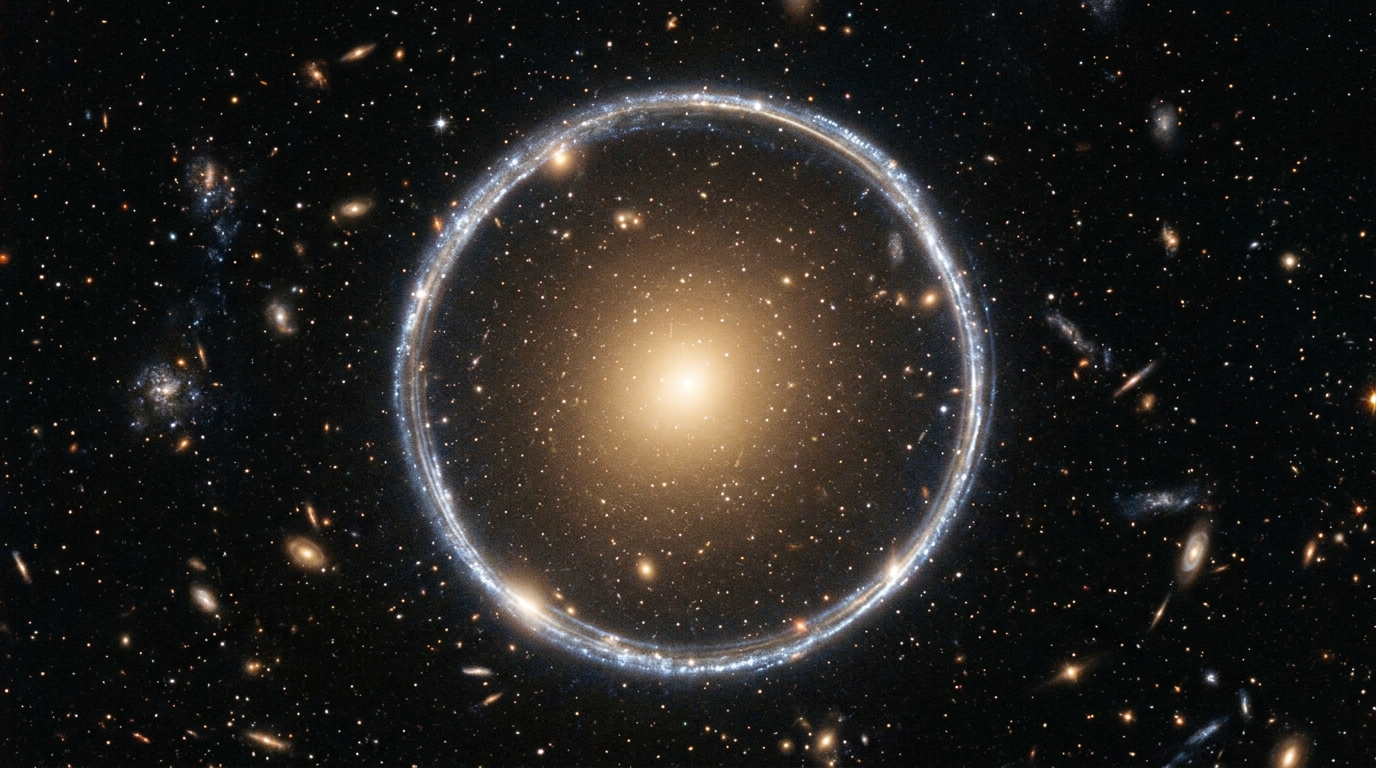
There are ideas so bold that their own creator doubts they could ever be verified. This is exactly what happened with one of the most fascinating phenomena in modern physics: a perfect ring of light born from the warping of spacetime by gravity. Its designer, convinced that no one would ever observe it, had nearly relegated it to the realm of a mathematical curiosity with no future. It would take several decades and the arrival of a telescope capable of peering into the far reaches of the universe for this prediction to emerge from the equations and take the form of a true photograph.
- In 1936, Einstein calculates the conditions for the formation of a light ring caused by the curvature of spacetime, but deems its observation virtually impossible.
- In 1998, the Hubble Space Telescope photographs a complete Einstein ring thanks to the fortuitous alignment of two distant galaxies.
- This phenomenon, called gravitational lensing, has become an essential tool for measuring the mass of galaxy clusters, including dark matter, and observing distant objects.
- Einstein predicted the impossible to photograph
- Hubble defies Einstein’s skepticism
- From theoretical curiosity to an astronomer’s tool
- What this discovery changes for modern astrophysics
Einstein predicted the impossible to photograph
While developing his general theory of relativity, Albert Einstein understood that light does not escape the influence of gravity. An object as massive as a star or a galaxy can bend spacetime to the extent that nearby light rays are deflected. In a very particular arrangement, when the observer, the light source, and the massive object are perfectly aligned, this deflection produces a spectacular effect: the light from the distant object is stretched into a circle almost perfectly around the mass that deflects it. This is what we now call an Einstein ring.
The problem is that Einstein himself judged this phenomenon almost impossible to observe with the instruments of his era. In a 1936 paper, he calculated the conditions necessary for the appearance of such a ring, but concluded that an alignment as precise as that among several celestial bodies is nearly a matter of cosmic chance. The observational instruments of the 1930s simply could not detect details so fine at such dizzying distances. The idea therefore remained confined to the pages of calculation, regarded by many as an elegant theoretical curiosity without practical application.
Hubble defies Einstein’s skepticism
It would take several decades and a major technological advancement for this prediction to change status. With the launch of the Hubble Space Telescope in the late 1980s, astronomy crossed a decisive threshold: for the first time, it became possible to observe the universe without the distortions of Earth’s atmosphere, with a clarity never before achieved from the ground.
Thus, in 1998, sixty-two years after Einstein’s calculations, Hubble managed to photograph a true complete Einstein ring, a result of the fortuitous alignment of two distant galaxies. The image, though subtle at first glance, constitutes a silent revolution: it vividly confirms a prediction that its own author believed would remain theoretical. This snapshot marks a turning point, turning an abstract concept into tangible visual proof of the curvature of spacetime.
From theoretical curiosity to an astronomer’s tool
What is most striking about this story is the speed with which a discovery deemed anecdotal becomes an indispensable scientific instrument. Once the concept proof was established, astronomers realized that this phenomenon, more broadly known as gravitational lensing, is not limited to perfect rings. It encompasses all deformations, arcs, and multiple images produced by the gravity of massive objects on the light passing through them.
This turning point changes everything. Where Einstein saw a mathematical oddity that could not be exploited, researchers discovered a powerful observational lever. By using galaxy clusters as real cosmic magnifying glasses, it becomes possible to amplify the light from objects even farther away and fainter, located far beyond what instruments could capture on their own. What was once only a theoretical curiosity becomes a full-fledged observational method, regularly used in space imaging campaigns.
What this discovery changes for modern astrophysics
Today, gravitational lensing plays a central role in several areas of research. It particularly enables the estimation of the total mass of a galaxy cluster, including dark matter, by precisely measuring the distortion it imposes on the light from objects behind it. This technique thus provides an indirect but incredibly effective way to probe matter that remains invisible by any other means.
Current major space surveys continue to exploit this principle to push the boundaries of the observable. Each new ring or arc detected enriches a valuable database, helping to better understand the distribution of matter in the universe and the history of its expansion. It is almost dizzying to think that a phenomenon Einstein deemed undetectable has become, less than a century later, one of the most reliable tools of contemporary astrophysics.
This trajectory, from initial skepticism to daily application, perfectly illustrates how science progresses in steps, sometimes slow, sometimes blazing. It also reminds us that a researcher, no matter how brilliant, cannot always anticipate the technological advances that will confirm or surpass their own intuitions. So, how many other ideas deemed today unrealisable are simply waiting for the right instrument to become, in turn, a scientific certainty?
