
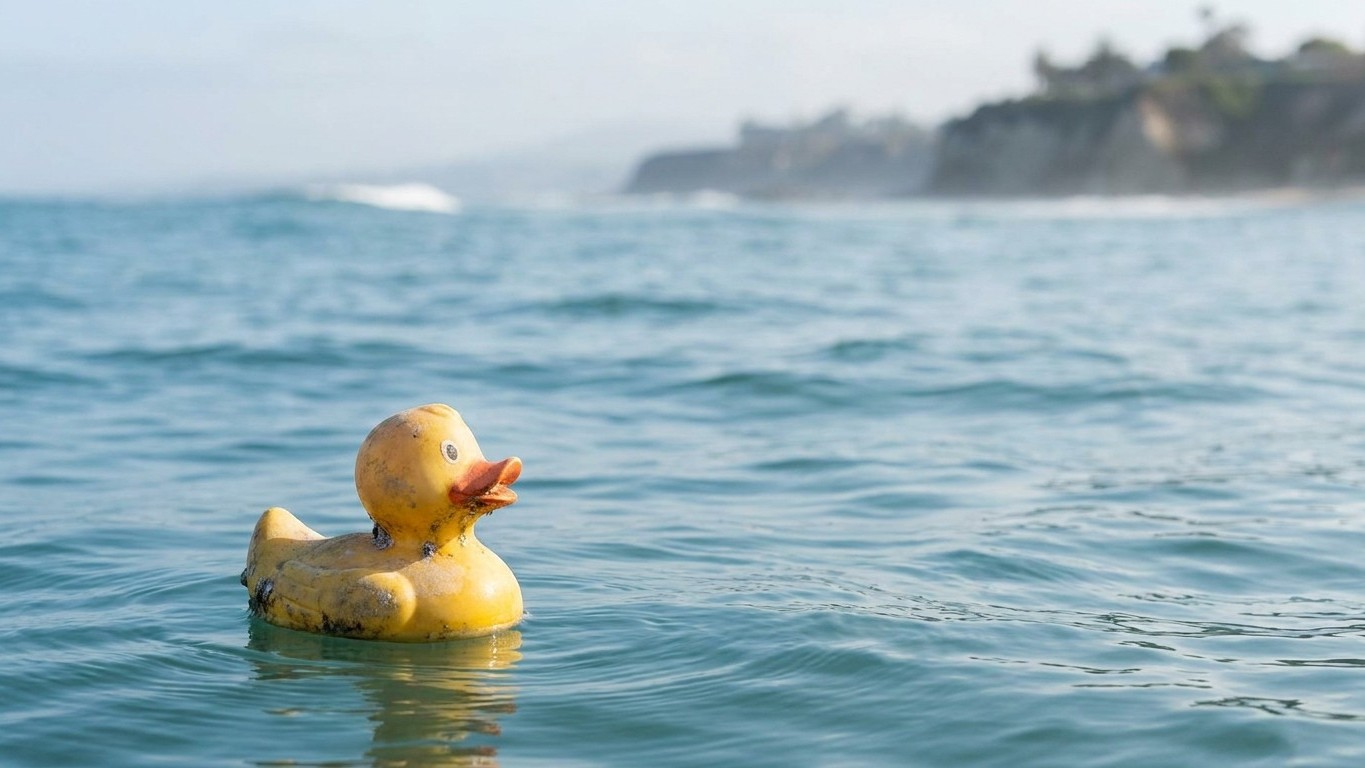
On January 10, 1992, amid a fierce storm in the northern Pacific near the date line, twelve containers tumbled overboard from a container ship plying the route from Hong Kong to Tacoma, Washington. Twelve intermodal boxes, each about 12 meters long, were lost, and one of them contained 28,800 Floatees—a bath toy for children offered in several shapes: red beavers, green frogs, blue turtles, and yellow ducks. Such incidents are not unusual in maritime records; they occur with some regularity. Yet this accident would feeding scientific inquiry for more than fifteen years.
Key takeaways
- A simple maritime accident becomes an involuntary floating laboratory
- Yellow toys journey from Alaska to the British Isles over fifteen years
- A revolutionary computer model emerges from this accidental spill
An unassuming shipwreck that turns into a scientific boon
On 10 January 1992, the container ship Ever Laurel, under the Taiwanese owner Evergreen, was navigating the Pacific, with the Aleutian Islands to the north and open sea to the south, near the date line, on the Hong Kong–Tacoma route, close to Vancouver’s waters. At some point, a container opened—perhaps due to a collision with other containers or with the vessel itself—releasing the toys into the ocean.
Two technical details would transform this spill into an unexpectedly valuable scientific instrument. First, each toy was packaged in a cardboard blister affixed to a support card, but later tests showed that the cardboard quickly disintegrated in seawater, releasing the toys. Second, unlike many bath toys, the Friendly Floatees have no holes, which prevented them from taking in water. The result was thousands of buoyant, watertight objects released at the same place and on the same date. A windfall, literally.
From Alaska to Scottish shores: fifteen years of drift
By autumn, the first reports started to come in. The Friendly Floatees began washing ashore along Alaska’s coast toward the end of 1992, roughly 3,200 kilometers from their origin. Some stalled there. Others kept moving much longer: those still afloat drifted toward Japan and then back toward Alaska, and a portion even reached the Bering Strait where they became trapped in Arctic ice, with Ebbesmeyer estimating that it would take several years to cross the pole before the warmer climate of the Greenland Sea released the ice.
The outcome is enough to surprise any geography aficionado. They remained imprisoned in the ice for five to six years, until melting allowed large quantities to reappear in the Atlantic in 2004; by 2007, many had reached the coasts of the British Isles, fifteen years after their voyage began. Bleached by their journey but still bearing sometimes the label “The First Years,” used to identify them, a small number washed up on the southwest coasts of the United Kingdom. A yellow duck journeyed from a frozen ocean to end up on a Hebridean beach fifteen years later: a reminder of how the concept of distance at sea can be redefined.
A computer model born from bath toys
Behind this saga stood two Seattle researchers, Curtis Ebbesmeyer and James Ingraham, already engaged in modeling surface currents. Oceanographer Curtis Ebbesmeyer learned of the spill and grasped its potential for studying ocean currents, dedicating himself to tracing the toys’ movements through reports from beachcombers and coastal workers. Each duck found, with its precise date and landing site, became a free data point in an ocean where such measurements were rare and expensive to obtain.
These reports fed into a tool that would become a benchmark in the field. Each animal report was integrated into Ocean Surface Currents Simulation (OSCAR), a computer model created by Ebbesmeyer and his colleague James Ingraham, combining data on atmospheric pressure with the speed and direction of weather systems to map the trajectories of surface-current indicators. The model was not merely theoretical: OSCAR successfully predicted the path of the Friendly Floatees, which reached Washington State a few years later.
The experience also refined understanding of a specific phenomenon—the great North Pacific gyre. By tracking these toys, Ebbesmeyer and his colleagues gradually sharpened knowledge of surface-current movement, discovering that floating objects take about three years to complete a full circuit of the subarctic gyre, a vast circular current spinning far to the north of the Pacific. This volunteer network went far beyond a vacation pastime: Ebbesmeyer established ties with beachcombers and built a network of individuals reporting strandings of items from this spill and others, using OSCURS, the simulator devised by Jim Ingraham, to track the movements of all kinds of floating debris.
The story does not stop at scientific pedagogy. The model refined thanks to the ducks eventually attracted far more serious players: nicknamed Oscur, this model earned Curtis Ebbesmeyer an unexpected collaboration with American and British police, who repeatedly asked him to model the maritime paths of human remains or abandoned vessels. A bath toy designed to entertain children ended up helping locate missing bodies at sea. It is hard to imagine a better illustration of the randomness that underpins research.
The Friendly Floatees were not an isolated case, only the most charming. In the 1990s, a container-ship disaster had also scattered 80,000 Nike shoes across the ocean, later examined by oceanographers. These accidental discharges, however regrettable environmentally, provided scientists with decades of data that no research budget could have funded voluntarily. The next time a plastic toy washes up on a beach, it might be worth checking the brand before discarding it.
Sources: prendreparti.com | letemps.ch
