
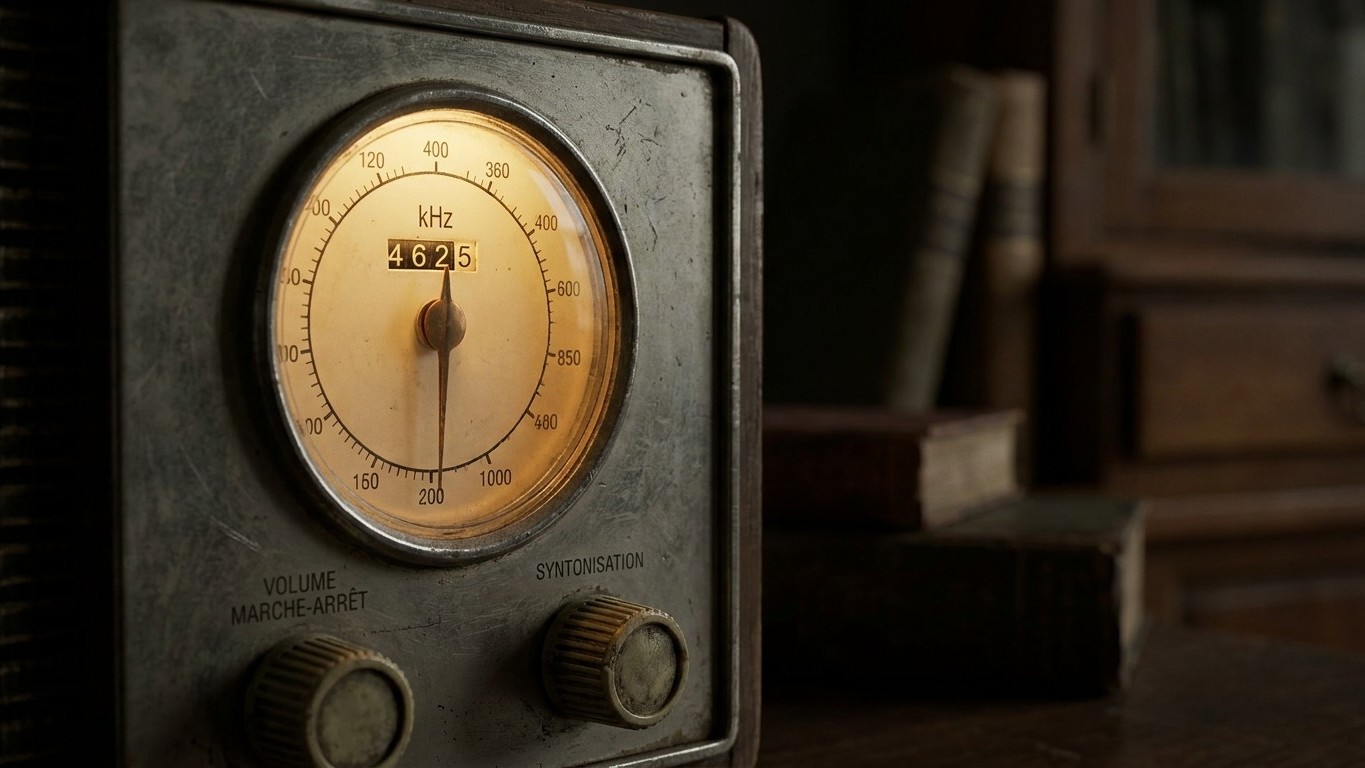
Russia has been looping a radio station that does not officially exist since 1976. On the 4625 kHz frequency, a brief buzz repeats about twenty-five times per minute, day and night, without interruption for nearly fifty years. It broadcasts a short monotone buzz, repeating at a rhythm of roughly 25 tones per minute, 24 hours a day. What sometimes breaks this monotony is not a technical fault or radio silence: it is a voice that strings together words and numbers, with no Russian authority ever confirming to whom it is addressed.
Key takeaways
- A machine that has been buzzing since the Taupe Monocle of the Cold War, with no documented interruption
- When the sound stops, a voice speaks names and numbers in Russian — but no one knows what they mean
- Governments stay silent, but radio amateurs scattered around the world provide the only chronicle that exists
A Buzz Older than the Fall of the Berlin Wall
The station goes by a code name, UVB-76, but everyone knows it by its nickname: The Buzzer, “the buzz-er.” The radio amateurs who hunted Soviet shortwave bands spotted it long before the Internet allowed it to be shared with the world. It has been active since at least the late 1970s or the early 1980s, when the first reports about this frequency were made. Since then, the signal has hardly ever disappeared from the shortwave ether, making it one of the oldest and most continuously documented transmissions by civilian hobbyists.
The sound itself has evolved in texture over the decades. The signal consists of a buzz lasting 1.2 seconds, followed by a pause of 1 to 1.3 seconds, repeating 21 to 34 times per minute; until November 2010, the tones lasted about 0.8 seconds each. Some observers even point to a mechanical rather than electronic origin. The buzzes lengthened and deepened with time, and outages became more frequent, suggesting they could be mechanically generated; in 2016, someone was heard striking the device to bring it back online. Someone, somewhere has physically watched this machine for half a century. That gives the affair a almost touching artisanal quality, far removed from the image of a ultra-sophisticated system.
When the Buzz Stops, a Voice Takes Over
Interruptions remain rare, but they have fascinated since the 1990s. The most famous remains December 24, 1997. At 21:58 GMT, the buzz abruptly stopped, replaced by a brief series of beeps, then a male voice speaking Russian announced: “I am UVB-76. 18008. BROMAL: Boris, Roman, Olga, Mikhail, Anna, Larisa. 742, 799, 14.” This format, names used as phonetic codes followed by numbers, has become the station’s signature.
Long previously sporadic, these vocal messages began to multiply from 2010. The vocal messages of UVB-76 were considered very rare until that year. In 2010, the call sign changed without explanation. Twenty-five vocal messages were broadcast before September 30, followed by 56 more between October and December, almost systematically replacing the call sign “UVB-76” with “MDZhB.” Since then, waves of activity have returned regularly, sometimes with unprecedented intensity. In June 2026, amateur monitors recorded an exceptional volley: between 16:44 and 17:10 Moscow time, the station transmitted seven distinct vocal messages in just 26 minutes, a level of activity unusually high, for a total of 29 code-words spread over twenty vocal messages. Among the words used that day were ordinary Russian terms like “spring,” “support,” or “peninsula,” with no evidence that their literal meaning related to the actual content of the coded messages. By the end of August 2026, another peak emerged: radio monitors reported that UVB-76 transmitted about 25 coded messages on August 27, 2026, a period of unusually concentrated activity.
Neither the Kremlin nor conspiracy theories have ever resolved it
No Russian ministry has ever acknowledged operating this frequency. The only clues come from radio amateurs, organized into a global network of permanent monitoring, who have detected at least two relocations of the transmitter over the years, a cat-and-mouse game that fuels both speculation and specialist forums. The most serious theory ties it to the military. “The Buzzer,” known to Russian listeners as “Zhuzhzhalka” (the buzz-er), would be a Russian military command network serving the Leningrad Military District, broadcasting continuously on 4625 kHz. Other sister stations, nicknamed The Pip and The Squeaky Wheel, would follow the same principle: repetitive channel markers, interrupted by coded vocal traffic, which suggests that The Buzzer is part of a broader military communications structure rather than a lone system aimed at apocalypse.
The most stubborn legend, the one that earned the station its nickname of “the Apocalypse Radio,” remains unconfirmed. If its true purpose has never been revealed, the transmission is not tied to the Dead Hand system, despite the nickname of “Apocalypse Radio” sometimes attributed to it. The fantasy of an automatic nuclear trigger remains exactly that: a fantasy, fueled by mystery more than by evidence. What analysts confirm, instead, is the prudence one must exercise with every captured word. A word that seems dramatic in isolation may simply belong to an encrypted message whose plain meaning has no relevance, and some transmissions could even be dummy traffic intended to resemble operational orders.
What stands out, at bottom, is not so much the content of the messages, indecipherable to anyone who does not possess the key, but the constancy of the device. Half a century of uninterrupted buzzing, kept alive by hand when it breaks down, listened to relentlessly by enthusiasts who archive every second of airtime on online receivers shared across networks. While governments stay silent, hobbyists scattered across continents craft, minute by minute, the only chronicle that exists for this frequency. An incomplete chronicle, certainly, but the only one that endures against Moscow’s official silence.
Sources: binoculars-telescopes.com | visegradpost.com
