
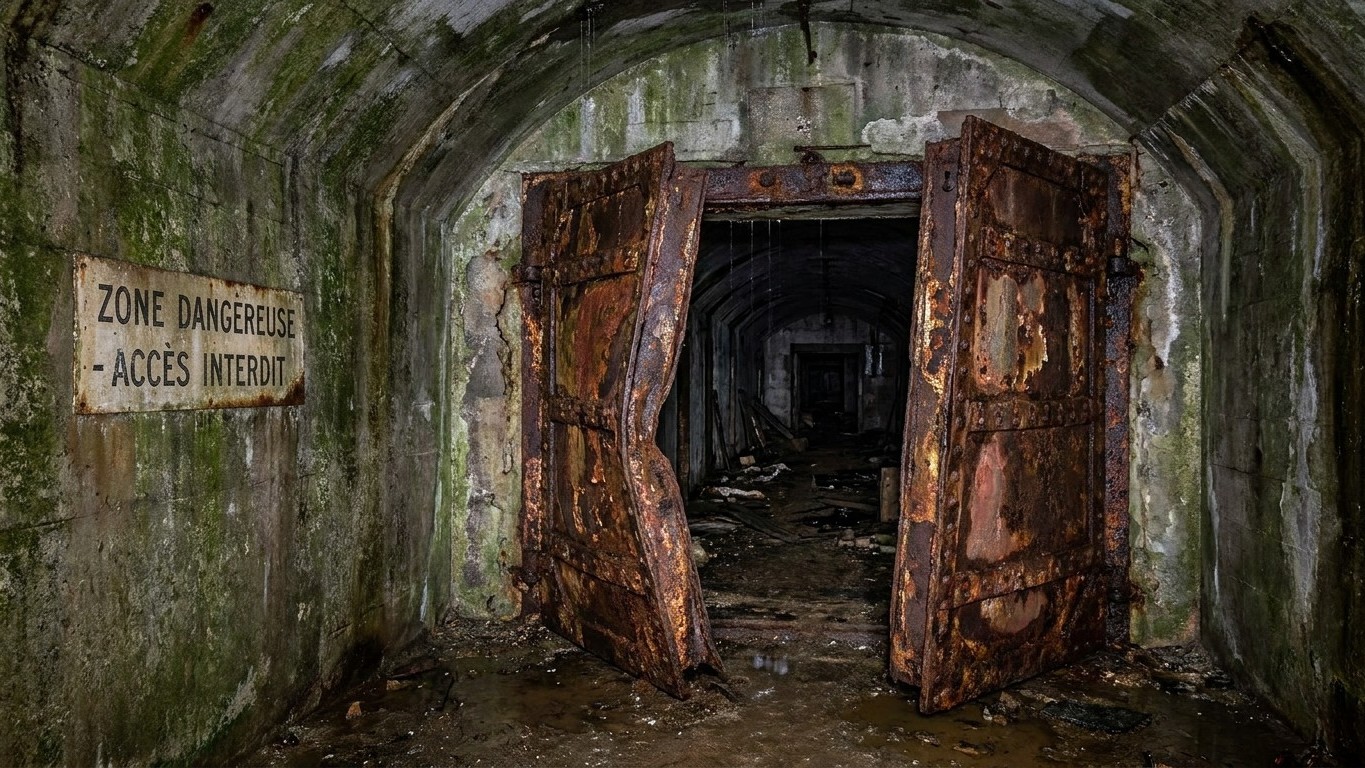
Since May 16, 1992, four tunnel mouths open on the side of the Plješevica massif, yet no aircraft ever emerges. Željava Airbase is an air facility located in Bihać on the border between Croatia and Bosnia and Herzegovina. On that day, the army that had built and used it for decades detonated its own galleries rather than surrendering them to the enemy. The armored doors intended to shield the installation from a nuclear strike have never reopened since. They rust, bent by the blast, at the bottom of a labyrinth that no one dares to explore anymore.
Key takeaways
- A 3.5-kilometer subterranean air base built in secret for six billion dollars
- Intentionally destroyed on May 16, 1992 by 56 tons of explosives to prevent surrender
- Armored doors weighing tens of tons still rust in the darkness three decades later
A colossal project hidden within a mountain
The construction began in 1957 under the code name “Objekat 505,” a project so sensitive that even locals in the region did not know its true scale. The base, stretching 3.5 kilometers, was completed in 1965 in utmost secrecy after roughly six billion dollars of work, but it did not become operational until 1968. A colossal budget for the era, allocated by a Yugoslavia that feared as much a Soviet assault as Western intervention.
The result is beyond imagination. The site was conceived in a context of total war and was meant to be entirely self-sufficient and autonomous: for one month, 1,000 people and about fifty fighters could live and work on site without any external supply. Three MiG-21 squadrons were permanently stationed there, the 117th Fighter Squadron with three MiG-21PF fighter-bomber squadrons and the 323rd Reconnaissance Squadron with its MiG-21R aircraft. The runways opened directly into the mountain, closed by concrete and steel doors capable of hermetically isolating the complex in an emergency, as described by the American site Ex Utopia regarding these “concrete and steel blast doors throughout Yugoslavia’s Željava Airbase complex” designed to seal the base. A radar perched atop the massif monitored three neighboring airspaces by itself, with a radar system boasting a 400 km range installed on the summit of the Plješevica massif.
The night the army blew up its own installation
The trigger was the collapse of Yugoslavia. As early as 1991, Croatian troops abandoned the base, and the Yugoslav air force, while leaving, destroyed the runways by blowing up cavities planned for that purpose beneath the asphalt. The base then fell under the control of the self-proclaimed Serbian Republic of Krajina. But their position became untenable in the face of the Croatian advance and the proclaimed independence of Bosnia and Herzegovina. The decision came from Belgrade: better to destroy than to surrender.
On May 16, 1992, Yugoslav army engineers who knew every nook of the galleries from having served there placed charges against the reinforced concrete arches, the armored doors, and the fuel depots. To prevent any future use of the complex by Croatian and Bosnian forces, the Serb Army of Krajina completed the destruction in 1992 by exploding a further 56 tons of explosives. The blast was so powerful that the ensuing explosion shook the nearby town of Bihać. For months, the landscape bore the mark of the disaster: villagers from nearby hamlets claimed that smoke continued to pour from the tunnels six months after the blast. The shock wave pulverized the interior of the mountain. The explosion caused the collapse of the main structural arches and the total destruction of the massive armored doors. Ironically, a base designed to withstand a nuclear blast would not resist the explosives of those who had built it.
Un radar qui a survécu trois ans de plus
Curiously, not everything disappeared that day. The radar system, which allowed monitoring of Austrian, Italian, and Hungarian airspace, continued to operate from 1992 to 1995. It would take the Croatian operation “Storm” to destroy this equipment as well, by the Serb Army of Krajina to prevent it from falling into Croatian hands. A technological last stand atop a mountain already scarred below.
What remains today beneath the mountain
More than thirty years later, no one has seriously reopened these galleries. Abandoned, the site remains highly dangerous to this day: polluted by mines and by chemical byproducts released during the 1992 sabotage, with no renovation undertaken since. A plan to convert it into a center for asylum seekers had been discussed for a time, then abandoned: the idea of building a center for refugees and asylum seekers was once considered, a choice that would permanently distance any reconstruction of the base for military purposes. A demining operation did take place recently, as the site was the subject of a demining project funded by the European Union and the Republic of Croatia from July 2017 to March 2018.
On-site, the scene remains frozen in the chaos of the explosion. The site features five runways, two in Croatia and three on either side of the border, and nearby you can still glimpse the wrecks of two American-made aircraft, a F-84 Thunderjet and a Douglas C-47 Skytrain. Local guides now offer supervised tours of the accessible portion, as several guides from both countries provide a secure visit. The rest of the labyrinth continues to rust in the dark, among metal debris and half-collapsed galleries, like a life-size Cold War relic slowly being digested by nature and time.
Sources: avionslegendaires.net | voyages.ideoz.fr | croatietourisme.com
