
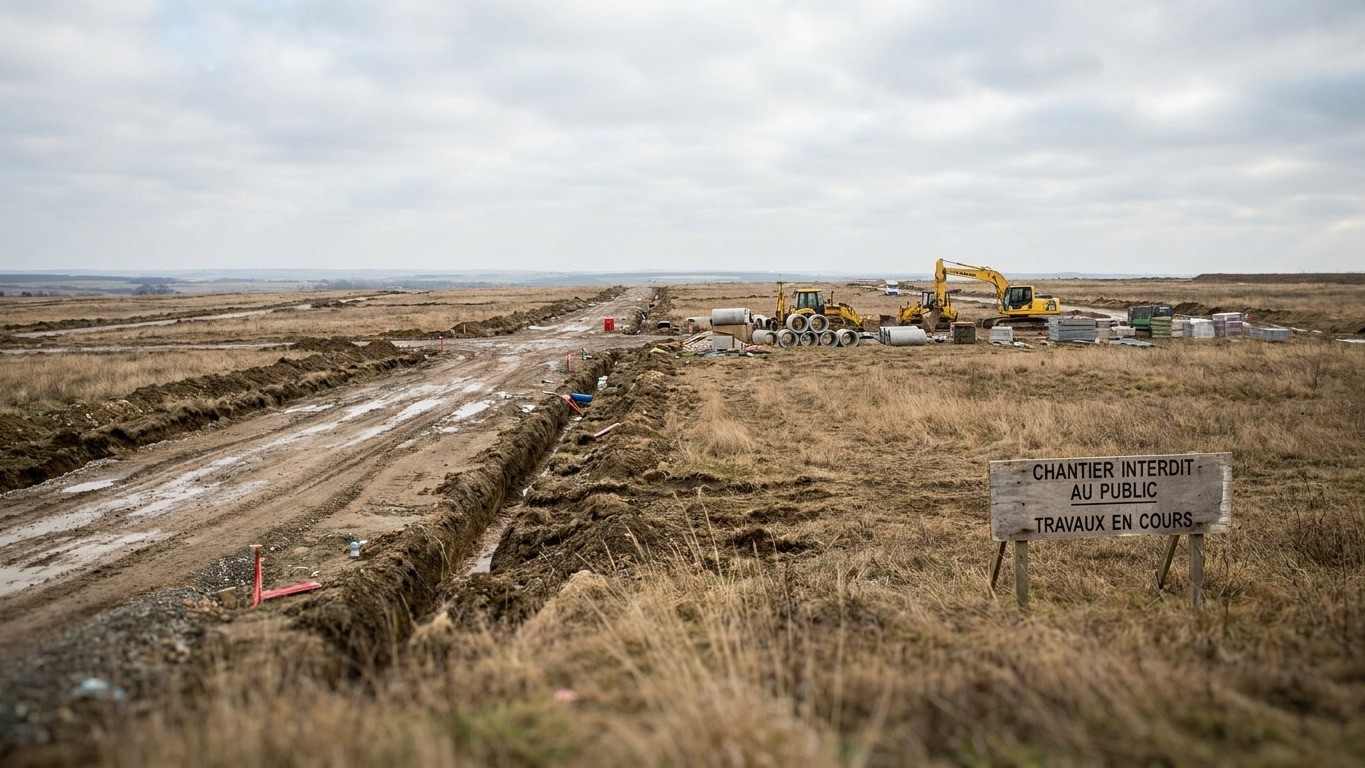
Two development zones in the very heart of the Saclay plateau are in the red, and no one can quite say who will foot the bill. In a deliberately prepared report dated November 7, 2025, the Île-de-France regional audit chamber states that two ZACs of the Paris-Saclay Public Development Establishment are in deficit, and that 36.8 million euros must be found to balance them. The zones involved: Moulon, spanning Gif-sur-Yvette, Orsay, and Saint-Aubin, and Corbeville, on the commune of Orsay. Two projects that for years had been touted as the showcases of the Île-de-France scientific cluster.
À retenir
- Two ZACs show an unprecedented financial hole: why the model is collapsing
- Roads handed back to the communities without anyone knowing their true value
- The Paris-Saclay EPA indebted by €300 million: the Cour des comptes raises the alarm
A financial shortfall that land sales cannot fill
The mechanism appears simple at first glance. The Paris-Saclay EPA buys land, then builds roads, networks and public spaces, and then sells land charges to developers and lessees to finance the whole. But in Moulon and Corbeville, the equation no longer holds: the expected proceeds from disposals are not enough to cover the cost of the facilities already built or to finance them. The imbalance is not new. As early as 2020, the institution’s internal documents already spoke of difficulties in these two sectors: the results of flagship projects like the ZACs of École Polytechnique and Moulon were stabilizing, but remained insufficient to cover the deficits of the new operations in Corbeville and Satory, which had not yet generated commercial revenue. Five years later, the shortfall has widened to 36.8 million euros, a sum that does not appear in any financing plan to date.
This isn’t just a detail hidden in an Excel spreadsheet. It is the equivalent of an entire municipal budget for a town of several thousand inhabitants, missing from two districts intended to accommodate housing, shops and public facilities in the years to come.
Roads handed back without knowing their price
The second point raised by the financial magistrates is even more troubling for the local taxpayer. Once the roads, networks and public spaces are completed, the EPA transfers them to the Paris-Saclay Agglomeration Community, which becomes responsible for their maintenance. Logical: it is the body that manages public space on a daily basis. The problem is that this transfer occurs without establishing the accounting value of these assets. The community receives a heritage—potentially tens of millions of euros’ worth of roads and networks—without knowing the exact amount or the future maintenance burden it represents.
The magistrates note public facilities handed to the agglomeration without their value being known and lament a partnership governance that is “partly defunct.” A courteous way of saying that the dialogue between the developer and the municipality that inherits the infrastructures no longer works as it should. The concrete consequence for residents of Gif-sur-Yvette, Orsay, or Saint-Aubin is that they will be paying tomorrow, through their local taxes, for the maintenance of roads and networks whose real value was not quantified at the time of transfer. A situation summed up without ambiguity by the mayor of Palaiseau, in a different context tied to the same establishment, who called to “understand where the sums allocated for building the public facilities in his district have gone.”
An establishment already under the Court of Auditors’ scrutiny
This local report does not sit in isolation. It echoes a broader diagnosis laid out by the Court of Auditors itself. In a report dated July 30, 2026, the national body warned of a serious financial deterioration that threatens the completion of the Paris-Saclay operation. The figures are staggering: the establishment carried €300 million in debt at the end of 2024, and a debt wall looms ahead, with €265 million in loans to be repaid between 2030 and 2034. In the face of these maturities, revenues have not kept pace: the proceeds from the establishment’s sales averaged only €33 million per year from 2017 to 2024.
The Court also flags management choices that aggravated the situation. According to it, the establishment’s maneuvering room was narrowed by decisions to pursue ancillary interventions tied to its core mission, further weakening an already stretched model. The slow-down in the housing market and the delays in transport infrastructure, notably Line 18 of the Grand Paris Express intended to unlock the plateau, did not help either. Thus, the €36.8 million shortfall on Moulon and Corbeville is not an isolated incident: it is a symptom among others of a development model conceived more than fifteen years ago that now struggles to self-finance as originally planned.
What is next for the communities concerned?
The regional audit chamber does not aim to sanction, but to alert public decision-makers. It remains to be seen whether the Paris-Saclay Agglomeration Community will obtain a precise inventory of the facilities already transferred, and whether the State or the Île-de-France Region, major shareholders in the governance of the establishment, will agree to cover all or part of the €36.8 million missing. A public consultation on the future of the Moulon and Corbeville ZACs was held in autumn 2025, signaling that the establishment is seeking to adjust its programs in light of these financial constraints. For plateau residents, the question goes well beyond accounting: it directly concerns the amount they will have to pay tomorrow to maintain roads already built today.
Sources: epa-paris-saclay.fr | aefinfo.fr | mobilites.newstank.fr
