
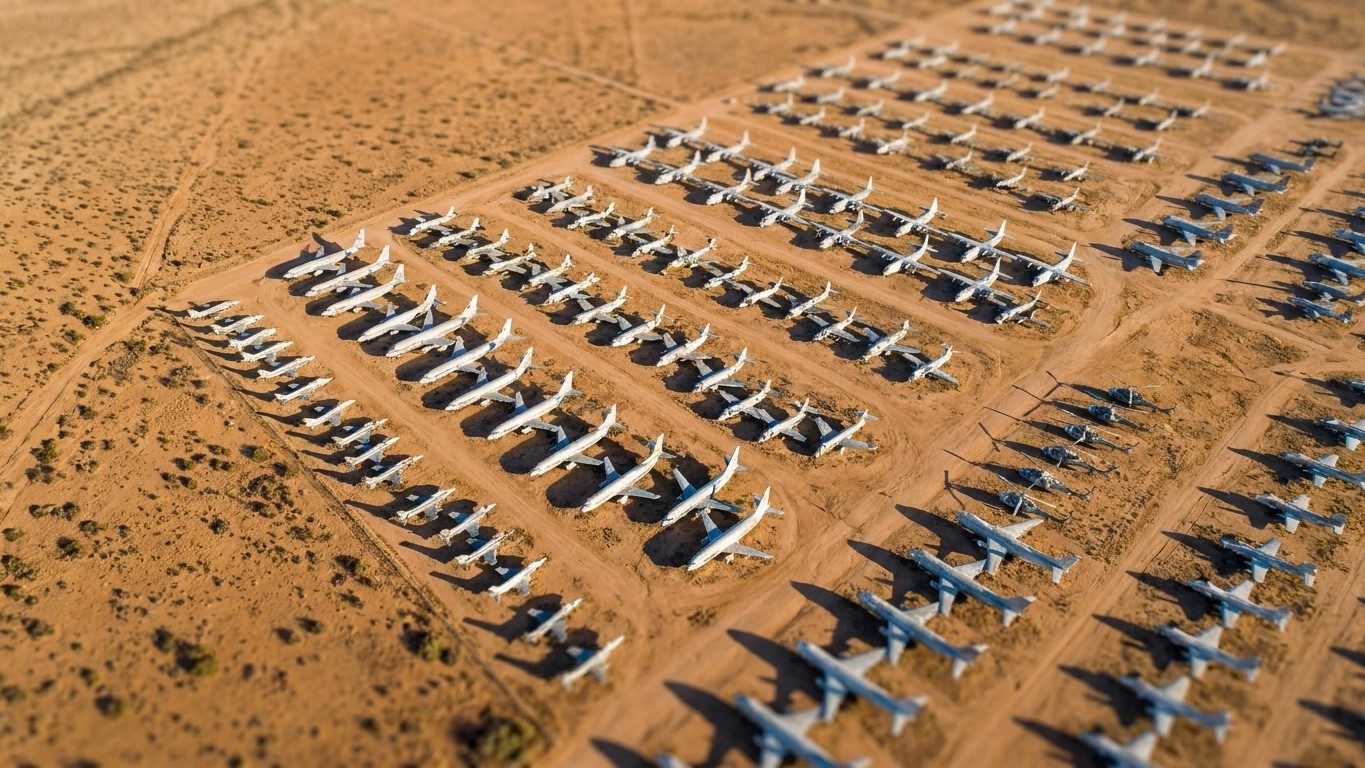
Since the end of World War II, an immobile army of aircraft has kept watch just south of Tucson. In the Arizona desert, on the tarmac of Davis-Monthan Air Force Base, the site’s inventory typically surpasses 4,400 aircraft, lined in geometric rows as far as the eye can see. Some arrived more than seventy years ago and have never left. Others wait, sometimes since the 1950s, for an administrative decision to finally seal their fate.
The place bears a name that strikes like a warning: the “Boneyard,” literally the cemetery of bones. Officially, it is the 309th Aerospace Maintenance and Regeneration Group (AMARG), the sole storage and parts-recovery facility for all surplus military and government aircraft in the United States. A bureaucratic label for what remains, in essence, the world’s largest cemetery of military aircraft.
Key takeaways
- Why the Arizona desert became the world’s largest repository for military aircraft
- Nuclear bombers and historic fighters sit alongside thousands of forgotten machines
- A secret facility turned tourist attraction and an unexpected solution for airlines
A desert chosen for its flaws… turned into strengths
Nothing is left to chance in this geographical choice. The region’s low humidity, ranging between 10 and 20 percent, the meager annual rainfall of 11 inches, the hard alkaline soil, and the high altitude of 2,550 feet collectively allow aircraft to be naturally preserved for cannibalization or potential reuse. The air is too dry for rust to take hold on the aluminum airframes.
A small technical detail changes everything: the desert’s geology allows for moving planes without the need to pave storage areas. No need to pour miles of concrete to house thousands of tons of metal. The naturally compacted soil bears the weight without sinking. A climate-controlled hangar would have cost a fortune. Nature, for its part, requires only a little administrative management.
Since 1946, the United States’ airborne memory
The story begins in the urgency of the postwar era. By May 1946, more than 600 B-29 Superfortress bombers and 200 C-47 Skytrain transports had been moved to Davis-Monthan. A place was needed to store this plenteous fleet, suddenly superfluous once the conflict ended. Among these early arrivals were pieces of history: about thirty other aircraft were also stored there, destined for museums, including the Enola Gay and the Bockscar, the two bombers that dropped atomic bombs on Japan.
The site has continued to grow ever since. In 1965, the Department of Defense decided to close its storage facility at Litchfield Park in Phoenix and consolidate the Navy’s surplus fleet at Davis-Monthan. The result: an open-air warehouse that never empties, generation after generation of aircraft. Today, the center spans roughly 10 square kilometers, about the size of 1,400 football fields laid end to end.
Spare parts, drone targets, and an open-air museum
Not every aircraft in the Boneyard is condemned to eternal immobility. The site employs 550 people, almost all civilians, tasked with sorting, dismantling, and sometimes regenerating the aircraft. Some fuselages serve solely as reservoirs of spare parts to keep the active fleet airborne. Others face a more radical fate: AMARG’s other role is to support a program that converts old fighters, such as the F-4 Phantom II or the F-16, into aerial target drones. Needless to say, they end up exploding in flight during live-fire exercises.
A handful of chosen ones escapes entirely from the scrap heap. The site also functions as an auxiliary facility for the National Museum of the United States Air Force and preserves the tooling of military aircraft no longer produced. And for the most strategic aircraft, waiting is not definitive: part of the inventory is carefully preserved, maintained, and kept ready to return to the runway at any moment. It is therefore not a cemetery in the strict sense. Rather, a giant waiting room, where some patients have slept for decades while others wake up in a matter of weeks.
According to an estimate cited by several industry sources, the accumulated value of the stored fleet—including hundreds of F-4 Phantom IIs—would run into tens of billions of dollars at their original purchase price. A dizzying figure for machines many of which will never take to the skies again.
A site closed to the public, but not invisible
Strolling around freely is not possible: Davis-Monthan remains an active military base. But the curiosity sparked by this metallic desert eventually opened a doorway. Every day, guided tours of about 45 minutes are offered to aviation and military history enthusiasts, typically paired with a visit to the neighboring aviation museum. The curious can particularly admire a symbol-laden aircraft: the Air Force One presidential jet used by John F. Kennedy is on display there, just a few hundred meters from the rows of anonymous fighters waiting to be dismantled.
The contrast is striking when aerial views of the site are scanned: perfectly orderly lines of airplane tails cutting through the ochre earth, like a military cemetery where every grave weighs several tons. The Covid-19 pandemic, in its own way, reminded of the unforeseen usefulness of these arid grounds: several commercial airlines temporarily parked their grounded fleets there, proof that the model devised for the United States military in the 1940s continues to inspire imitators far beyond the defense sector.
Sources: restaurantesaranjuez.com | techguru.fr
