
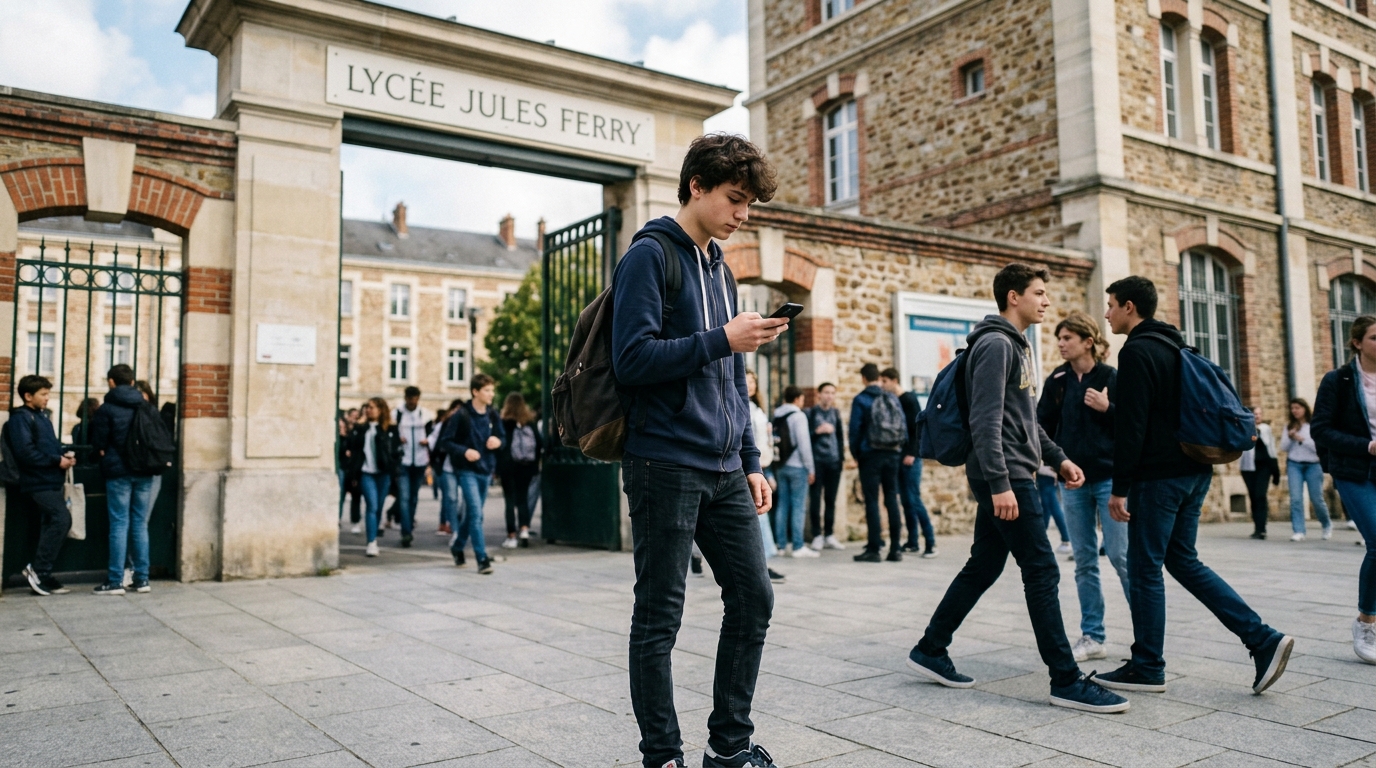
The backpack, the pencil case, the student communication notebook, and now… a pocket for the phone. At the start of the school year, thousands of high school students will discover a new morning ritual. Long spared from the restrictions imposed on younger students, high schoolers are now joining elementary and middle school students in a school life without smartphones. A shift that, on paper, seems minor, but that promises to profoundly transform the habits of an entire generation raised on notifications.
To Remember
- In the 2026 school year, mobile phones will be banned for high school students from the first bell to the last bell, with no grey area.
- Each institution will freely determine how to separate devices (locked lockers, locked pouches, or a deposit in a bag), with exemptions for teacher-guided educational use or for meals and boarding.
- This generalization continues measures already applied in primary and middle schools, aiming to limit micro-distractions and the exposure to addictive dynamics of social networks.
Table of Contents
- The Phone at the Door: What High School Students Can Expect in Concrete Terms
- Why This Measure Is Already Upending Students’ Habits
- What Research Says About Screens and Concentration in the Classroom
- Between Acceptance and Resistance: What This Back-to-School Year Really Changes
The Phone at the Door: What High School Students Can Expect in Concrete Terms
In practice, the rule is clear: no phone on, visible, or used anywhere inside the high school, from the first to the last bell. The President himself summarized the spirit of the text by describing an application “from bell to bell, from start to finish within the establishment,” modeled on the system already in place at the middle school. So no more sneaking a smartphone into a pocket to discreetly check a conversation between classes or during lunch.
In practice, each establishment retains some leeway to organize this removal: locked lockers, locked pouches, or a simple deposit in a bag—the choice lies with the school leadership. A guide distributed to high schools specifies, however, that exemptions remain possible, notably for teacher-guided educational uses, or for the proper functioning of meals and housing in boarding facilities. Before any change to the internal rules, consulting the council of delegates for student life is now mandatory, to involve the first affected in this daily reorganization.
Why This Measure Is Already Upending Students’ Habits
To grasp the scale of the change, one must remember that the phone has never been merely a gadget for high school students. It serves as an alarm clock, a watch, a payment method, a way to message parents, and of course, constant access to social networks. Removing it for several hours disrupts a routine built since entering middle school, where the device remained at least accessible during breaks thanks to the “phone on pause” scheme piloted as early as 2024 before its generalization the following year.
This time, there is no grey area: the cut is total during school hours. Students will have to relearn to be bored a little, to chat without screens in between during breaks, or to check a wall clock rather than their wallpaper. A disruption that also affects family life, since parents will no longer be able to contact their child directly in case of an unforeseen event during the day, except by going through the school’s front desk.
What Research Says About Screens and Concentration in the Classroom
The context in which this decision sits is not incidental. Teenagers aged 15 to 19 spend more than five hours a day in front of a screen on average, a figure that continues to rise year after year. This constant nibbling away at attention is not without consequences for concentration in class: every notification, every vibration in the pocket, acts as a micro-distraction that diverts the brain from the task at hand, even when the phone remains off in the bag.
This phenomenon can be likened to trying to follow a conversation in a room where the radio crackles in the background: even if faint, the noise gradually gnaws at listening quality. By physically removing the device from the equation, the aim proclaimed by the Ministry of National Education is to restore more stable learning conditions, while limiting minors’ exposure to the addictive dynamics of social networks, a goal at the heart of the law passed this summer.
Between Acceptance and Resistance: What This Back-to-School Year Really Changes
On the ground, the reception of this generalization remains mixed. Some high school students see it as an additional constraint in an already heavy academic load, while others readily admit they would be unable to do without their phone without an external imposed framework. Teachers’ teams, for their part, mainly hope to reclaim classrooms where students’ gaze no longer drifts toward a screen hidden under the desk.
However, the success of this measure will largely depend on its concrete implementation, school by school. Between high schools that will invest in individual lockers and those that will rely on a simple oral instruction, disparities are likely to be numerous in the first weeks. The ministerial circular also invites high schools to anticipate these logistical questions upstream, while recalling that this ban is part of an educational continuity started in primary school in 2018, then strengthened in middle school, before expanding now to the entire secondary level.
Ultimately, this school year marks less a brutal rupture than a logical step in a policy begun several years ago. It remains to be seen whether, after the initial weeks’ surprise wears off, high school students will rediscover the virtues of a day without notifications, or whether the smartphone will continue, in one way or another, to slip into the corridors unseen.
