
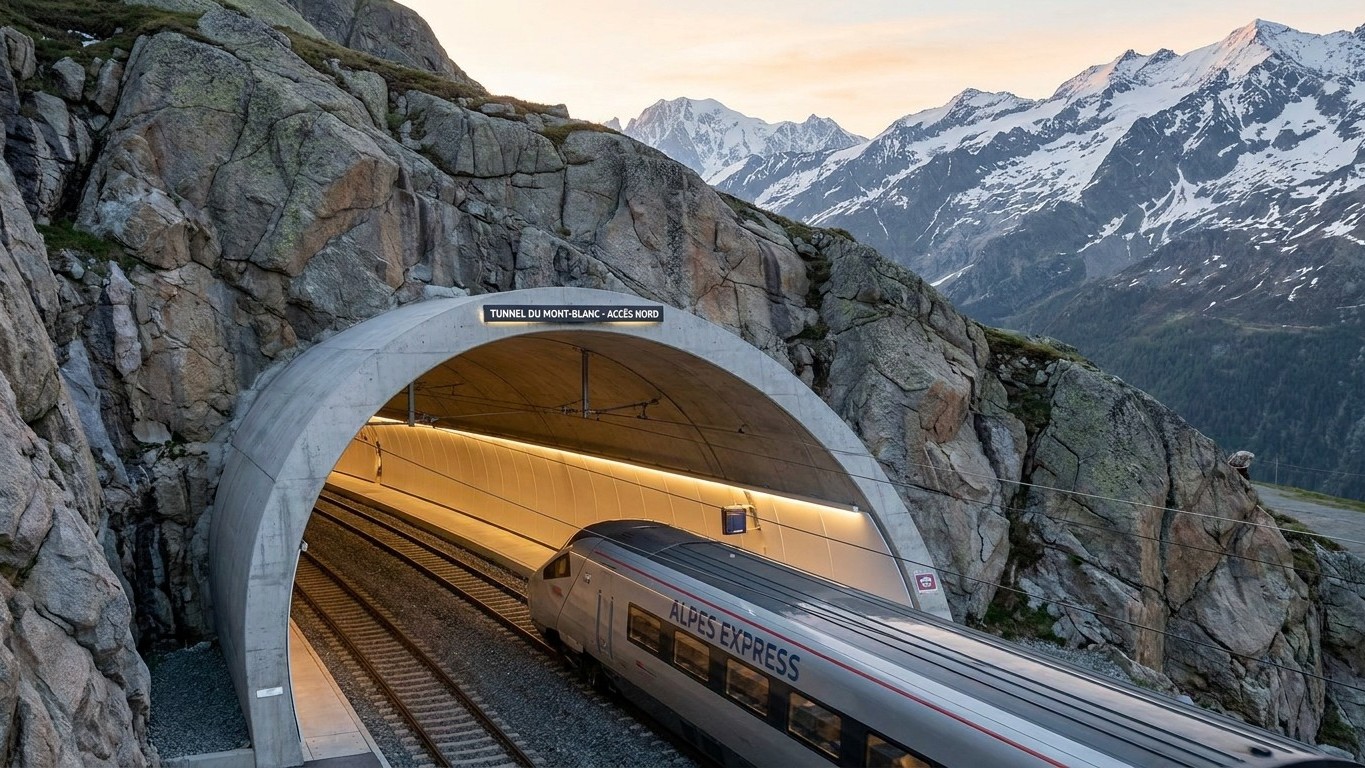
11 December 2016: Switzerland officially opens to the public the Gotthard Base Tunnel, a 57-kilometer tunnel bored more than 2,000 meters beneath the Alpine summits. Seventeen years of drilling, blasting, and concrete would be necessary to conquer this mountain, yielding a result that still today holds the world’s top spot for railway tunnels. Behind this record lies an XXL construction site: 28 million tonnes of rock were excavated and had to be removed, equal to five times the volume of the Great Pyramid of Khufu in Egypt.
Key takeaways
- Why did it take 17 years to carve a simple passage beneath a mountain?
- Where did all 28 million tonnes of rock excavated from under the Alps go?
- How does this tunnel completely reshape rail routes across Europe?
Seventeen years to bore through a granite wall
The work began in 1999. Beneath the massif, two parallel tubes, each 57 kilometers long, cut through the Alpine rock at a vertigo-inducing depth, with rock cover above the tunnel reaching up to 2,300 meters according to official AlpTransit data. In some places, the granite cover is even more imposing: the tunnel is the deepest in the world, with a granite layer reaching 2,450 meters near Piz Vatgira.
At this depth, the mountain fights back. Natural temperatures reach 45 °C, forcing the teams to install giant fans to keep the galleries at a maximum of 35 °C. The boring relied on four gigantic tunnel boring machines, nicknamed Sissi, Heidi, Gabi I, and Gabi II. These TBMs, each over 400 meters long and weighing up to 2,700 tonnes, are the stars of the Gotthard Base Tunnel, and they dug 80% of the tunnel, the remainder being cut through by blasting. Up to 2,400 workers labored day and night to complete this colossal undertaking. A figure that, in itself, speaks to the scale of the logistical challenge: feeding, transporting, and safeguarding thousands of people miles underground for nearly two decades.
Where did all that excavated mountain go?
Twenty-eight million tonnes of stone do not vanish into any old place. Some of it found an elegant reuse: the excavated rock was conveyed by conveyors across tens of kilometers and then used to form the concrete for the tunnel itself. In a sense, the mountain helped to build its own passage.
The remainder—considered unsuitable for concrete or simply extra—had a more surprising destination. This portion of the material was deposited on the surface, notably in Lake Uri near the mouth of the Reuss. It wasn’t improvised backfilling: the Uri Lake filling project envisioned creating two groups of wild islands akin to a delta, along with the restoration of shallow water zones with high ecological value. The result is reeds, nesting birds, and fish forming today a lakeside landscape designed for biodiversity, rather than a mere heap of rubble. An ecological conversion one might not expect from a railway project.
This extravagant expenditure comes at a price. The official budget put the Gotthard Base Tunnel at 9.7 billion francs in 1998 prices, excluding inflation, VAT, and interim interest, for an effective cost of 12.2 billion francs. Twice the initial estimate, yet the project did meet its deadlines, which, for a project of this size, remains rare.
A shortcut that redraws Europe’s rail map
The tunnel is not merely a triumph of engineering; it is a tangible transport instrument. Its capacity supports up to 260 freight trains and 65 passenger trains per day, with scheduled speeds of 100 km/h for freight and up to 200 km/h for passenger services, delivering a crossing in just under 20 minutes. Twenty minutes to slip beneath peaks that used to have to be circumvented for hours.
On the Zurich–Lugano route, time savings reach 45 minutes once the axis was fully completed. Farther south, the impact extends into Italy: the Zurich–Milan journey time drops from 3 hours 40 minutes to 2 hours 40 minutes. A full hour gained on a transalpine route is no small thing for the thousands of travelers and freight operators who use it daily.
This tunnel does not appear out of nowhere. It forms the backbone of a high-speed rail corridor linking the ports of Rotterdam and Genoa, connecting the industrial centers of several European countries. The political objective was clear from the start: shift some freight traffic from road to rail to relieve alp valleys overwhelmed by trucks.
The construction was not without tragedy. Nine workers lost their lives during the seventeen-year process, between 1999 and 2016. A figure often overlooked behind the record length and depth, but one that reminds us that beneath these 57 kilometers of gleaming new track there were human lives committed to one of Europe’s most extreme construction sites.
Sources: bmw-actu.com | batiactu.com
