
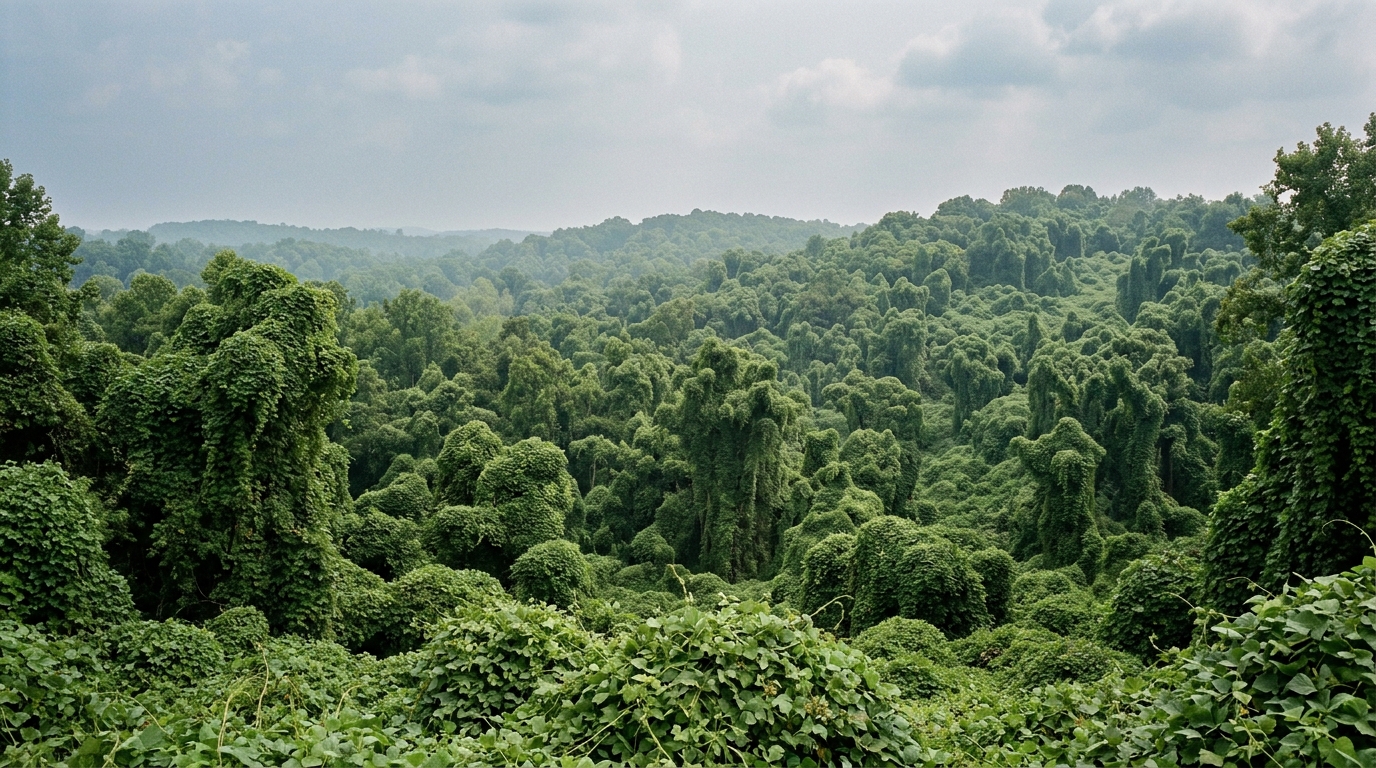
Who hasn’t cursed a climbing plant that gradually overruns the garden fence, choking everything in its path without anyone really knowing how to stop it? This small domestic nuisance, almost anecdotal at our scale, takes on a completely different dimension when imagined spread across millions of hectares. Yet that is precisely what happened in the United States, where a vine imported from Japan for a perfectly laudable goal ended up swallowing entire landscapes, turning lush forests into veritable green graveyards.
A vine meant to save the soils of the American South
In the 1930s, the southern United States faced a major agricultural crisis. Soils, depleted by decades of intensive cotton monoculture, were eroding at an alarming rate. The wind and rain carried away fertile soil, leaving landscapes impoverished and unable to nourish crops. Faced with this silent environmental disaster, American authorities sought a quick and inexpensive solution to stabilize these fragile lands.
Enter the kudzu, a vine native to East Asia already known for its explosive growth and dense root system. Drawn to its capacity to rapidly cover barren ground, American agronomists aggressively promoted its planting from 1935 onward. The government even went so far as to fund its cultivation, distributing millions of plants to Southern farmers with the promise of land finally protected against erosion.
When the remedy becomes worse than the problem
What no one had truly anticipated was the astonishing speed with which this plant would take hold once established on American soil. Free from its natural predators and the competitors present in Asia, kudzu finds the hot and humid climate of the American South to be an ideal environment. The vine can then grow by several dozen centimeters per day, covering everything in its path: trees, power lines, abandoned houses, and even vehicles left standing for too long.
The problem is that this plant does not merely creep along the ground as originally planned. It climbs, coils, and forms a true vegetal mantle that literally suffocates the plants it covers. Deprived of light, the plants beneath this green carpet eventually wither, unable to photosynthesize properly. What was supposed to be a temporary solution to soil erosion gradually becomes an uncontrolled invasion.
Whole forests disappearing under a green carpet
Over the decades, kudzu ceases to be confined to agricultural land for which it was introduced. It gradually spreads to forest edges, then pushes deeper into the heart of the Southern woods. Trees, unable to withstand this constant onslaught, are literally swallowed by successive layers of foreign foliage. Some entire forests disappear beneath this vegetative veil, as if frozen in a living husk that keeps growing.
Today, it is estimated that kudzu covers about 3 million hectares in the southern United States, mainly in Georgia, Alabama and Mississippi. To put it in perspective, this area is roughly the size of Belgium transformed into an ocean of tangled leaves. Local authorities spend substantial sums each year trying to contain this proliferation, without really managing to curb it in a lasting way.
Kudzu today: ecological nightmare or forgotten resource
If kudzu remains one of the worst invasive species ever introduced on American soil, some researchers and entrepreneurs are beginning to explore its potential uses. After all, this plant is not devoid of qualities: its roots contain usable starch, its flowers can be used to make syrups or jams, and its strong fibers have long been used in Asia for weaving. Some see it less as a scourge and more as an underutilized resource, lacking a structured economic chain in the United States.
That said, the scale of the phenomenon makes large-scale exploitation particularly challenging to organize. Kudzu continues to advance each year, benefiting from a warming climate that gradually expands the regions where it can thrive. What began as a pragmatic response to an agricultural crisis has thus become a case study, often cited to illustrate the dangers of introducing a species without proper controls.
This story, nearly a century after its beginnings, continues to fascinate as much as it raises questions. It serves as a reminder of how a decision made with the best intentions can permanently disrupt an entire ecosystem. So, at a moment when many countries, including France, are keeping a close watch on the introduction of new plant species on their territory, it is hard not to view kudzu as a real-world warning against overhasty solutions to environmental challenges.
