
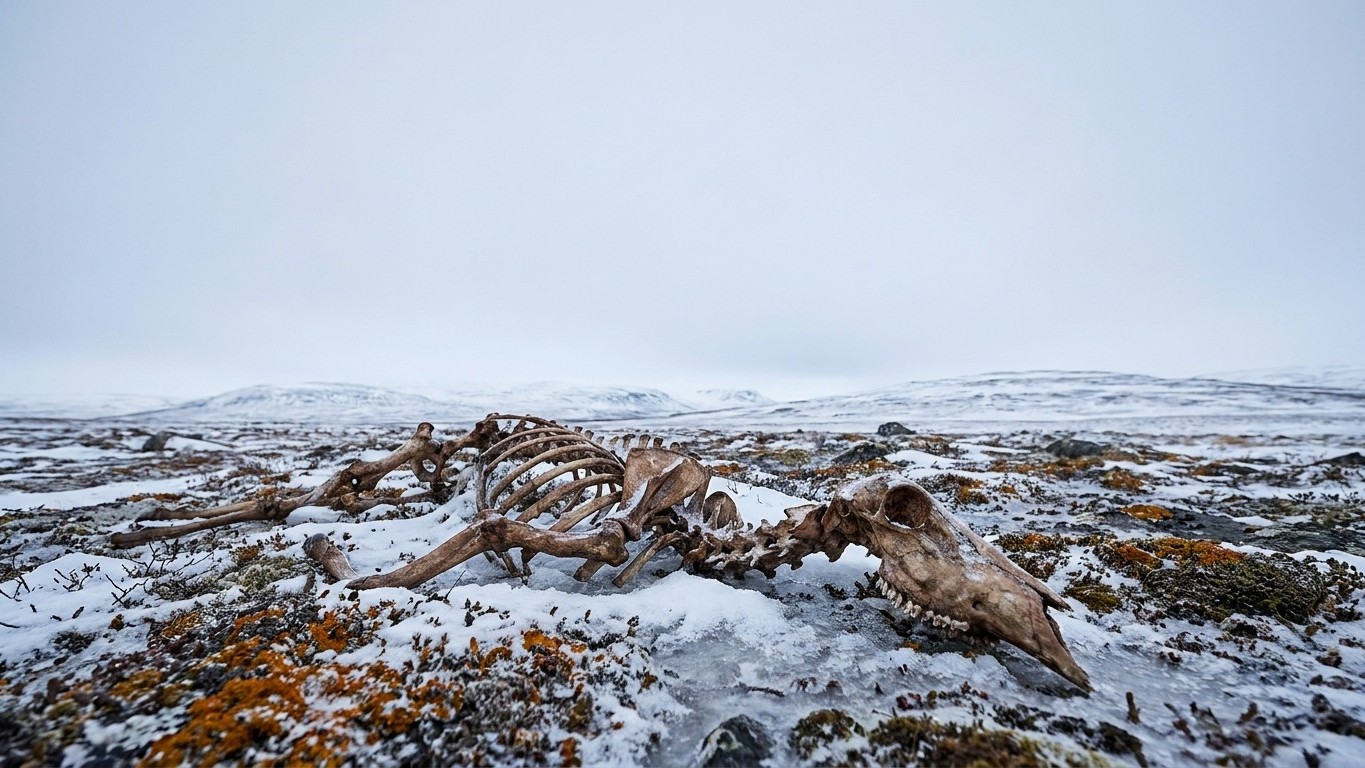
Forty-two. That is the number of reindeer found alive on Saint Matthew Island in 1966, compared with 6,000 three years earlier. The culprit is not a wolf, nor a hunter, nor a disease: it is winter. A winter so brutal that it wiped out 99% of a population that, just months before, seemed to flourish without limit in this remote corner of the Bering Sea.
The story begins in the middle of World War II, on a scrap of land adrift off Alaska. In August 1944, American coast guards set up a navigation radio station there, with nineteen men tasked with keeping it running. As a precaution, in case resupply should fail, they also loaded 29 reindeer from Nunivak Island onto a barge, bound for Saint Matthew, more than 200 miles away, one of the most isolated spots in Alaska. The idea: keep a living herd as a marching meat reserve.
But the war soon tilts in favor of the Allies. The men never fire a single shot at a reindeer; the Allies win the war, and the coast guards recall their detachments from the island. They return home, leaving the reindeer to fend for themselves. No one foresees their fate at the time: an island of 332 square kilometers, free of predators, blanketed with lichen so thick that it is described as mats of lichen four inches deep covering some parts of the island. A never-ending buffet, for keeps.
Key takeaways
- How 29 reindeer turned into an army of 6,000 in less than two decades
- Why the obvious explanation of overgrazing is not the true cause of the disaster
- What this collapse reveals about the fragile limits of closed ecosystems
A Demographic Explosion Worthy of an Ecology Textbook
Thirteen years later, in 1957, biologist David Klein arrived on the island to study its wild ruminants. What he found exceeded all expectations: the 29 reindeer released in 1944 had grown to 1,350 individuals by the summer of 1957. Even more striking, these animals showed an impressive form: body mass far surpassing that of domesticated herd reindeer by 24 to 53% in females and by 46 to 61% in males. In other words, they were high-caliber athletes compared to their domesticated cousins.
Klein was already spotting the first signs of local overgrazing, but nothing alarming. The set-up for a disaster seemed complete: a healthy group of herbivores, a limited food resource, and no predator at the top of the chain. On paper, the mechanism appeared inexorable. It would be proven dramatic six years later, in a spectacular fashion.
In 1963, a new expedition arrived. The herd had exploded to 6,000 reindeer that summer, a density of 47 reindeer per square kilometer. A staggering figure for such a small, isolated island. But the warning signs were unambiguous this time. Klein noted that the animals’ body size had decreased since his last visit, as had the ratio of young reindeer to adults. The message was clear to those who could read it: the party was ending.
The Winter That Carried Everything Away in a Few Months
Klein could not return to the island until 1966, due to lack of transportation. What he learned in the meantime, from passing coast guards in 1965, chilled him: dozens of reindeer skeletons, bleached by the tundra, lay strewn across the landscape. The worst was yet to be uncovered on site. Upon his return, accompanied by another biologist and a botanist, the team found the island covered in skeletons; they could count only 42 living reindeer, no fawns, 41 females, and a single male with abnormally formed antlers, probably unable to reproduce.
In the span of a few winter months, the herd collapsed by 99%. This was not a gradual decline spread over several lean seasons. It was a brutal, almost instantaneous collapse on a biological scale.
For a long time, the dominant narrative blamed overharvesting of the lichen as the sole cause: too many reindeer, not enough food, hunger doing the rest. A scientific reassessment published in Rangifer, led by Frank Miller and colleagues, cast doubt on that scenario. The reproduction and fawn-survival data from 1957 to 1963—often cited as evidence of a gradual population decline—would turn out, in fact, to be the result of a methodological error. Growth had persisted at a high annual rate of 1.32 for nineteen years, before the entire mortality occurred in a single winter, the winter of 1963-1964, making it the greatest collapse ever recorded for a reindeer population.
According to this reinterpretation of the facts, the trigger was less chronic lichen scarcity than the encounter with an exceptionally violent winter by a population already demographically fragile. Klein himself, decades later, shared this intuition with two climatologists, Martha Shulski and John Walsh, who reconstructed weather data for the winter of 1963-1964. The result is unequivocal: weather records for St. Paul and Nunivak islands for that winter show extreme conditions, both in cold and snowfall. Snow so abundant and hard that it likely prevented the reindeer from reaching the little lichen still available beneath the frozen crust, turning a harsh winter into a generalized lethal trap.
The Final Silence of an Island Without Reindeer
The fate of the 42 survivors was sealed in advance. With only a single fertile female for company and a male likely sterile, no viable reproduction was possible. Without a reproductive population, the Saint Matthew Island reindeer died out in the 1980s. Today, there is not a single scrap of wood or hoofprint left on the tundra: Arctic foxes have returned to be the island’s only large mammals.
This case study, popularized under the name overshoot and collapse, has educated generations of ecology students and demographers keen to understand the limits of a closed environment. It serves as a simple but often overlooked lesson: a growth that seems triumphant can merely be the quiet prelude to a collapse, and it takes just one winter too many for decades of abundance to vanish into emptiness.
Sources: gi.alaska.edu | slate.fr | tontondaniel.over-blog.com
