
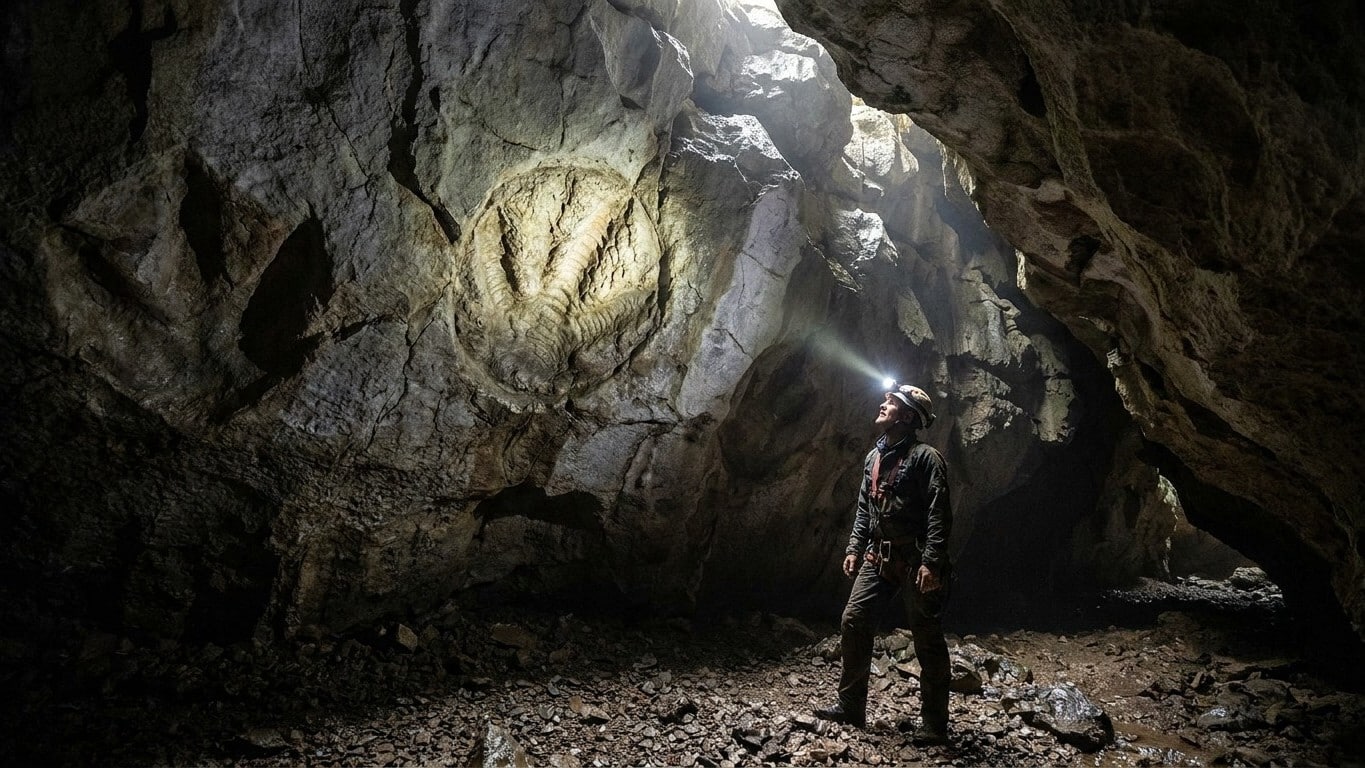
December 2015. An amateur speleologist points his headlamp toward the ceiling of a vast underground chamber beneath the Causse Méjean, in Lozère. What he glimpses in the oblique beam is not a mere calcareous concretion: circular footprints measuring up to 1.25 meters in diameter on the ceiling of the main hall. Tens of thousands of visitors had passed through this cave without ever noticing them. The discovery would prove to be unique in the world.
Key takeaways
- An underground chamber hides fossil traces like nowhere else in the world.
- The 50-ton giants left clues that escaped thousands of visitors.
- Geology itself acted as custodian, creating this buried museum.
500 Meters Underground, in the Causses Labyrinth
These fossil traces were discovered in the Castelbouc cave (in the commune of Sainte-Énimie), about 500 meters beneath the surface of the Causse Méjean, in Lozère. Access requires first submitting to an unusually strenuous physical challenge. One must descend 500 meters underground, crawling for an hour through a labyrinth of passages usable only in the dry season. The footprints are then found on the ceiling of a chamber that is 80 meters long and 12 meters high.
Thousands of people had passed through this cave without ever seeing anything, as the paleontologist Jean-David Moreau of the Biogeosciences Laboratory notes, still astonished. It only took one person to study the ceiling more closely than usual, and the traces appeared, clearly visible: those of giant dinosaurs. Result? An absolute first in the world. These are the very first tracks of giant dinosaurs discovered in a deep natural cavity.
50-Ton Animals on the Edge of a Lagoon
These footprints, dating to the Bathonian stage, between 168 and 166 million years ago, were left by quadrupedal, herbivorous dinosaurs known as sauropods. These animals were probably titanosaurs or titanosauriforms, whose length exceeded 30 meters and weight reached 50 tons. To give a sense of scale: the footprint alone, at 1.25 meters long, surpasses the size of a standard desk. These creatures were not solitary either. Two or three individuals walked side by side to form a true path that traverses the gallery from end to end.
The landscape of the era bore little resemblance to today’s Lozère. Sedimentological and mineralogical studies conducted in the cave have shown that Castelbouc’s sauropods lived in a littoral environment, leaving their footprints along the edge of a lagoon, not far from a conifer-dominated forest. Researchers even recovered plant remains and small saltwater fish, which confirm this tropical coastal landscape at the land-sea interface.
The quality of preservation is equally remarkable. The marks of digits, pads, and claws are strikingly fossilized. The three tracks yield sauropod footprints reaching 1.25 meters in length, making them among the largest dinosaur footprints known worldwide.
Why Are the Traces on the Ceiling?
This is the question everyone asks, and the answer lies in a geological chain of almost unsettling elegance. Millions of years after the dinosaurs’ passage, water infiltrations in these karst settings, mixing limestones and clays, eventually formed the hundreds of natural cavities present in the Causses region. This explains why it is possible to find dinosaur traces on a cave ceiling. The geological strata, for their part, have never been overturned.
The traces visible on the ceiling are not “footprints” in the strict sense, but “counter-feet” or casts, explains Moreau. The dinosaurs walked on a clay surface, now entirely eroded to form the cave. What one sees is the upper sediment layer that filled the footprints, leaving relief casts that protrude from the ceiling. The image is striking: it is exactly as if plaster had been poured into a footprint in the mud, left to dry, then the mud had been wiped away. What remains is the mold, in positive, suspended above one’s head.
The footprints were exposed after the softer rocks beneath them were eroded away by acidic waters to form what is called a karst cave. Geology, in a sense, has created its own underground museum.
A New Species and a Scientific Undertaking Far from Over
Because the morphology of the footprints discovered in Castelbouc cave had hitherto been unknown, the work undertaken by paleontologists has allowed the description of a new type of trace they named Occitanopodus. This name pays homage to the discovery region and to the particular morphology of the traces, published in the Journal of Vertebrate Paleontology.
The Causses basin had until now offered a rich collection of tracks from small carnivorous theropods. It is also the first time that sauropod footprints have been found in the Causses basin, which is nevertheless rich in fossil traces: across this area spanning several hundred square kilometers, straddling Aveyron, Lozère, Gard, and Hérault, dozens of fossil-track sites existed, but no traces of giant herbivores had been found there until now.
In January 2023, a new expedition pushed the investigations further. As part of a scientific expedition, these traces were the subject of a documentary in which paleontologist Jean-David Moreau and a team of speleologists 3D scanned these preserved tracks 500 meters underground. This digital modelling now allows studying the footprints without forcing researchers to crawl for an hour on each visit, and makes the details accessible to the international scientific community.
The project is not finished. Moreau now leads researchers in the exploration of another deep and long cave, which is said to have yielded hundreds of dinosaur footprints. The results have not yet been published, but they could well prove to be among the most important of all. The Causses, indeed, still guard a few secrets in their calcareous innards.
Sources: planet-terre.ens-lyon.fr | insu.cnrs.fr
