
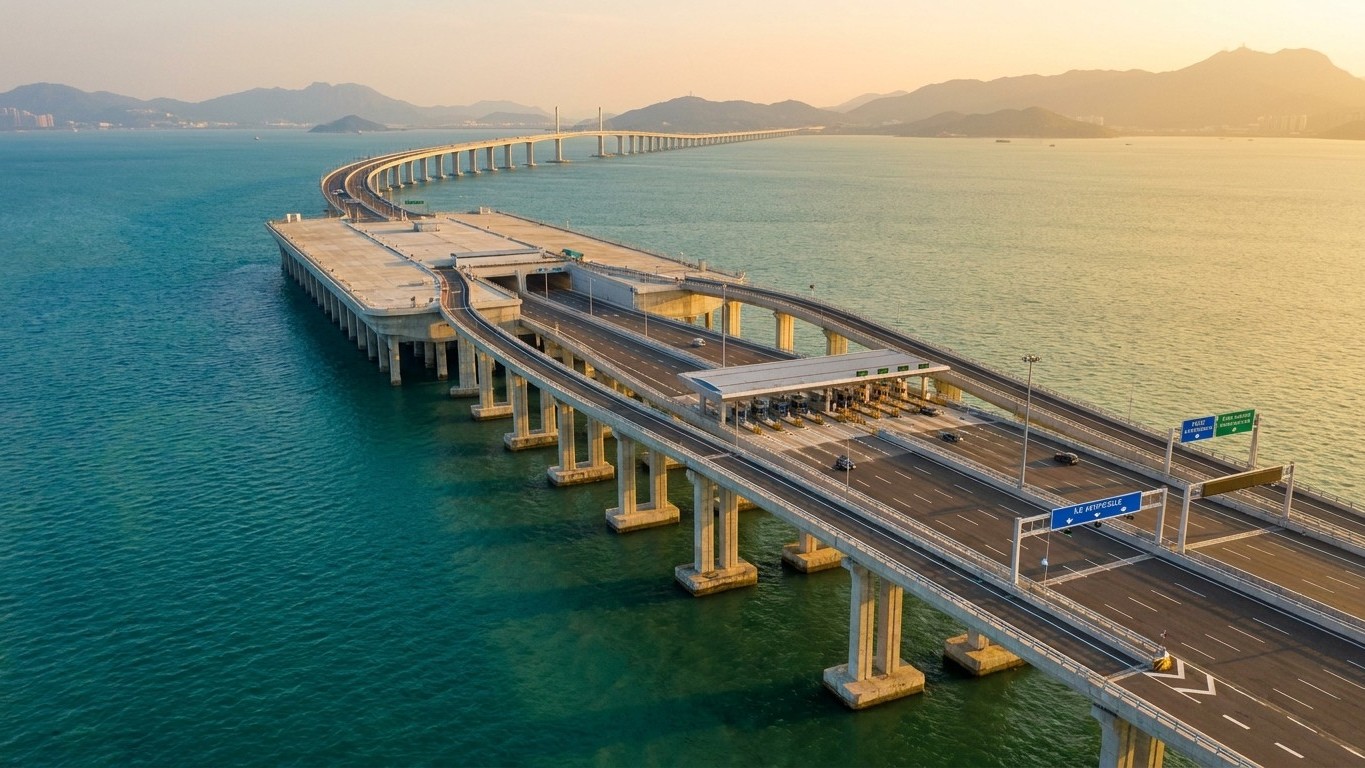
On October 24, 2018, a 55-kilometer ribbon of concrete and steel closed over the South China Sea, linking Hong Kong, Macau, and the inland city of Zhuhai. To achieve this, the engineers did not merely build a bridge: they literally hauled two artificial islands out of the water, placed like giant anchors in the middle of the Pearl River Delta. Inaugurated by Xi Jinping himself, the project remains today the longest sea-crossing bridge in the world, an infrastructure designed to economically fuse three territories with distinct political statuses.
Key takeaways
- How were two artificial islands raised from the sea to connect a colossal bridge-tunnel?
- US$20 billion spent to save 20 minutes: a bet deemed extravagant yet ultimately vindicated
- After seven years of waiting, traffic surges following a pivotal administrative measure
An extraordinary construction, built on piles and underwater
The project blends three radically different techniques along a single route. Most of the path, more than 22 kilometers, unfolds on viaducts and suspension spans above the waves. But at the center—where the container-ship traffic could not tolerate a single pier—the engineers chose burial: an underwater tunnel of 6.7 kilometers that is not only the longest in the project, but also, at nearly fifty meters below the water’s surface, the deepest. To link this tunnel to the bridge decks, there needed to be anchor points out at sea. The solution was to fabricate two artificial islets from scratch, a system designed to resist typhoons and earthquakes while delivering environmental protection.
The most surprising technical detail concerns the foundations of these islands. Teams used roughly 20,000 square meters of bamboo planks, a material thermally treated to withstand saline humidity and marine corrosion. Six years after commissioning, these bamboo elements have held up against storms and heat, proving that renewable materials can find a place even in the most monumental undertakings. The tunnel itself required the immersion of 33 prefabricated tubes, each 180 meters long and weighing 80,000 tonnes, assembled at the riverbed like a colossal underwater construction toy.
A bill that drew criticism
Twenty billion dollars. That is roughly the amount spent on this union of three cities that, in essence, had to become one connectivity project. Estimates vary, but the ballpark remains: the January 2018 cost assessment put the construction bill at 120 billion yuan, about 18.4 billion dollars. Some outlets place the total closer to 19 billion once adjoining ports and road connections are included. To put this into perspective, the sum roughly corresponds to a country’s annual budget for space research.
The project did not proceed without turmoil. Nine years of construction, from 2009 to 2018, were punctuated by delays, budget overruns, and even corruption prosecutions, not to mention fatal accidents on site. The French press did not mince words at the opening: Courrier International summarized the controversy by noting that spending nearly 20 billion dollars to gain 20 minutes of travel time seemed trivial. A harsh verdict, but it mirrored the era’s broader uncertainty about the project’s real return on investment.
Traffic that took seven years to find its cruising speed
The early years vindicated the skeptics. The bridge, designed to absorb tens of thousands of vehicles daily, long carried only a fraction of that capacity. In 2019, usage was modest: border authorities recorded 12.88 million passengers and 860,000 vehicle trips that year. Daily vehicular traffic at the Zhuhai checkpoint hovered around 9,000 vehicles per day in 2023, well short of the original ambitions.
The turning point came with two administrative measures introduced in 2023, allowing vehicles registered in Hong Kong and Macau to move more freely toward the mainland without the standard quota. Since then, the curve has shot upward. The daily flow rose from about 9,000 in 2023 to more than 18,000 now, with weekend and holiday peaks pushing toward 20,000. In April 2026, the bridge even set an all-time high with 29,800 vehicles checked in a single day, of which 22,800 were registered in Hong Kong or Macau. Seven years after its opening, the structure has registered 93.34 million passenger passages and 19.42 million vehicle trips, a total nobody anticipated during the initial wave of criticism.
Local authorities no longer hide their optimism for the future. After an average annual growth rate of 34% in passenger flows since the northbound traffic measures began, officials expect to surpass 20 million trips for the first time in 2026. Long-range projections remain ambitious: by 2035, some experts forecast 60,000 cars and 250,000 daily passengers crossing the delta—nearly triple the current high. A bet that, ten years after opening, seems on track to pay off, provided the road infrastructure in the three cities can keep pace with this cross-border surge.
Sources: obo.fr | vietnam.vn | english.news.cn
