
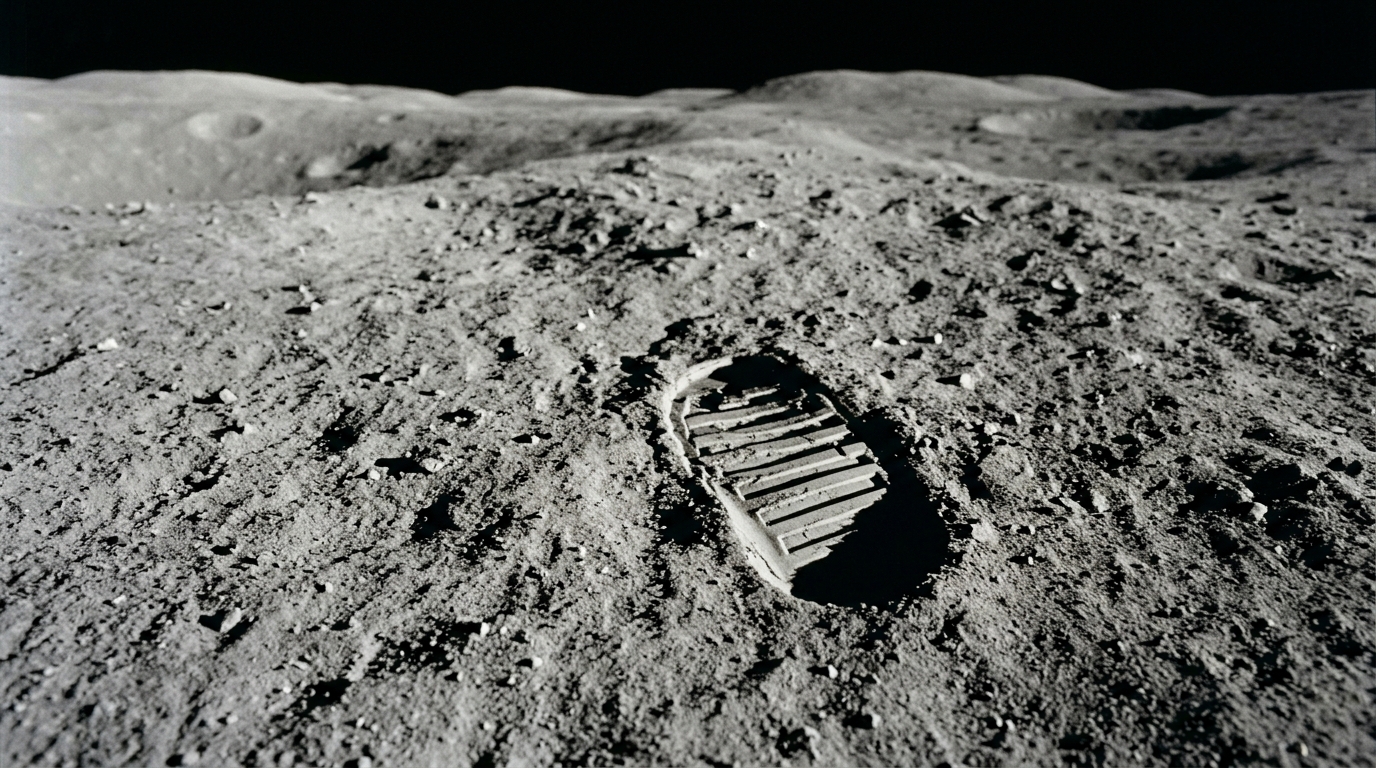
There exists, somewhere on the Moon, a work of art that no one ever mentions in art-history manuals. A small statuette of only a few centimeters, resting in the gray dust of our satellite for more than half a century, that its own creator could never commercially exploit. The cause of this strange situation lies in a single word: NASA, which has always refused to let its space program serve as a publicity springboard for anyone, even the author of the only sculpture ever installed beyond our planet. This story, blending space exploration and artistic creation, reveals an overlooked facet of lunar conquest, where a Belgian sculptor found himself at the heart of a legal and symbolic tangle worthy of a novel.
An eight-centimeter statuette placed on a ground that no art had ever trod
In August 1971, as the Apollo 15 mission was drawing to a close, Commander David Scott gently placed on the lunar surface a small aluminum object measuring barely 8.5 centimeters. Named Fallen Astronaut, meaning “the fallen astronaut,” this statuette depicts a stylized human silhouette, devoid of any distinctive marks. It is laid beside a commemorative plaque engraved with fourteen names, those of American astronauts and Soviet cosmonauts who perished during the space conquest.
This gesture, seemingly trivial, is in fact a unique event in human history: never before had a work of art designed as such been installed on another celestial body. The lunar ground, trodden a few years earlier by humanity’s first steps beyond Earth, now hosts an artistic symbol that remains, to this day, without an equivalent.
Paul Van Hoeydonck, the Belgian sculptor who conquered the Moon without meaning to
Behind this discreet work lies a name few French readers know: Paul Van Hoeydonck, a sculptor born in Antwerp and a notable figure in Belgian contemporary art. Far from seeking space glory, this artist was approached by David Scott himself during a dinner held before the Apollo 15 launch. The two men talked, bonded, and the idea germinated to create a work intended to honor the memory of the space pioneers who had died.
Van Hoeydonck then designed a silhouette that was intentionally ambiguous: neither male nor female identifiable, nor attached to any specific nationality. This aesthetic choice is not incidental; it responds to a clear wish to symbolize all astronauts and cosmonauts who fell in the service of space exploration, regardless of country or gender. A sober, almost universal artistic approach that contrasts with the pomp usually associated with the feats of lunar conquest.
A secret agreement between an artist and a NASA astronaut
What makes this story particularly fascinating is the secret that surrounded the entire operation. The Apollo 15 crew did not reveal the existence of the statuette until after the mission, once back on Earth. During the entire flight, the presence of this artwork on the lunar surface remained completely confidential, known only to the protagonists of this unofficial agreement between the artist and the astronaut.
This discretion can be easily explained: NASA, a public institution funded by American taxpayers, had never officially validated this artistic deposit. David Scott therefore acted in a gray area, driven by his personal conviction that such a tribute deserved to exist, even if it meant temporarily bypassing the agency’s usual channels of communication.
The banned sale: how NASA locked the fate of the work
Once the matter came to light, consequences did not wait. The National Air and Space Museum, a prestigious American institution dedicated to the history of aeronautics and space, demanded a replica of the statuette for display. But Van Hoeydonck believed he had reached a different agreement with the astronauts, thinking he could dispose more freely of his work.
Buoyed by this conviction, the Belgian sculptor planned to market up to 950 copies of his creation, a project that could have represented a substantial financial opportunity for an artist still relatively unknown to the international public. But that was without counting on NASA’s firmness, staunchly opposed to any form of commercial exploitation tied to its space program. Under this institutional pressure, Van Hoeydonck eventually renounced his project, deprived of the financial recognition he might have hoped to derive from his bold artistic gesture.
A forgotten monument on the Moon, an erased signature on Earth
Today, Fallen Astronaut remains the only artwork officially deposited on the Moon, a unique status that spans both the history of art and that of space exploration. A pioneering position that few artists can claim, but which never brought its creator the commercial recognition that had been hoped for.
Paul Van Hoeydonck passed away in the spring of 2025, in Wijnegem, Belgium, at the age of 99 years. To mark the fifty-year anniversary of this extraordinary artistic venture, a life-size replica of the statuette was inaugurated in 2021 in Antwerp, at the Botanic Sanctuary hotel, finally giving the public tangible access to this otherwise inaccessible work. Finally, note that a rumor, never confirmed to date, speaks of the clandestine deposition of another miniature work during the Apollo 12 mission in 1969, two years before Van Hoeydonck’s. A lead that, if ever verified, would upend this already singular history.
From this improbable adventure, one mainly retains the thwarted fate of an artist whose most famous work will forever remain out of reach, both physically and commercially. A paradox that invites reflection on the place of art in grand scientific epics: should it be seen as a simple symbolic gesture, or as proof that even space cannot escape the property and control logics that govern our terrestrial societies?
