
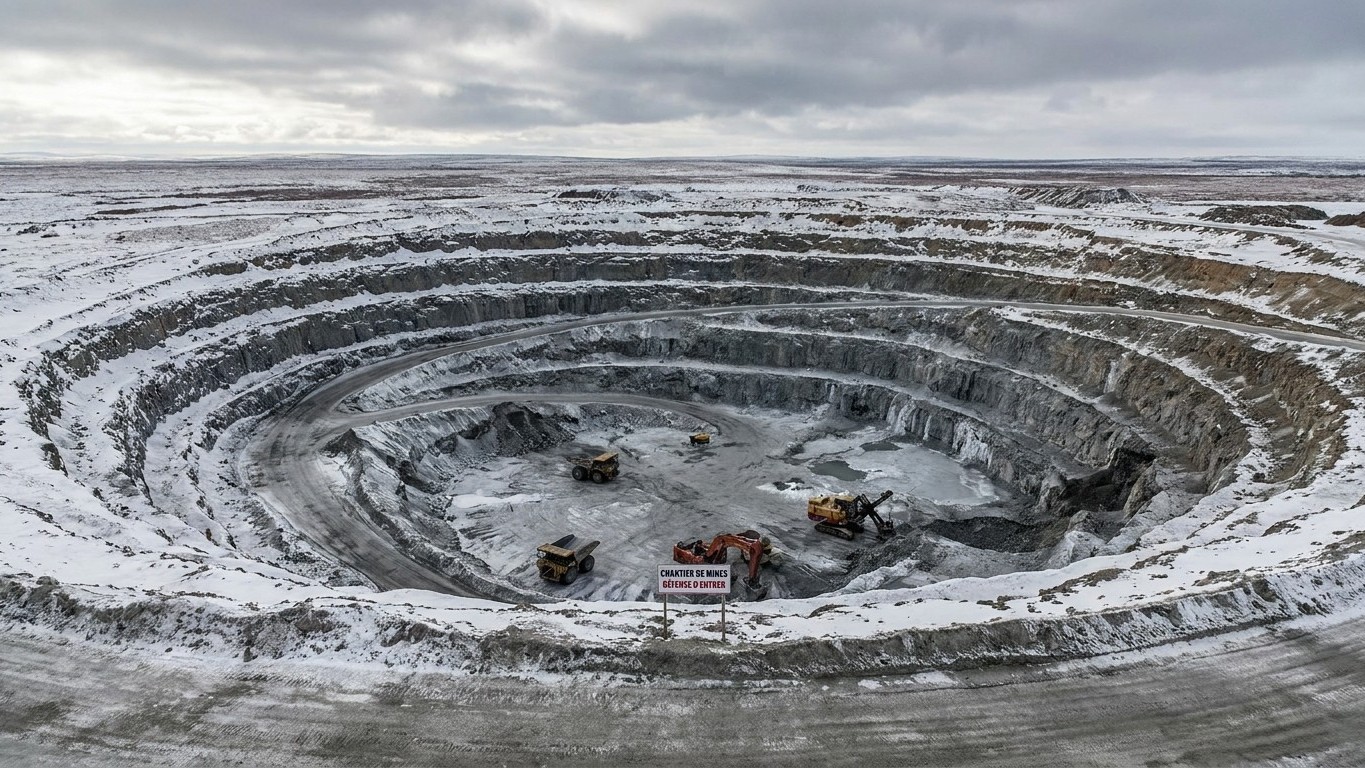
On July 14, 2026, the Supreme Court of British Columbia sealed the fate of the Ekati mine in the Northwest Territories. A British Columbia court formally placed Ekati in receivership at the request of the Northwest Territories government, the receivership being managed by the insolvency firm PricewaterhouseCoopers. Not an exhausted ore body, not a blizzard that toppled the facilities. The real cause lies in one word: money. The territorial government told the court that the situation was urgent, the company needing to exhaust all its cash within the following week.
Ekati is not just any mine. Founded in 1998, it is the oldest of the Northwest Territories, the very first in the country to commercially mine industrial diamonds. Nestled near Lac de Gras, about 300 kilometers northeast of Yellowknife, it exploited several kimberlite pipes, rock formations in the shape of carrots formed by ancient volcanic eruptions that act as natural diamond capsules. Extraction began on the surface before delving underground, over hundreds of meters, to reach the deepest mineralized pockets. A technical feat in the Arctic, where the ground must sometimes be artificially frozen to contain the tailings basins.
The domino-like scenario that precipitated the collapse is striking. In May, the Arctic Canadian Diamond Company, owner of the mine, sought protection from creditors, opening the door to a potential buyer. An auction followed. Result? Radio silence. Bidders had until the end of the previous week to submit a bid, and according to publicly released court documents, no bid was received despite 140 potentially interested parties being contacted. One hundred forty companies approached, zero hands raised. A figure that, in itself, says everything about the current disaffection for the natural diamond industry.
À retenir
- Une cour suprême place la mine sous séquestre après que 140 acheteurs potentiels se désintéressent du site
- Le prix du diamant s’est effondré à 24 dollars le carat sous le poids des droits de douane américains
- En trois décennies, le Canada passera de six mines de diamants à une seule en activité
A price drop fueled by American tariffs and synthetic stones
The natural diamond sector is facing a crisis that goes far beyond the Canadian case. Since American tariffs began to apply in early 2025, the average price per carat fell to $24 in December 2025, with Ekati diamonds averaging around $27 in their last two sales. Twenty-four dollars per carat is barely the price of a fast-food meal for what remains, in the public eye, an absolute symbol of rarity. The US taxes on imported jewelry crushed demand across the Atlantic, and India, the world hub for diamond cutting and polishing, suffered particularly from the tariffs imposed on it. Even partial relief in 2026 was not enough to revive the machinery: inventories had piled up with wholesalers, permanently weighing on prices.
Added to this pricing pressure was a rival the industry did not foresee on this scale: lab-grown diamonds, produced in laboratories within weeks and sold for a fraction of the price. The weak global diamond prices, combined with tariffs, competition from synthetic stones, inflationary pressures, and supply-chain bottlenecks created a formidable set of challenges that proved insurmountable. The federal Canadian government nevertheless tried to keep Ekati afloat. Ottawa injected about C$185 million into Ekati in recent months in the form of various loans. A massive show of support, but insufficient: an additional C$50 million promised to Burgundy in May was never transferred, due to the absence of a viable offer after the July 10 deadline.
A precipitous closure, years ahead of the planned deadline
The most striking aspect of the case is the brutal timing. Ekati was due to shut down in 2029, but it is now in receivership after its parent company failed to find a buyer for the site. Three years of operation wiped out in a judicial stroke. By July 10, the debtors had only about C$14 million in cash, including nearly C$3.5 million earmarked for accrued paid time off and C$2.1 million for payroll and regulatory payments. In other words, a drop in the bucket compared with the needs of an Arctic mining operation.
Ekati entered receivership after its owner, a Burgundy Diamond Mines subsidiary, ran out of money and no one stepped forward to purchase the mine. Burgundy’s chief, Jeremy King, called the situation “deeply disappointing for Ekati’s workforce, Burgundy’s stakeholders, and the Northwest Territories communities.” About 340 people were still working on site by the end of March, according to court filings. Their future, as well as the economic‑benefit agreements with Indigenous groups, remains suspended pending the receivership’s arbitrations.
Canada, soon reduced to a single diamond mine in operation
What is at stake goes beyond the fate of a single industrial site. Ekati’s closure will leave Canada with only one operating diamond mine, the Gahcho Kué operation run by De Beers, itself nearing the end of its expected life. A dizzying reversal for a country that, a little over a decade ago, boasted a true Arctic diamond belt. Canada once had more than half a dozen diamond mines, including De Beers’ Snap Lake and Victor, closed in 2015 and 2019, and Stornoway Diamonds’ Renard mine in Quebec, closed in 2023. This year also saw Diavik definitively halt operations, while Gahcho Kué announced the cancellation of an expansion and a plan to reduce its workforce.
Facing this drain, territorial authorities are attempting to look elsewhere. The territorial Industry Minister acknowledged that the territory was losing its diamond mines while highlighting new investments in Arctic security and critical minerals, asserting the aim of turning this focus into lasting benefits for Northern residents. The lingering question over Lac de Gras remains: what becomes of a region shaped for nearly thirty years by diamond extraction when the last truck leaves the site for good? The rehabilitation of the frozen ground, meanwhile, will likely take longer than the market took to collapse.
Sources: private-diamond-club.fr | ici.radio-canada.ca
