
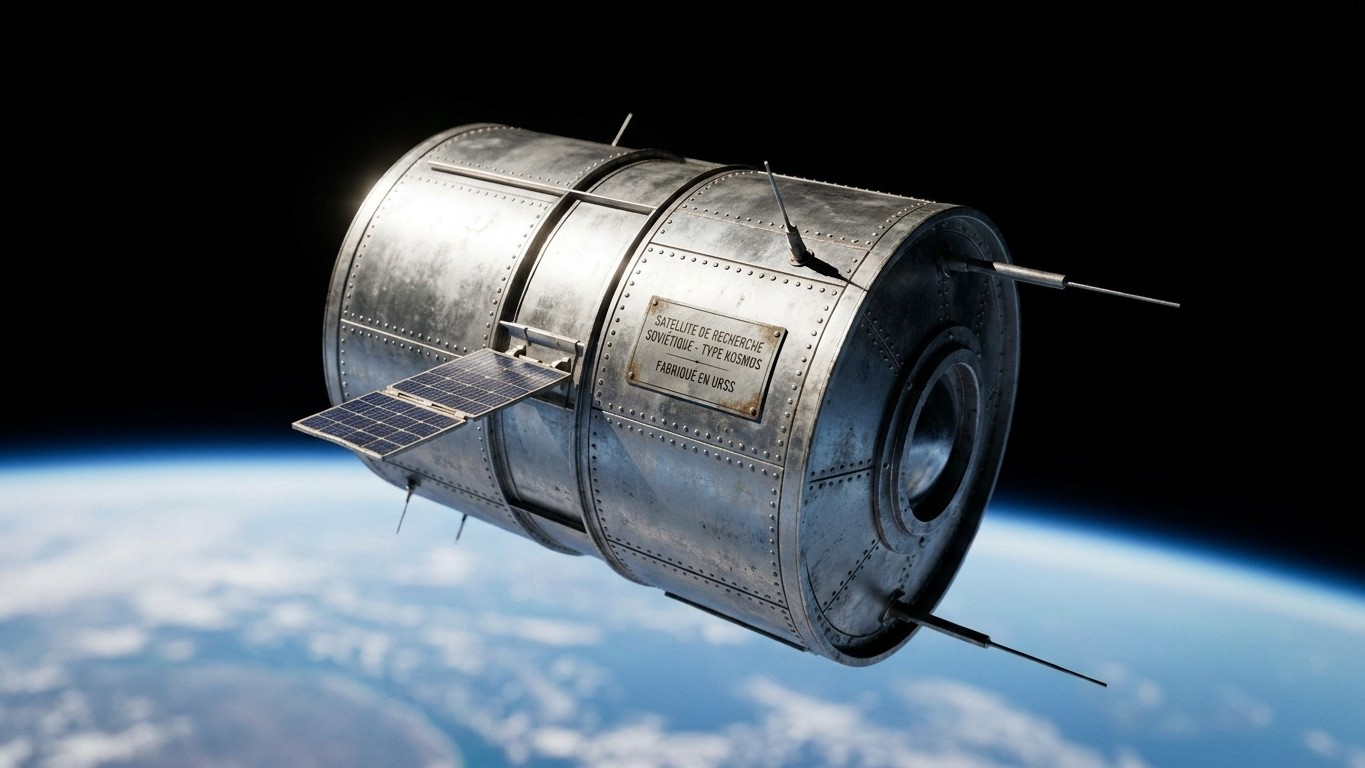
An object the size of a small refrigerator is currently streaking overhead at more than 27,000 km/h, at an altitude somewhere between 1,268 and 1,317 kilometers. Its name: SNAP-10A. Its status: the first and only American nuclear reactor ever launched into space. Its peculiarity: it ran for only 43 days in 1965 before failing, yet no one has ever been able to recover it. It continues to orbit, silent and out of service, on a path so high that atmospheric drag will not bring it down for centuries.
Key takeaways
- An American nuclear reactor has been in orbit for 58 years without ever being recovered
- A simple electronic failure sidelined this technological marvel after only 43 days of operation
- The mysterious debris observed in 1979 raises unanswered questions about orbital nuclear risks
A technological gamble launched in the midst of the Cold War
The story begins on April 3, 1965, at Vandenberg Air Force Base in California. On that day SNAP-10A was launched and placed into an orbit of roughly 500 nautical miles around the Earth. The craft formed part of the SNAPSHOT program, an acronym for Space Nuclear Auxiliary Power Shot, led by the American Atomic Energy Commission and the manufacturer Atomics International. The objective? Prove that a compact nuclear reactor could supply electricity to a satellite for extended periods, far more efficiently than the solar panels or chemical batteries of the era.
After a successful launch, the SNAPSHOT vehicle was placed as planned into a polar orbit. The order to start was issued remotely 3.5 hours after liftoff, and within six hours the reactor reached criticality in orbit, i.e., the nuclear chain reaction became self-sustaining. A technical milestone for the era: it marked the very first time a nuclear reactor operated in space.
SNAP reactors used enriched uranium fuel, a moderator made of zirconium hydride, and a liquid sodium-potassium alloy as a coolant. Twelve hours after liftoff, the nuclear reactor automatically reached its operating temperature and initially produced more than 600 watts of electricity. This power could feed onboard instruments, thanks to thermoelectric converters that directly transformed the heat from the core into electricity. All of this fit within a craft weighing under 440 kilograms, including shielding and instruments.
A banal failure, an eternal orbit
The dream comes to a swift end. Once in orbit, SNAP-10A supplied electricity for 43 days before shutting down abruptly due to a voltage regulator with no direct relation to the reactor itself. It wasn’t the nuclear technology that failed, but a mundane electronic component—a part you could replace in five minutes on Earth. But at an altitude of about 1,300 kilometers, there was no maintenance technician to fix it.
The reactor shut down permanently, but the radioactive danger had been anticipated long before launch. The SNAP reactor had been designed to be started and operated remotely, so that no dangerous fission-related radiation would appear before the reactor reached orbit safely, thereby limiting risks to ground personnel. A precaution that matters: even in the event of a launch failure, the core would not yet be active.
Today the American administration confirms the situation plainly. The reactor remains safe, shut down, and positioned on a stable orbit for 4,000 years. It’s a staggering figure: at that altitude, the residual atmospheric drag is so weak that natural reentry will take many generations. Some orbital databases even propose a theoretical reentry date around the year 2965, a sign that estimates vary with models, but all converge toward a horizon of several centuries.
The 1979 incident that still unsettles astronomers
The SNAP-10A dossier does not end with its deactivation. Fourteen years after launch, the wreck experiences a resurfacing. In November 1979, the relic begins to fragment in a completely unexplained manner, generating roughly fifty debris pieces that can be tracked by ground-based observation stations. A collision with another object remains the most probable explanation, though no definitive conclusion has been reached.
What alarms orbital trackers is the nature of these fragments. Radar properties suggest they are unlikely to originate from a leak of the sodium-potassium coolant, but the possibility that these fragments are radioactive cannot be ruled out. There is no public safety alarm here; the altitude is well above the International Space Station and crewed satellites. Yet the incident highlights a broader issue: the management of nuclear waste in orbit, a topic for which there is, to date, no established reprocessing or disposal procedure.
An isolated case, but far from being a global exception
SNAP-10A remains, to date, the only fission reactor ever launched into space by the United States. Washington did explore other avenues afterward, such as the SP-100 program in the 1980s or the Prometheus project in the early 2000s, but none advanced beyond the study phase due to insufficient funding.
The Soviet Union, by contrast, chose a radically different path. Between the 1970s and 1980s, more than forty reactors were sent into orbit, the vast majority Soviet-made, as part of the RORSAT program intended for maritime surveillance. Several of these Soviet devices also experienced leaks or ruptures, sometimes with more visible consequences, such as Cosmos 954 reentering over Canadian territory in 1978.
That orbital silence surrounding SNAP-10A is not the final word for space-based nuclear energy. China is planning reactors for propulsion by 2040, the United Kingdom has entrusted a study into the feasibility of a compact space reactor to an industry player, and NASA continues to test small prototypes like Kilopower. The first American reactor in history does not require an upgrade: it will continue to complete an orbit every 111 minutes, long after the last engineer who helped design it has passed away.
Sources: vice.com | x.com
