
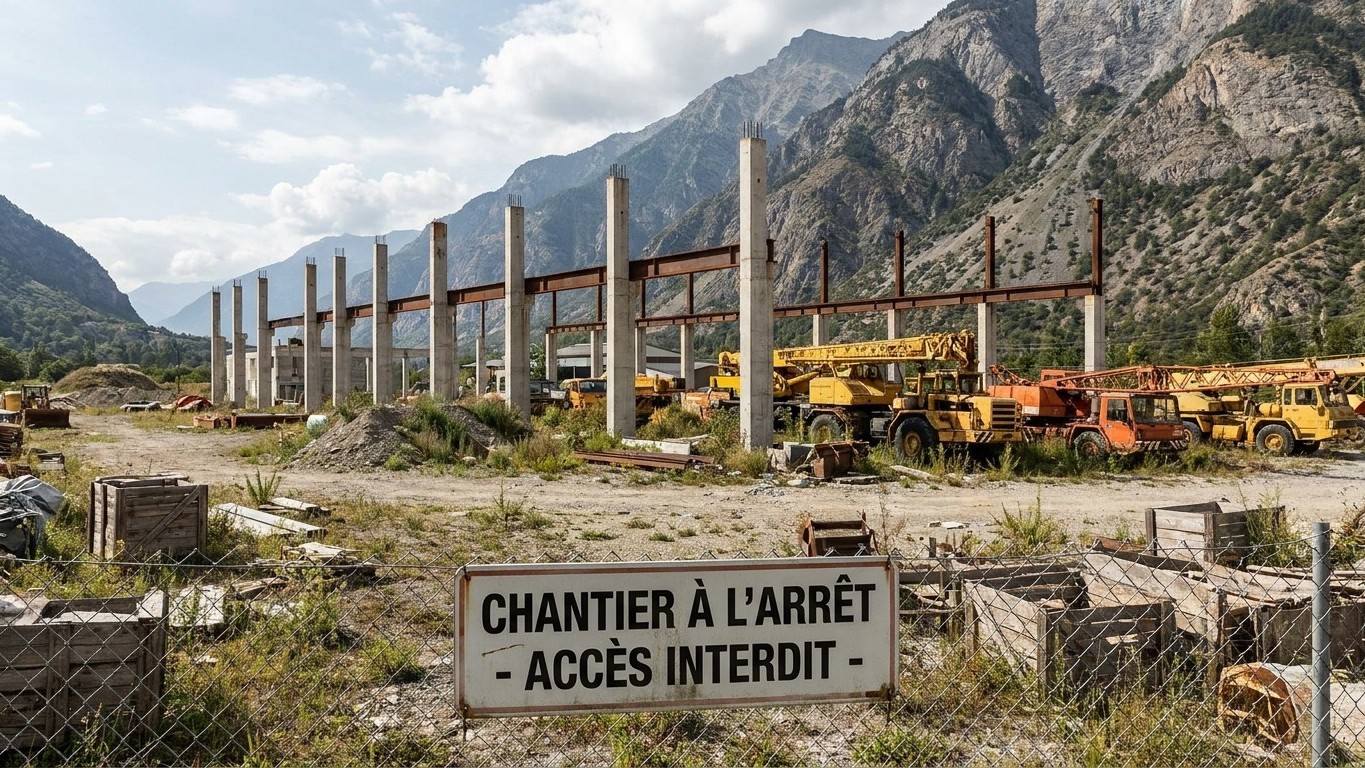
A single figure sums up the malaise: out of €2.9 billion of public money promised to expand the Crolles site in Isère, only €574 million had been paid by the end of 2025, and exclusively to one of the two project partners. By the end of 2025, €574 million had been paid to STMicroelectronics and nothing for the American foundry, which has so far invested nothing in the project. The other half of the team, the American GlobalFoundries, simply has not committed its share of the construction.
Key takeaways
- A colossal €2.9 billion envelope remains stuck between two partners unevenly mobilized
- The Court of Auditors flags the absence of contractual safeguards to protect public money
- The promised production capacity targets for 2028 may never come to fruition
A project named Liberty, launched with fanfare
Back in July 2022. President Emmanuel Macron traveled to Crolles to announce, alongside STMicroelectronics and GlobalFoundries, the construction of a massive expansion to the historic Isère site. This Liberty project is the joint venture led by STMicroelectronics and American GlobalFoundries Inc., aimed at building, by 2027, a joint semiconductor production plant in Crolles on ST’s production site, with the added promise of creating 1,000 local jobs on site. The stated ambition is bold: to produce 300 mm wafers to supply the automotive, space, and telecommunications industries, leveraging French FD-SOI technology.
The project cost also swelled with each announcement. The investment amount, initially estimated in 2022 at €5.7 billion, rose to €7.5 billion in 2023, consisting of €4.3 billion for GlobalFoundries and €3.1 billion for STMicroelectronics. To support this colossal effort, the State laid on the table a comparably vertiginous envelope. On June 5, 2023, the economy minister of the time, Bruno Le Maire, unveiled the amount of state aid granted to the project: €2.9 billion, i.e., €1.85 billion for GlobalFoundries and €1.05 billion for STMicroelectronics. A colossal sum, validated by Brussels under the European Chips Act, which aims to double by 2030 the European Union’s share of the global market in the sector.
The industrial objective, however, was precise: to increase French production capacity by 620,000 silicon wafers per year by 2028. It would transform Crolles into a showcase of French technological sovereignty. On paper, all the elements seemed in place for a resounding success.
What the Court of Auditors says, three and a half years later
On April 21, 2026, the Court of Auditors published a 118-page report that dampened this initial enthusiasm. “The amount of aid programmed between 2018 and 2025 for the semiconductor sector is €8.7 billion, which represents one of the largest sums granted to an industrial sector,” the document states. A colossal sum, committed under the France 2030 plan, with Crolles taking a disproportionately large share. The project absorbs more than half of the €5.5 billion public investment envelope planned by the State over five years in semiconductors.
But the institution does not stop at the amount. It questions the real industrial counterpart of this budgetary generosity. On one hand, STMicroelectronics keeps to its schedule: according to the company’s management, the program, for the part that concerns ST, is now in the completion phase, with 80% of ST’s investments realized by the end of the first quarter of 2026. This represents an investment of nearly €2 billion to date, which has allowed expanding cleanroom surfaces, installing equipment, and starting the production of next-generation components.
On the other side of the same site, radio silence. GlobalFoundries has not committed any euro to its portion of the project, even though the public funds allocated to it, €1.85 billion, remain reserved, awaiting disbursement as construction milestones are reached. The Court of Auditors directly highlights this asymmetry, going so far as to call for a revision of the stated objectives. The evaluation criteria for the electronics strategy, whose capacity targets rely mainly on this project, will need to be revised soon to account for GlobalFoundries’ investment delay. Translation: the promised production capacity for 2028, the one intended to justify the scale of the subsidy, is no longer tenable as stated.
Aid distributed without safeguards
What particularly irritates the financial magistrates is the weakness of contractual safeguards. Unlike other industrial powers, France has not locked its disbursements to strict obligations of results. The contracts contain few requirements regarding domestic production or jobs created, unlike American or Japanese practices. A choice that leaves a partner the option to delay, without the money already committed being automatically reclaimed.
The mechanism of clawback, intended to protect public finances in the event of a beneficiary’s failure, does exist, but its effectiveness remains theoretical for now. Clawback clauses were introduced only recently, under European impetus, for beneficiaries of more than €50 million, and their effects will not take hold until 2028. Two years of waiting, then, before the State has a real lever to recover its investment in the event of an outright project failure. Until then, the Court of Auditors recommends a more structural reform of the system. It recommends generalizing refundable advances as of 2026, taking into account the maturity of projects.
Asked about these criticisms, STMicroelectronics preferred to dodge. The company’s management indicated that it is not their role to comment on the report, choosing instead to refer to the progress of their own portion of the project. One question remains unresolved by the report: what happens concretely to GlobalFoundries’ stake in this joint venture if the American company never decides to pour the first concrete on its side of the site? The foundry, the world’s second-largest player in the sector behind Taiwan’s TSMC, has long been facing financial difficulties that could explain its reluctance to commit new capital in France, without either the company or the State publicly detailing the reasons for this blockage.
Sources: presse.economie.gouv.fr | usine-digitale.fr | clubic.com
