
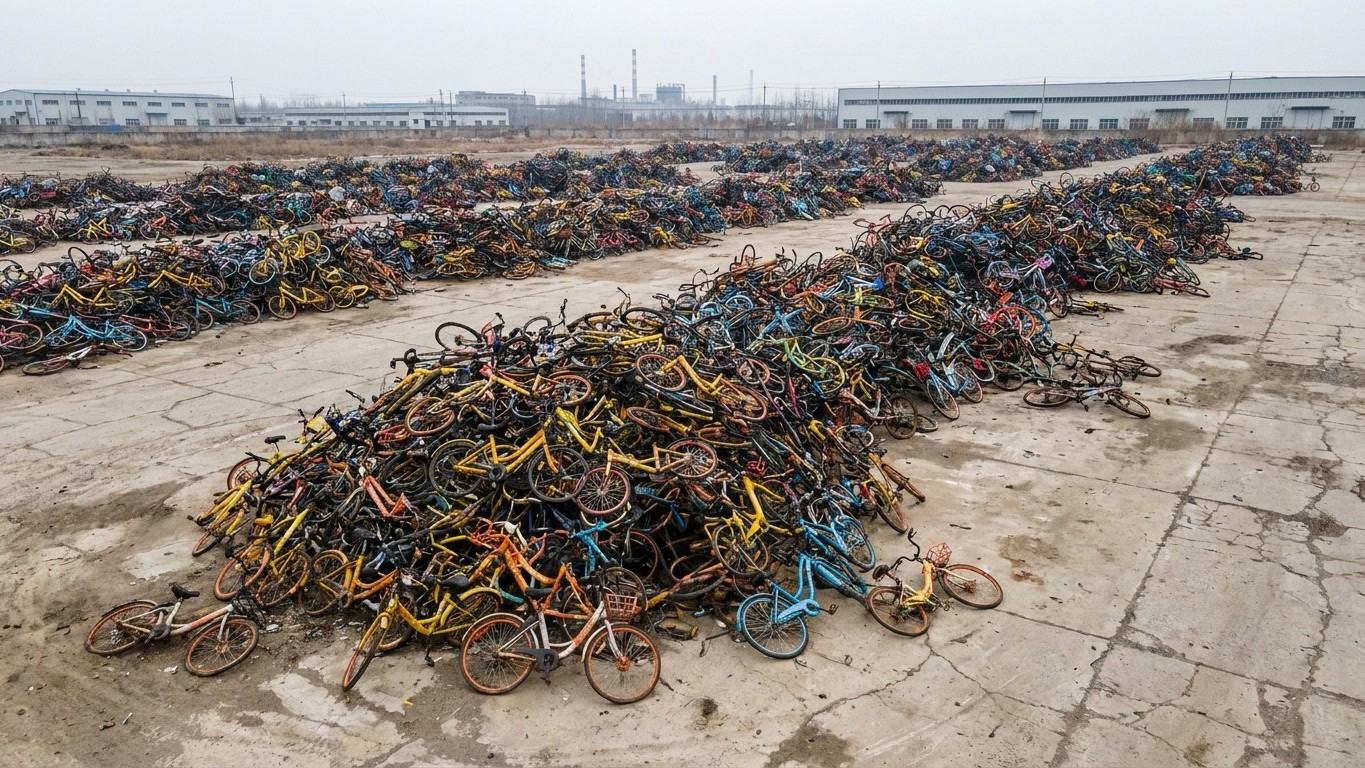
Two hundred thousand bicycles stacked on a single site, stretching to the horizon, forming multicolored hills visible from an airplane. This isn’t an art installation but the aftermath of an industrial fiasco: the collapse of Chinese bike-sharing between 2017 and 2018, which left tens of millions of bicycles without users, without buyers, and often without a solvent owner to recover them.
Key takeaways
- Two hundred thousand bicycles stacked in Xiamen form hills visible from planes — but why such a giant graveyard?
- Ofo, once presented as a national innovation on par with the high-speed train, collapsed, leaving 13 million users without refunds
- Twenty-five million rusting bicycles were still awaiting recycling plants — what was the true value of this wreck?
Vacant lots transformed into open-air dumps
The most photographed site is in Xiamen, in Fujian province, in the southeast of China. Among the most spectacular graveyards, because among the largest, was photographed by aerial drones in Xiamen, featuring no fewer than 200,000 bicycles stacked high. The Hong Kong daily South China Morning Post captured the magnitude with a concise line: these depots were described as “little mountains.”
Xiamen is not an isolated case. Similar graveyards exist in almost every major Chinese city, from Tongzhou in the east of Beijing to Tangjialing in the north of the capital. Shanghai and Hefei faced the same fate, with mounds sometimes covering the equivalent of a football pitch. It was the Guardian that first revealed these images to the world in 2017, showing a bicycle graveyard that covered an entire football field in that same Xiamen city. A Chinese photographer, Wu Guoyong, then systematized the approach: his drone surveyed 15 sites to photograph the rainbow-colored pits, a project titled “No Place to Place” that has since toured the world.
A clear chronology helps explain the scale of the disaster. It all began in 2015 with the appearance of Ofo bikes, the first to experience real success, notably on university campuses. The Chinese regime even encouraged the movement, viewing it as a national tech showcase: according to industry players, these solutions were categorized by Beijing among its major innovations, alongside high-speed rail and mobile payments. Dozens of companies surged into the opportunity, flooding sidewalks with yellow, orange, and blue bikes. Too many bicycles, too little genuine demand: the business model collapsed as quickly as it had exploded.
Ofo, a symbol of a multi-million yuan failure
The name Ofo remains linked to this fiasco. Yet backed by giants like Alibaba and Didi, the Beijing-based company found itself cornered into bankruptcy despite its status as the world leader in dockless bike sharing. The crisis erupted in late 2018, when unpaid bills began to pile up: the trust crisis started toward the end of 2018, when several suppliers reported unpaid invoices. The Chinese Ministry of Transport had to intervene directly, ordering the company, at the end of December, to “accelerate the refund procedures” for deposits paid by users who requested them.
The scale of the liabilities is dizzying. Fearing the loss of their deposits, ranging from €12.50 to €25, more than 13 million Chinese users requested refunds, amounting to a total bill of €150–300 million. Some tallies even point to nearly 990 million yuan—about €126 million—claimed by users who filed formal complaints. In the Beijing offices, tension rose to another level: furious customers literally stormed the premises to demand their dues, an episode recounted by several Chinese business publications. The founder, Dai Wei, eventually spoke publicly about liquidation possibilities in a letter to his employees, acknowledging the financial dead end looming over his company.
Meanwhile, the bikes themselves piled up on the site, quite literally. Rusty, ownerless, unmarketable on the second-hand market due to the lack of a solvent buyer, they had become worth only the scrap value of their aluminum frames.
Recycling, the only solution for millions of wrecks
Facing this mountain of scrap, local authorities ultimately organized what they had failed to anticipate: removal. Recycling companies recovered these rusted bicycles from the graveyards, repurposing the tires to equip running tracks in stadiums and recycling the metal for industry. In practical terms, each bike handed over to scrapyards yielded only a few tens of yuan—an insignificant sum compared with the original production cost, yet sufficient to justify the operation on an industrial scale.
The stated objective of the Chinese authorities measures the scale of the problem to be tackled. The plan was to send the remaining 25 million abandoned bikes to recycling plants, thereby erasing a problem that polluted urban landscapes. Twenty-five million—the approximate population of Australia—crammed into rusted frames on empty lots and derelict sites.
The phenomenon left a lasting impression on the Chinese collective imagination, to the point that the local press continues to refer to it as a lesson in applied economics. What stands out in hindsight is the speed of the escalation: three years separate the triumphant launch of Ofo on university campuses from the image of its yellow bikes corroding in the rain, abandoned a few kilometers from where they were manufactured. A complete industrial cycle, from ecological promise to mass waste, completed in record time that few other sectors can claim, for better or worse.
Sources: eduprobiz.com | franceinfo.fr
