
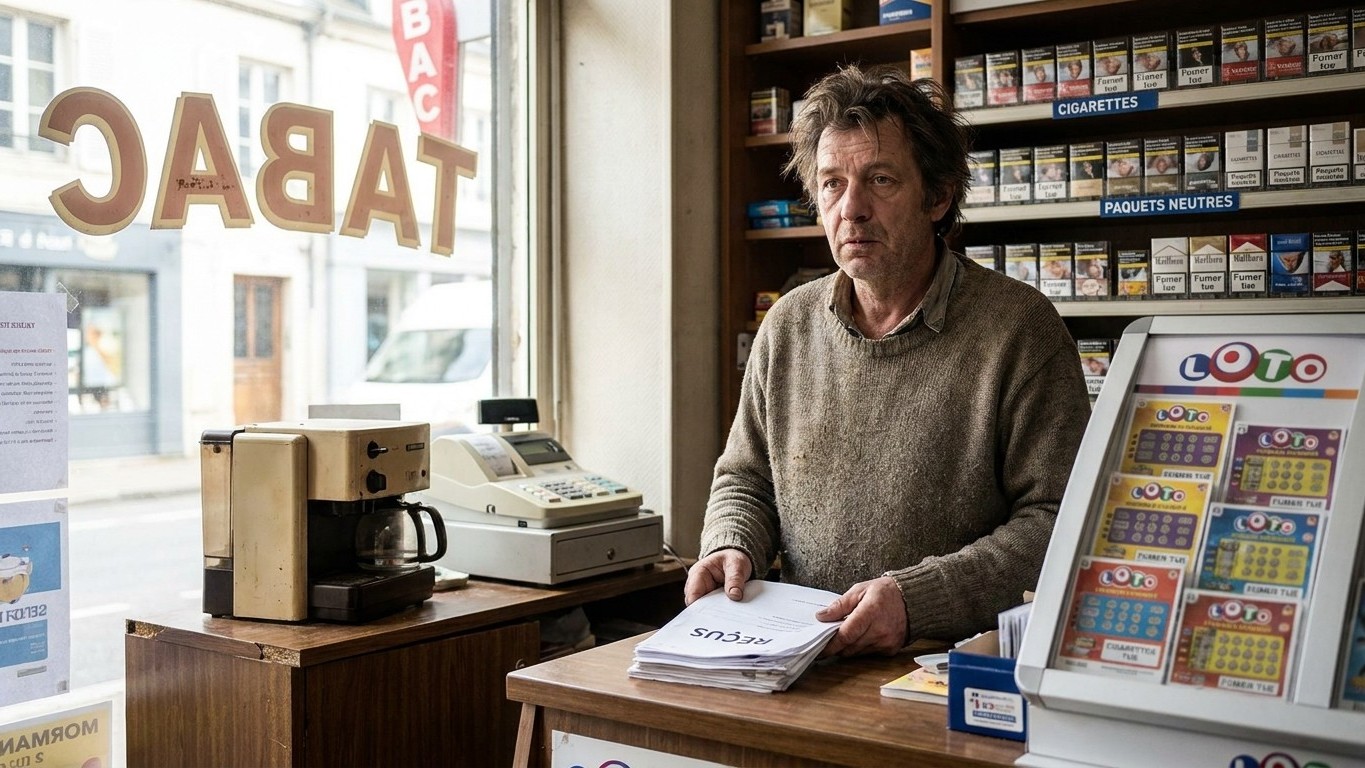
Since 2004, the State has allocated hundreds of millions of euros each year to its 23,000 tobacconists to support the planned decline in tobacco sales. The agreement signed in February 2018 between the Ministry of Economy and the Confederation of tobacconists, later renewed and extended until 2022, promised a transformation of the network: less reliance on tobacco, more diversified local shops. The preamble of the following protocol recalls that from 2018 to the end of 2022, the State paid more than 375 million euros in aid to the tobacconists’ network. A colossal windfall. But a windfall that mainly ended up in merchants’ pockets as supplementary income, without the promised reconversions materialising to the extent of the sums committed.
Key takeaways
- Why the Court of Auditors has been sounding the alarm for years without any changes
- The perverse mechanism that rewards big tobacco sellers instead of helping them diversify
- How the State distributes hundreds of millions without even being able to verify where the money goes
An arsenal of aid measures designed to accompany the transformation of the trade
The 2018 protocol was built around three main levers. This protocol provides for the creation of a temporary transformation fund for tobacconists aimed at enabling the profession to shift toward less dependence on tobacco sales, as well as a transitional discount for tobacconists whose tobacco deliveries had fallen significantly. In addition, there was a diversification bonus for activities, enhanced on this occasion: the amount of the diversification bonus is raised to €2,500, and to €3,000 for tobacconists eligible for the transitional discount. An end-of-activity indemnity completes the system for those who simply wish to close shop.
The transformation fund, the centerpiece of the agreement, was meant to concretely finance the reshaping of the points of sale. Under the 2018-2021 protocol, the Confederation of tobacconists negotiated a transformation fund of €20 million per year, covering 30% of pre-tax expenditures, raised to 40% for tobacconists benefiting from the supplementary discount, with a ceiling of €33,000. The protocol was subsequently extended by one year: an amendment signed on October 22, 2020 extended the duration of these aids by one year, bringing the total allocated to the transformation fund from €80 million to €100 million. On paper, everything seemed to be well aligned. In practice, the results proved far from rosy.
The Court of Auditors’ unequivocal verdict
The Court of Auditors has been tracking this file for a long time, and its assessment has hardly varied across reports. In its public annual report of February 2017, entitled The fight against smoking: a policy to be strengthened, it had already raised the alarm. Support to tobacconists, all aids combined, amounted to €2.6 billion between 2004 and 2011, i.e., more than €300 million per year. A colossal sum for a mixed result: the Court denounces a support policy conducted blindly, with schemes insufficiently controlled and targeted by the administration, despite detected fraud.
The central problem, identified at that time, lies in the complete lack of conditionality. No one, at any moment, demonstrated that these hundreds of millions of euros injected each year actually slowed cigarette sales or accelerated the reconversion of the points of sale. The subsidies fell, mechanically, without any quantified assessment to verify whether the merchant had diversified their activity or simply pocketed the cheque. A report from the National Assembly already noted in 2013 this same structural flaw: the primary objective of the future contracts, from 2004, had been to support tobacconist diversification, but on this point progress was weak, the State did not fulfil all its commitments, the strengthening of the role of public-interest counter was never implemented, and the deployment of nearby services did not take place.
A mechanism that rewards big sellers, not those who have diversified
The most troubling design flaw lies in the calculation of the main aid, the net discount. This rate, paid on every pack sold, continues to rise across protocols: from 7.70% in 2018 to 8.35% planned for 2025. The more a tobacconist sells tobacco, the more public money he earns. The exact opposite of the stated objective of gradually reducing the network’s dependence on tobacco. According to recent work on this dossier, this mechanism pays the tobacconist a percentage of his tobacco turnover: the more packs he sells, the more he earns, and this same calculation logic indexed to volume also applies to the transformation aid for the points of sale and to end-of-activity allowances intended to facilitate the reconversion of the most fragile shops. Three schemes designed to help a decline, but all calibrated to favour those who decline the least.
The administrative monitoring has hardly improved the situation since. An anti-tobacco association noted in 2024 a persistent traceability problem: while the Confederation of tobacconists asserts that 4,426 outlets have transformed since 2019, it is impossible to verify this figure because the control administration, the DGDDI, does not have access to the revenue evolution of these professionals. The State pays, the profession communicates a figure of its choosing, and no one at Bercy has the means to verify whether public money was actually used to transform a tobacco outlet into a fine grocer or a parcel-relay point, rather than merely offsetting a cash flow gap.
The new protocol signed in January 2023 for the 2023-2027 period nevertheless repeats the same tactics: a continued rise in the net discount, a transformation fund capped at €20 million per year, security aid maintained. The DGDDI has now set up a semiannual dashboard to monitor the aids paid to tobacconists, with an annual exchange intended to track the number of transformation aid applications and the amounts committed. A first step toward greater transparency on paper. It remains to be seen whether this dashboard will go beyond simply counting files, to finally measure whether tobacconists receiving these aids have truly changed their trade, or only changed their accounting line.
Sources: contre-feu.org | maire-info.com | economie.gouv.fr
