
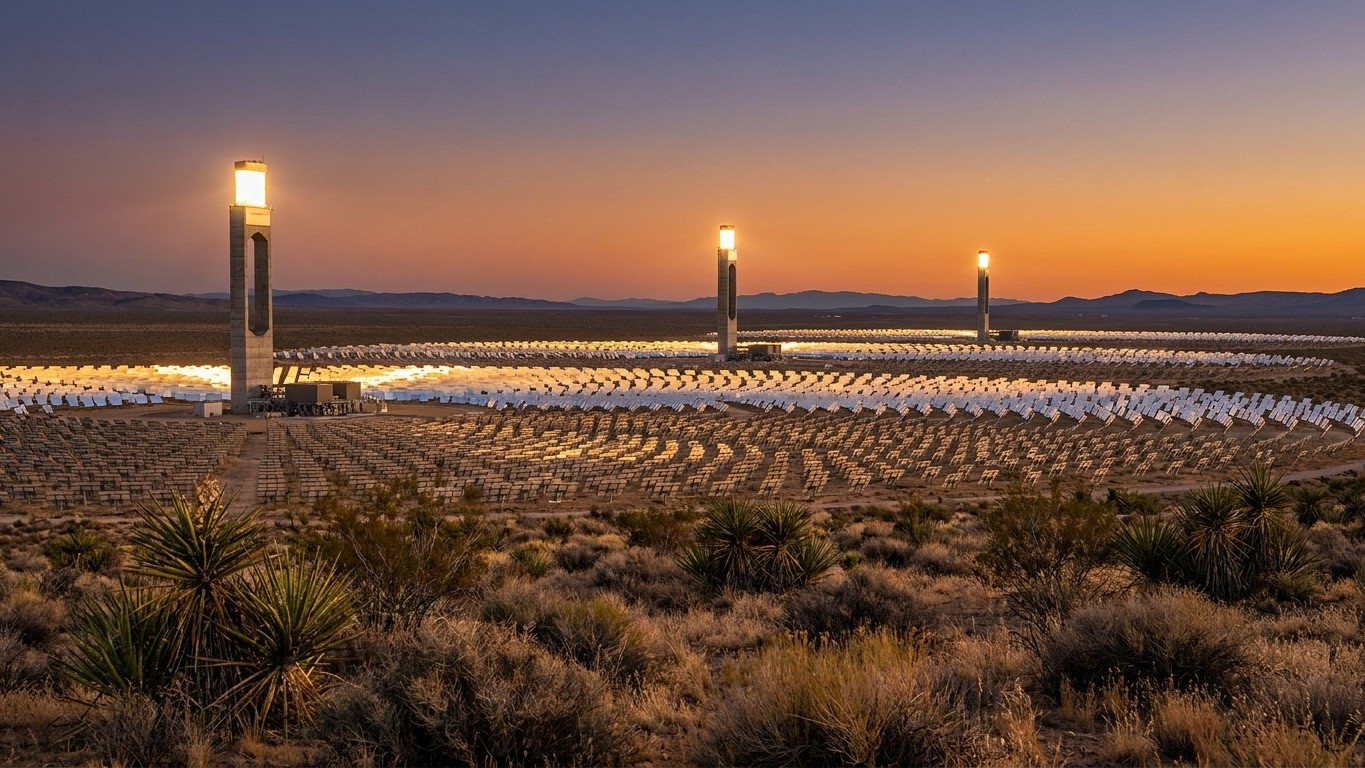
Three 140‑meter towers rise from the Mojave Desert, more than 173,000 steerable mirrors aimed at the sky: the Ivanpah Solar Electric Generating System was meant to embody the future of large‑scale solar power. Twelve years after its commissioning, the plant has not been felled by a major technical failure or by a lack of California sunshine. What doomed it was a simple figure: the price per megawatt‑hour produced by conventional photovoltaic energy had fallen to half of its level.
To remember
- A 386‑megawatt plant with 173,500 mirrors was meant to revolutionize large‑scale solar
- It burned natural gas heavily every morning to start up, contrary to its promises
- PV fell twice as fast as expected, rendering Ivanpah economically obsolete within about fifteen years
A colossal project financed by public credit
Commissioned in February 2014 after a construction start in 2010, the Ivanpah Solar Electric Generating System is a 386‑megawatt project composed of three concentrating solar power plants located in the Mojave Desert, in San Bernardino County. The installation spans about 1,420 hectares, or 14 square kilometers, on the border between California and Nevada. Its technology starkly contrasts with standard photovoltaic panels: 173,500 computer‑controlled mirrors, called heliostats, reflect sunlight toward a receiver at the top of one of the three towers, heating a liquid to produce steam that drives a turbine.
The financing of this project read like both an industrial achievement and a political bet. The facility received a $1.6 billion loan guarantee from the U.S. Department of Energy, for a total project cost of $2.2 billion. American taxpayers bore most of the financial risk for a technology still young, at a moment when nobody imagined that conventional photovoltaic panels would crash in price so quickly.
The production mirage: less steam than expected, more gas than promised
The first warning signs came from the plant’s own performance. In June 2015, the Wall Street Journal reported that fifteen months after startup, the plant was producing only 40% of its target of more than a million megawatt‑hours annually, before a notable improvement in the second year. The problem wasn’t a shortage of sun in the desert; it was the need to heat the boilers every morning before the mirrors could take over.
Ivanpah, marketed as a pure solar plant, actually relied heavily on natural gas. Each unit includes two steam boilers powered by natural gas, an auxiliary boiler, and a night‑preservation boiler, the first used to bring the plant to operating temperature during the morning startup cycle. The practical result: operators had to scale back their ambitions from the very first year. California approved in August 2014 increasing the permitted annual natural gas consumption from 328 million cubic feet to 525 million cubic feet. A detail that changes everything: a plant meant to demonstrate the viability of pure solar ended up burning, each morning, the equivalent of a small thermal plant just to start the day.
Overtaken by photovoltaics, not by a failure
The real verdict did not come from a technical incident. It came from the market. The plant, although profitable when conceived in 2009, is now twice as expensive to operate than photovoltaic technology, whose price has fallen much faster than anticipated over fifteen years. The power purchase agreement signed at the time set a price near $200 per megawatt‑hour, a figure that seemed reasonable in 2009 but became untenable as PV plants could produce at a fraction of that cost.
Pacific Gas & Electric, the plant’s main electricity purchaser, eventually faced the consequences of this gap. In 2023, under regulatory obligations, PG&E sought proposals to restructure or terminate renewable energy purchase agreements to reduce costs for its customers, before finalizing in January 2025 the termination of two of its three purchase agreements with Ivanpah’s owners. The operator NRG itself acknowledged the economic logic of backing away: “Ivanpah has been a successful demonstration of CSP technology, but it has been surpassed by photovoltaics due to far lower investment and operating costs,” the company said. The plan called for shutting down two of the three units, with the remaining unit continuing under contract with Southern California Edison.
The California regulator blocks the exit
That is where the story takes an almost ironic turn. While everyone—operator and buyer—seemed ready to move on, the regulator said no. The California Public Utilities Commission rejected, without prejudice, the termination agreement between PG&E and Solar Partners, effectively forcing two units of the plant to stay operational. The reasons cited were not about technical performance but about grid strategy. The commission justified its decision by the need to keep existing clean generation in service, the rising demand for electricity, and the fact that the loss of hundreds of millions of dollars invested in the associated transmission infrastructure would exceed the losses cited by the companies.
The paradox is complete: a plant deemed too expensive by those who must buy its power remains open because the state fears losing the transmission investments already made. A note published by the Institute for Energy Research estimates the direct cost of this forced keeping online: the plant’s continued operation costs customers an additional $105 million. Industry experts, cited by SolarPACES, point to the structural flaw of the original model: without storage, Ivanpah has become an expensive source of electricity precisely when prices are at their lowest, sometimes even negative. Some now propose converting the towers to molten salt storage with twelve hours of thermal storage to finally render the installation controllable, rather than watching it run on gas every morning to produce electricity that, economically, no one truly wants to pay for.
Sources: energy.ca.gov | reviewjournal.com
