
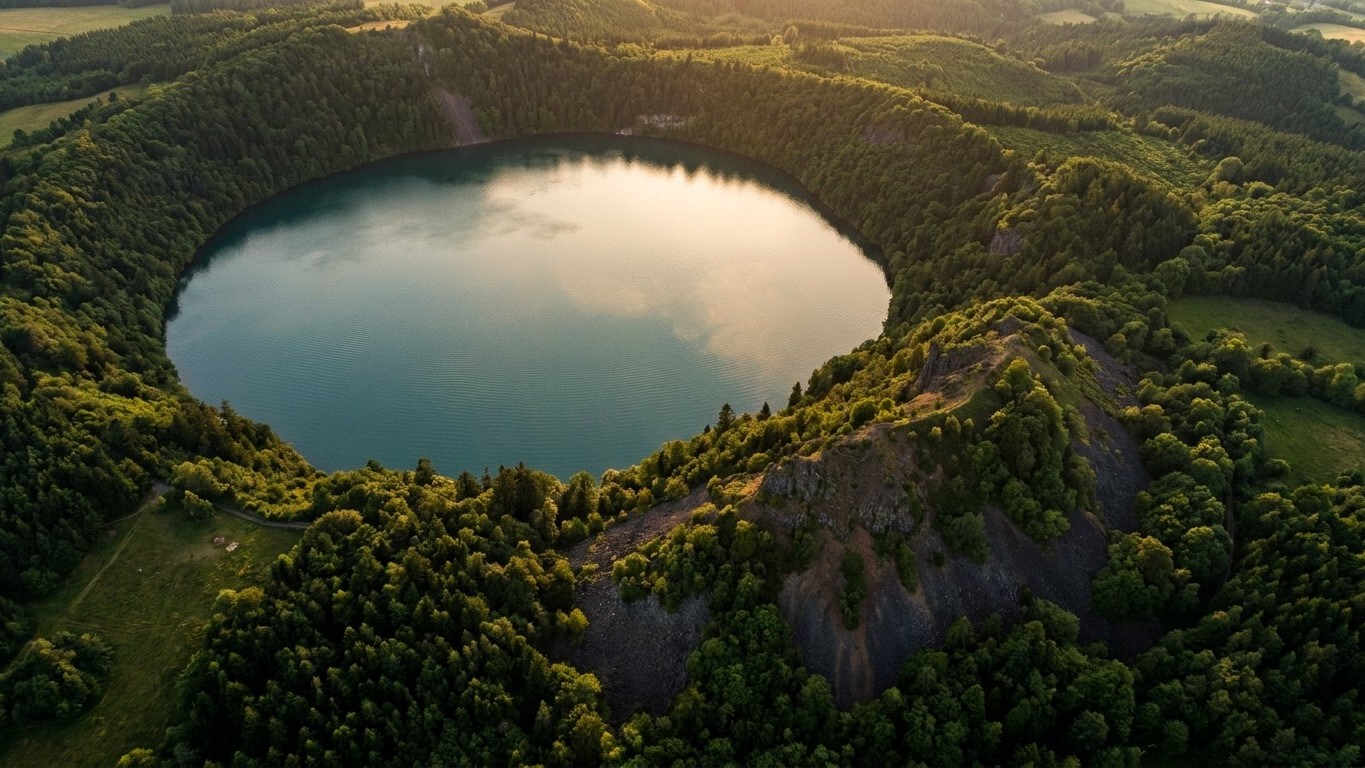
Like a mountain lake, you imagine it churned by wind, rain, and the seasons, its waters renewing each year like a natural breath. Lake Pavin, in Auvergne, does not follow this rule. Beneath its first 60 meters, a body of water has remained still for millennia, cut off from any circulation, and it accumulates in the dark dissolved gases that have unsettled scientists for decades.
Key takeaways
- In the heart of the youngest volcano in France, a stagnant body of water has accumulated for 7,000 years without ever mixing with the rest
- Two worlds coexist in the Pavin: a living surface and frozen depths enriched with dissolved gases
- The Nyos disaster from Cameroon haunts volcanologists: could it be repeated in Auvergne?
The youngest crater in France hides a lake apart
Pavin is not an ordinary mountain lake placed in a valley. It is a maar, a cavity created by an explosive interaction between hot magma and groundwater, a phreatomagmatic eruption that blasted materials tens of kilometers away and shaped a circular depression gradually filled by rainfall and underground springs. This depression, almost perfect, now measures about 700 to 800 meters in diameter, bordered by a crisp crater rim and steep slopes.
The age of this formation often surprises. The most recent datings place the eruption about 6,900 years ago, making it the youngest volcano in metropolitan France, a figure long rounded to 6,500 years in older scientific literature. On a geological timescale, it is yesterday. The Massif Central, which is commonly associated with landscapes thought to be stationary since the Tertiary era, has therefore known volcanic activity almost contemporary with the first agricultural civilizations of the Near East.
Two lakes in a single crater
The true peculiarity of Pavin is not visible from the shore. It lies 60 meters deep, where an invisible boundary separates two bodies of water that never mix. Scientists call this phenomenon meromixis, and Pavin today is the country’s only meromictic lake, a few cousins existing elsewhere in Europe—in the Eifel maars in Germany, or among the Phlegrean Fields near Naples.
On the surface, the mixolimnion behaves like any lake: it oxygenates, circulates with the seasons, hosts fish and plankton. But at 60 meters down begins another world. This deep layer, from -60 to -96 meters, does not mix with the rest of the water column and remains permanently in complete anoxia. Without oxygen, without light, without mixing, it functions like a closed vessel where time literally accumulates in the water’s chemistry. This deep compartment has enriched itself with dissolved reduced compounds such as ferrous iron, methane, ammonium, as well as CO2 and phosphates, generating chemical and biological reactions that researchers still poorly understand. Some even see a possible analogue of conditions that may have favored the appearance of the first life forms on Earth.
The name of the lake itself tells this ancient worry. The word “Pavin” comes from Latin pavens, meaning “dreadful,” a designation tied directly to the presence of dissolved gases in the depths. The locals did not have seismographs or CO2 sensors, but they saw bubbles rising to the surface, attributing them to wicked spirits exhaling their malefic waves. The local myths go further: they tell that an entire city, punished for its sins, would have been swallowed in a single night. These legends sometimes anticipated science with unsettling precision.
The scenario that haunts volcanologists: the Nyos disaster
What makes this accumulation of gas worrying is not an abstract hypothesis. On August 21, 1986, at Nyos Lake in the northwest of Cameroon, a similar phenomenon turned into tragedy. This lake, also housed in a volcanic crater, had accumulated CO2 in its depths for decades, just as Pavin does today. That night, a limnic eruption triggered the death of 1,746 people and nearly 3,000 head of livestock, by releasing roughly 100,000 to 300,000 tonnes of carbon dioxide suddenly. The cloud, invisible and denser than air, rose at nearly 100 km/h before descending on neighbouring villages, suffocating people and animals within about 25 kilometers of the lake. Survivors recall hearing “a loud crash, like thunder” before losing consciousness in their sleep.
The exact cause of this trigger remains debated: most geologists suspect a landslide, but some mention a slight volcanic eruption at the bottom of the lake. Since the disaster, a system of pipes continuously pumps the deep waters of Nyos to degas them artificially. The tally, forty years later, is rather reassuring: according to the most recent measurements, about 90% of the dangerous gas has now disappeared from the Cameroonian lake.
Pavin monitored, but not yet alarming
Should we fear a similar scenario in Auvergne? Not in the near term, respond the researchers. Since a 2009 scientific conference, the teams at the Clermont-Ferrand Observatory of Physical Geography and the BRGM agree: the current level of dissolved gas in the depths of Pavin remains too low to trigger spontaneous degassing on its own. A network of sensors measures gas concentrations and the stability of the water column continuously, a constant watch over this site designated as a sensitive natural space and visited by 200,000 visitors each year.
The real danger, according to volcanologists, would not come from warming air or a sudden chemical instability, but from a much slower phenomenon: the erosion of the crater’s slopes. The lake’s stability hinges above all on its depth and the shape of the crater, far more than the air temperature. It is the water, ice, and wind that slowly wear away the volcanic rock, with the long-term risk that a bank collapse could disturb the fragile balance of these dead waters. The Pavin may never explode. But it will continue, year after year, to trap a little more of the air that mankind has not breathed since the Bronze Age.
Sources: france3-regions.franceinfo.fr | le-caucase.com
