
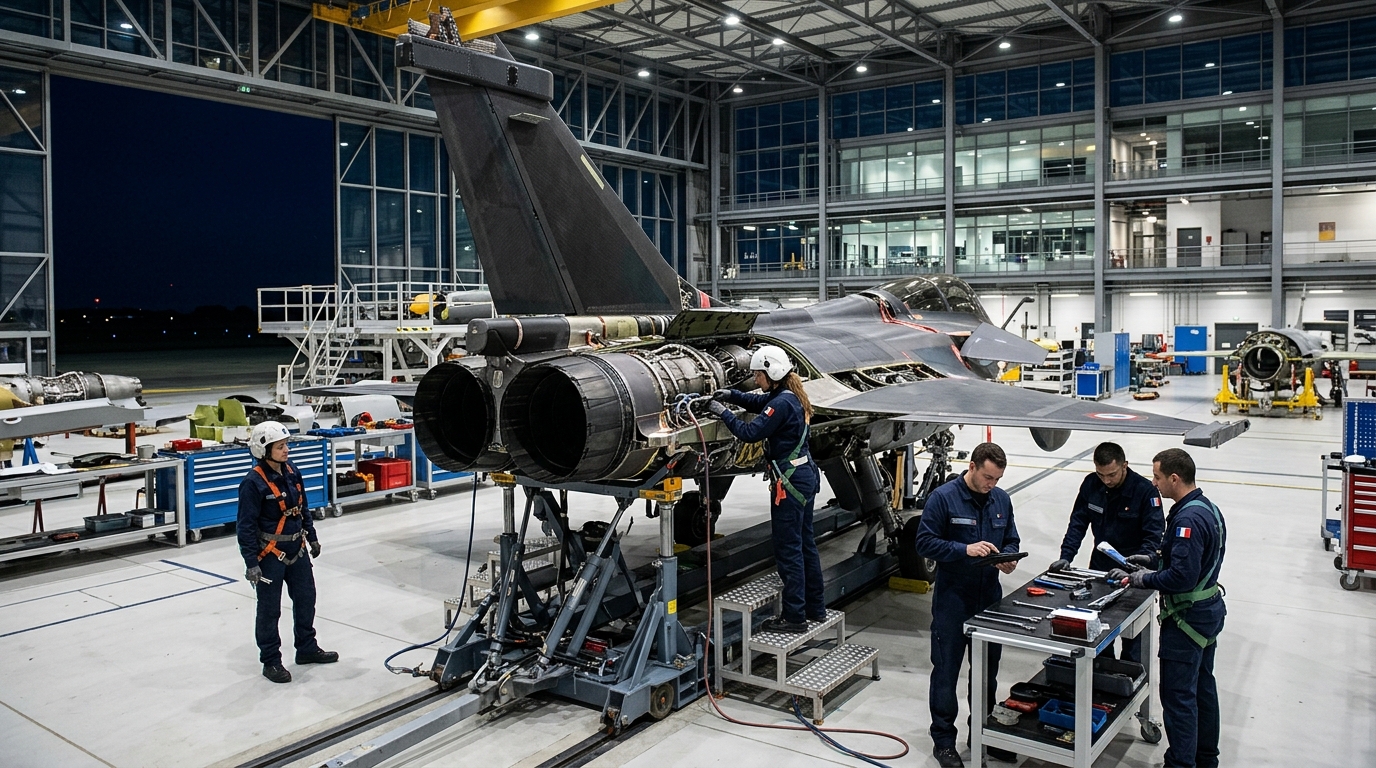
We were promised a united European sky, a fighter designed by many hands to embody the continent’s air power. The reality is quite different: France now advances on its own. Dassault Aviation has just confirmed the development of a Rafale successor, conceived and built without a foreign partner, with a launch expected around 2034.
The European dream crashes mid-flight
For several years, the program SCAF (Système de combat aérien du futur) embodied the ambition of a Europe capable of jointly designing its own next-generation fighter. The idea looked appealing on paper: pooling French, German and Spanish expertise to create a common aircraft, a symbol of shared military sovereignty. But in June 2026, this project was abandoned due to the lack of a viable industrial agreement.
The breaking point crystallized between Dassault, representing French interests, and Airbus, the voice of Germany and Spain. It was impossible to reach a viable industrial compromise between the two partners. It was like two architects refusing to share the plans for a single building, each defending their own vision of the final structure. The result: the dream of a unified European fighter crashed before it could take off.
Dassault takes back the reins alone
Facing this failure, France did not wait long to respond. It was Éric Trappier, CEO of Dassault Aviation, who laid out what happened next. During the Rencontres des Entrepreneurs de France in Paris, he announced on BFM Business that his company was now developing a new combat aircraft named Rafale F5, quickly nicknamed the super Rafale by the media.
This project directly answers an explicit request from the French armed forces. Trappier also used the occasion to reaffirm a long-held belief at Dassault: the company is capable of designing a combat aircraft on its own, without needing to pool capital with other manufacturers. A way of turning the page on the SCAF without closing the door entirely to future cooperation, since international collaborations remain possible, even if their exact nature has not been specified.
An aircraft designed to last until 2034
The announced schedule gives a sense of the scale of the undertaking. The actual launch of the Rafale F5 is targeted around 2034, with a broader window spanning from 2033 to 2035. A timeline that may seem long, but reflects the inherent complexity of designing a next-generation military aircraft, where every system must be conceived, tested, and validated before entering service.
This new aircraft will be more advanced than the current Rafale, though precise technical specifications have not yet been released. Neither the budget nor the financing arrangements for the program have been detailed at this stage. This lack of detail is coherent with the development phase in which the project resides: the main directions are set, but the technical and financial details will likely follow in the coming months and years.
France resumes its export strategy
Beyond the needs of the French armed forces, this future fighter also carries an export ambition. The Rafale F5 could be offered for export as early as 2035, thus extending the strategy that has made the current Rafale a success on the international stage. It is a card that France knows well: a locally designed aircraft, but conceived from the outset to win over foreign customers.
This solitary approach offers a clear advantage: it avoids the logjams associated with multi-party negotiations that brought down the SCAF. A choice based on Dassault’s own capabilities, without an expanded European partnership. A bet taken, relying on Dassault’s historical expertise rather than on pooling resources.
As summer draws to a close, this announcement marks a turning point in France’s industrial policy for aerial defense. By choosing to chart its own course rather than waiting for an uncertain European consensus, France shows a pragmatism, even if it means temporarily foregoing the ideal of a unified Europe’s defense. It remains to be seen whether this choice, presented today as a necessity, will pay off in about ten years when the super Rafale must prove itself against international competition.
