
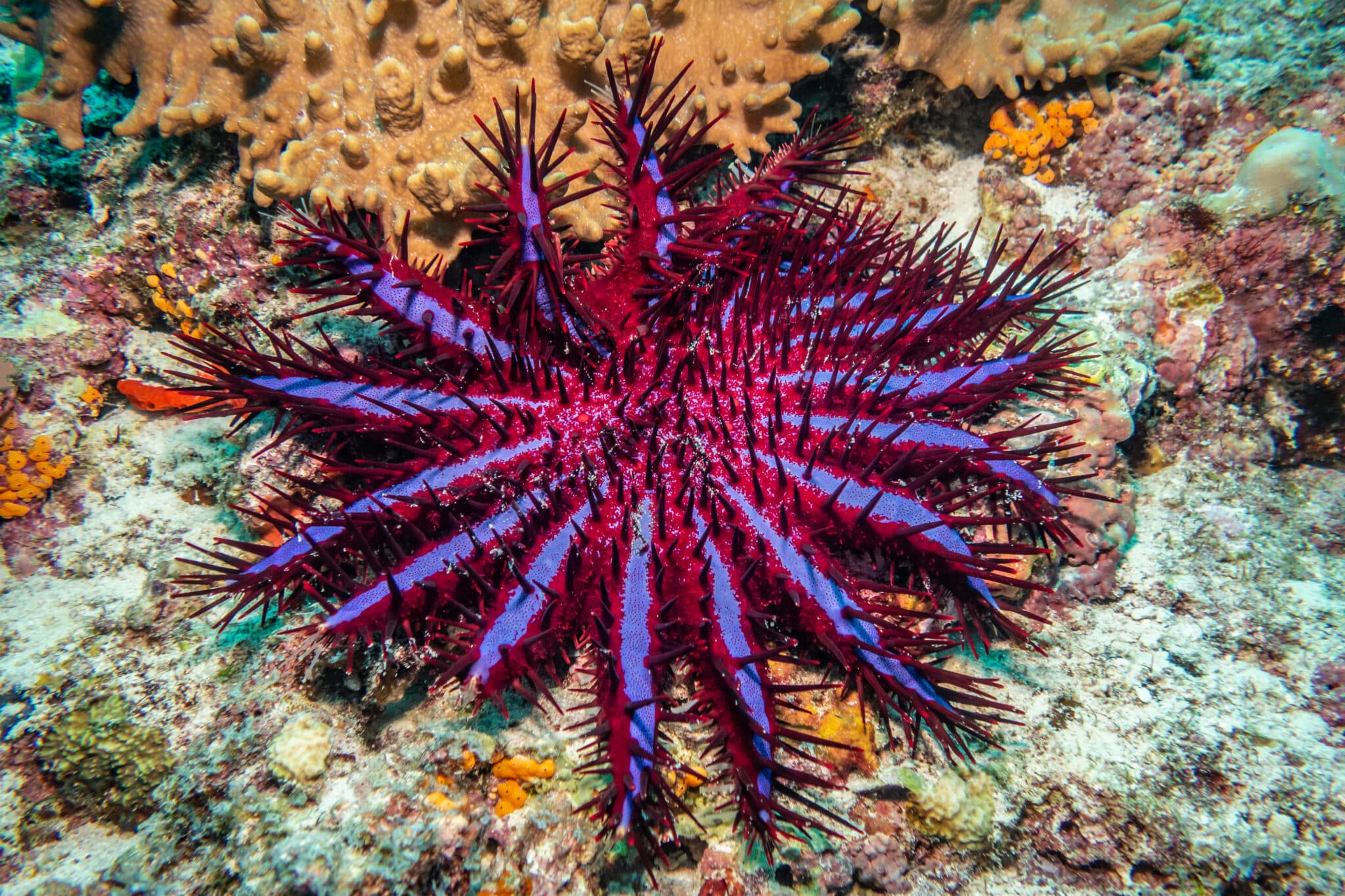
They would look right out of a science fiction movie. Covered in venomous spines, lacking a brain, capable of regrowing their arms… Crown-of-Thorns Starfish (Acanthaster planci), or CoTS, have long intrigued and unsettled marine biologists. Yet a recent scientific discovery reveals that these insatiable predators, able to decimate hectares of coral reefs, possess an unsuspected mode of communication. An invisible chemical language that could explain their mysterious coordinated attacks.
Conducted jointly by the Australian Institute of Marine Science (AIMS), the University of the Sunshine Coast, and the Okinawa Institute of Science and Technology (OIST) in Japan, this study sheds light on a phenomenon as captivating as it is worrying: these starfish transmit biochemical messages through their spines to organize their movements and collective behaviors.
A hidden communication network beneath the sea
For a long time, scientists have wondered about the crown-of-thorns’ ability to gather into true destructive swarms, capable of ravaging coral reefs in a blink. These starfish are not mere opportunists that happen to share the same patch of coral. They actively coordinate. But how, without a brain, without blood, without a centralized nervous system comparable to that of other animals?
The answer lay… on their backs. Their spines, until now seen only as a means of defense, play a far more strategic role: they emit and detect specific proteins that serve as chemical signals in the water. These molecules, named COTSP (Crown-of-Thorns Starfish Proteins), propagate quietly around individuals, triggering among their conspecifics precise changes in behavior: movement, clustering, agitation.
A little-known social behavior
By reproducing these proteins in the laboratory, researchers observed that their mere presence was enough to alter the behavior of starfish kept in a tank. More active, more mobile, they steered their movements in specific directions, as if following instructions from elsewhere. No external stress, no immune reaction seemed involved. These proteins serve neither defense nor digestion. Their function is purely social.
Thanks to advanced genomic analyses, the team confirmed that these spines are not simple passive tips, but sophisticated sensory organs, capable of capturing and emitting a genuine chemical language. A rudimentary communication system, to be sure, but devilishly effective.
A plagu e for reefs, a boon for science
Renowned for their ability to liquefy corals with digestive enzymes, Crown-of-Thorns starfish pose one of the Pacific’s greatest threats to coral reefs. Their populations swell in waves, forming invisible armies that leave behind vast patches of bleached and dead coral. Until now, attempts to curb their spread were tedious and often ineffectual: you had to locate and remove these hardy starfish individually, capable of surviving the loss of several of their limbs.
The discovery of this “chemical language” opens a completely new avenue. Researchers have managed to synthesize a non-toxic peptide capable of mimicking these natural signals and drawing the starfish to a precise location. This lure, dubbed “Acanthaster attractins,” could allow concentrating individuals in one place, greatly simplifying their removal. A major hope in the fight to preserve coral reefs.
« We discovered that the CoTS spines detect and secrete a broad range of peptides, playing a role far more complex than that of simple defenses, » explains Professor Noriyuki Satoh, director of the marine genomics unit at OIST. « By reproducing these peptides that we suspected acted as pheromones, we were able to influence the starfish’s behavior and imagine new strategies to control their swarms. »
A decisive step for ocean protection
This scientific advance could transform how CoTS populations are managed in the years ahead. Ultimately, it could be feasible to deploy these synthetic peptides in strategic zones to lure the starfish toward traps or disposal points, reducing their impact without resorting to harmful chemicals.
As coral reefs are already weakened by climate warming, pollution and ocean acidification, efforts to combat natural destructive predators like the crown-of-thorns starfish become more urgent than ever. This discovery also demonstrates how vast the mysteries of the deep still are, even for species that have inhabited our oceans for more than 500 million years.
Understanding their language could well be the key to saving what remains of the reefs.
