
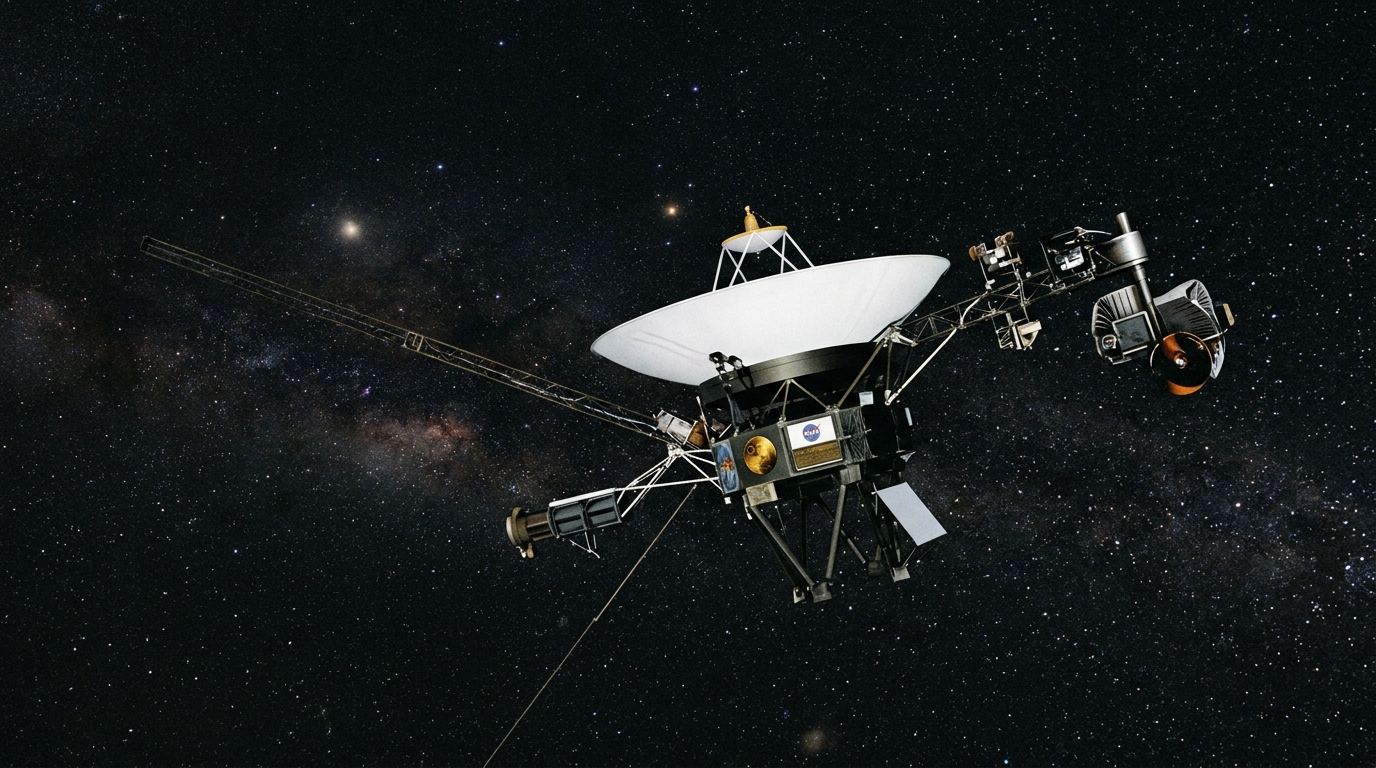
Imagine six individuals wielding a power that no government, no world assembly, and not even the United Nations have ever possessed: the sole authority to define, on their own, what humanity as a whole represents. No popular vote, no international panel of experts, no second chance if they err. Yet that is exactly what happened when NASA entrusted a small team with the task of crafting a message for potential extraterrestrial civilizations. In barely six weeks, with a modest budget, this tiny group decided what the stars would hear about us for tens of thousands of years.
The Phantom Committee That Speaks in Our Name
It all began with an idea from John R. Casani, the Voyager project manager, who desired to embed a durable testament of earthly life aboard the spacecraft. Rather than magnetic tapes, deemed too fragile to endure the harsh environment of space, the chosen medium was a metal phonograph disc—robust and capable of withstanding the ages. Casani turned to Carl Sagan, an astrophysicist at Cornell University, to take the lead on this extraordinary project.
Sagan did not work in isolation. He gathered Frank Drake, Ann Druyan, Timothy Ferris, Jon Lomberg, and Linda Salzman Sagan. Notably, three of them—Sagan, Drake, and Linda Salzman—had already collaborated a few years earlier on the Pioneer Plaque, another attempt at interstellar communication. This tight-knit core thus became, without any democratic mandate or public consultation, the unofficial spokesperson for all humanity when facing the cosmos.
Six Weeks to Choose Eternity
The schedule imposed an almost absurd constraint in light of the stakes: six weeks to gather, select, and engrave what should stand for human civilization as a whole. The budget was equally modest, with the entire project not exceeding 18,000 dollars, a mere fraction compared with the ambition of the message. Even more striking, the initial budget entrusted to Sagan by Casani was only 1,500 dollars, forcing the team to dip into their own pockets to push the project to completion.
In this high-stakes, time-pressured context, every decision carried heavy weight. Which music would endure among thousands of works? Which languages should greet hypothetical cosmic listeners? Which images could we distill into a few dozen frames to represent the planet’s diversity? None of these choices underwent public debate, yet each would become, literally, etched into metal for millions of years.
What the Message Really Says
The result of this frenzied effort took the form of a copper disc plated in gold, known as the Golden Record, with a diameter of roughly 30 centimeters. Its cover is not innocuous: it contains a source of uranium-238, whose half-life of 4.5 billion years would, in theory, allow distant discoverers to calculate precisely the time elapsed since the probes were launched. A true cosmic manual, grounded entirely in mathematics and physics, accompanies the package to render its contents decipherable without prior knowledge of our languages.
On this disc are arranged 116 images illustrating life on Earth, a 90-minute musical selection drawn from various cultures and eras, and greetings recorded in fifty-five languages. There are also written messages, signed by the American president Jimmy Carter and the United Nations Secretary-General at the time, Kurt Waldheim. A capsule of humanity on a single disc, conceived as a message cast into the galactic ocean, with the awareness that the Voyager probes will probably not encounter a star for at least 1.7 light-years away, for roughly 40,000 years.
After Launch, Nothing Belongs to Us Anymore
What renders this story truly vertiginous is the total absence of institutional guardrails. No official validation of the final content was required by NASA before launch. In other words, a handful of scientists and artists were given carte blanche to compose, without external filters, what would become the official calling card of humanity to any potential extraterrestrial civilizations.
Once Voyager 1 and Voyager 2 were launched in 1977, no corrections could be made. The disc was sealed, the trajectory set, and the message fixed for eternity, or almost. This irreversibility gives the project a nearly philosophical depth: what would this message look like if we had to reassemble it today? Which music, which voices, and which images would we choose collectively, were such a collective choice even imaginable?
This adventure reminds us how profoundly symbolic decisions can rest on the shoulders of a very small group, acting under pressure and with limited means. The Golden Record endures as a captivating object, technically modest yet immense in its reach—a silent witness to a moment when six minds dared to summarize, in six weeks, all that we are. And it leaves us with a lingering question that hovers somewhere between two stars: what if someone, someday, truly listened to it?
