
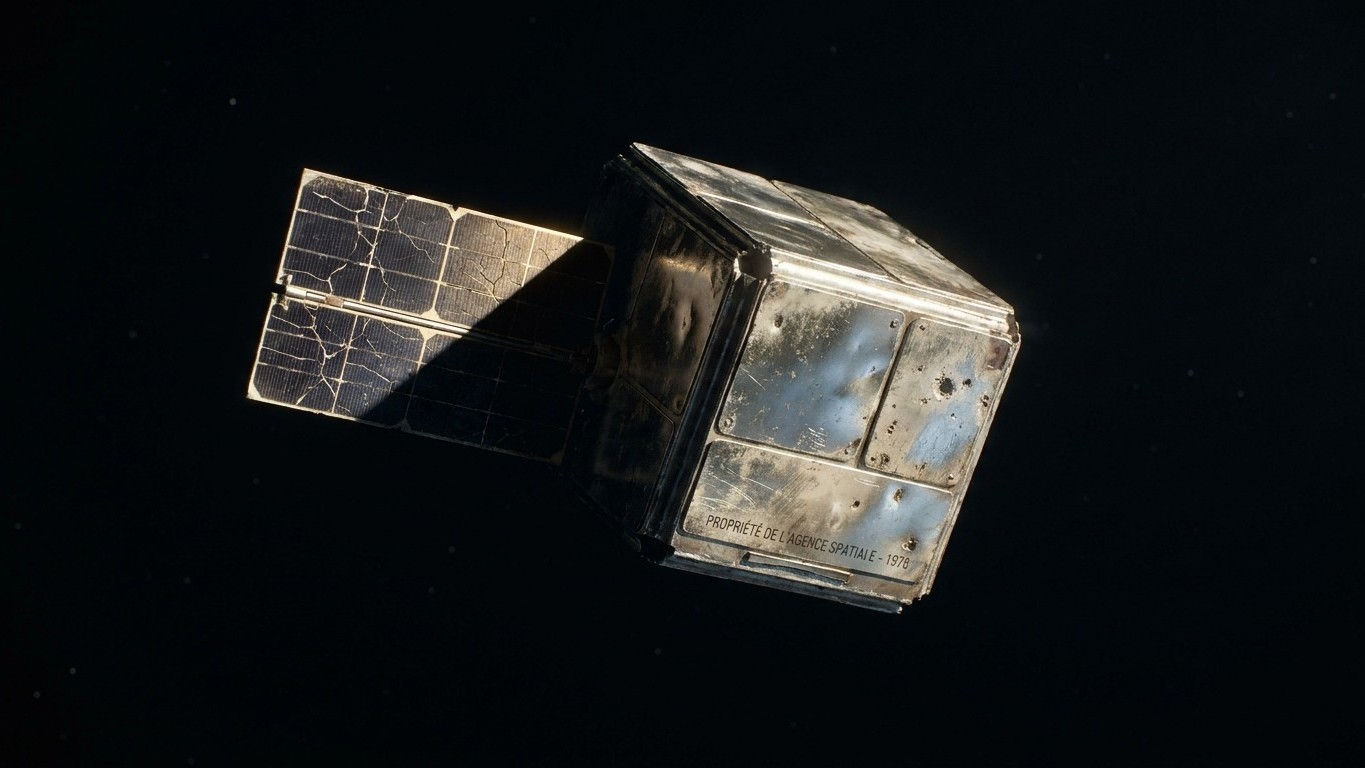
An American military satellite, silent for forty-five years, suddenly resumed transmissions in the English countryside. No one pressed a button. No NASA or U.S. Air Force engineer reactivated anything from a control center. The signal that ended this record-breaking silence came from the craft itself, tumbling alone in a low Earth orbit since 1965, forgotten by almost everyone except a handful of amateur radio enthusiasts.
The story begins with the United States Air Force launch on February 11, 1965, which marked the active use of the X-band (7 to 11.2 GHz) to serve hundreds of users. Named LES-1 (Lincoln Experimental Satellite 1), this small 31-kilogram device was not an ordinary satellite: it introduced a design conceived to exploit the SHF ground stations of the West Ford project, a military communications program run by MIT’s Lincoln Laboratory. On paper, the prospects looked bright. In practice, the mission devolved into a near-immediate fiasco.
Key takeaways
- A satellite that failed in 1967 suddenly emits after 45 years of total silence
- The signal detected in England comes from a completely autonomous source
- MIT scientists still do not know why this craft woke up
A technical fault that doomed the mission from day one
LES-1 never managed to leave its original mid-level circular orbit because of a fault in the onboard assist motor, and the resultant uncontrolled spin, combined with an unsuitable orbit, rendered the satellite unusable for the planned experiments. In plain terms: a wiring error in the pyrotechnic circuit prevented the second stage from triggering correctly. The satellite found itself stuck in a near-circular orbit about 2,800 kilometers up, far from the targeted elliptical trajectory.
Its twin, LES-2, launched three months later, did not suffer this problem. It managed to reach its final orbit a few months afterward, in May 1965, accomplishing what LES-1 had failed to do. Ironically, the space calendar’s both the failure and the success emerged from the same production line, just weeks apart.
Despite this handicap from the outset, LES-1 continued to operate, albeit poorly, for two years. After four and a half months of operation in a radiation-heavy environment, no significant circuit or component malfunctions had been noted, but the performance of the solar cells gradually declined over time. Wear finally took its toll: due to a wiring fault in the pyrotechnic circuit, the satellite never left its circular orbit and ceased transmitting in 1967. The protocol called for a gentle shutdown of the transmitters. LES-1 powered down cleanly, like a device you unplug. No one imagined ever seeing it again.
Forty-five years of silence, then a phantom signal
The satellite should have simply remained a line in orbital catalogs, doomed to continue circling Earth in silence for millennia as its high orbit gradually decayed. That is where the story veered into the improbable.
In December 2012, a hobbyist in north Cornwall, England, scanned the ultra-high frequency waves from his home. His signals were detected by Phil Williams, callsign G3YPQ, from North Cornwall in the southwest of England, on December 18, 2012. A strange, repetitive sound captured at 237 MHz—the exact frequency of LES-1’s UHF downlink. Williams did not conjure anything: he simply noticed a pattern that didn’t fit anything known, and dug deeper.
The discovery was confirmed in the following days by other operators around the world. Other members of the Hearsat group verified the observation, notably Flávio A. B. Archangelo in Brazil on December 22, 2012, then Matthias Bopp in Germany on December 27, 2012. Three continents, three different antennas, the same impossible signal. It was not a measurement error.
Why did this dead satellite start talking again?
The question remains, even today, largely without a definitive answer. “The voltage on the solar panels spikes, and that can trigger the phantom signal,” Williams explained, while noting that the satellite’s battery is likely completely exhausted, making the energy source of these transmissions mysterious. The strongest hypothesis: a faulty electronic component, aged by fifty years of radiation and extreme thermal cycles, behaves like an intermittent switch when the solar panels capture direct sunlight.
The satellite’s motion adds an almost theatrical dimension to the phenomenon. According to Williams, LES-1 was determined to be tumbling at a rate of once every four seconds, as evidenced by the characteristic fading of the signals. The sonic result captured by the hobbyists evokes a slow, irregular pulsation, almost organic, a signal that swells and fades in rhythm with the craft’s tumble in the void.
The MIT Lincoln Laboratory, which designed the craft six decades earlier, did not ignore the news. The team set up a dedicated listening system to monitor these sporadic transmissions. Navid Yazdani, head of the Advanced SATCOM Systems and Operations group at the laboratory, summed up the situation with professional admiration: “LES-1 is one of the oldest satellites in orbit and part of Lincoln Laboratory’s SATCOM heritage, so to see it still transmitting after all these years is remarkable.”
It isn’t an isolated case in space history, but it is among the oldest. Other probes have experienced late resurrections, as recalled by the example of the solar observation satellite SOHO, which had lost contact with NASA in 1998 before being eventually re-found. But none waited as long as LES-1 to show signs of life again. The satellite continues to rotate today, posing no danger to anyone, simply debris that has become a scientific curiosity. And if one day its signal fades for good, no one can say with certainty whether it is a final malfunction or another multi-decade nap.
Sources: drewexmachina.com | twistedsifter.com
