
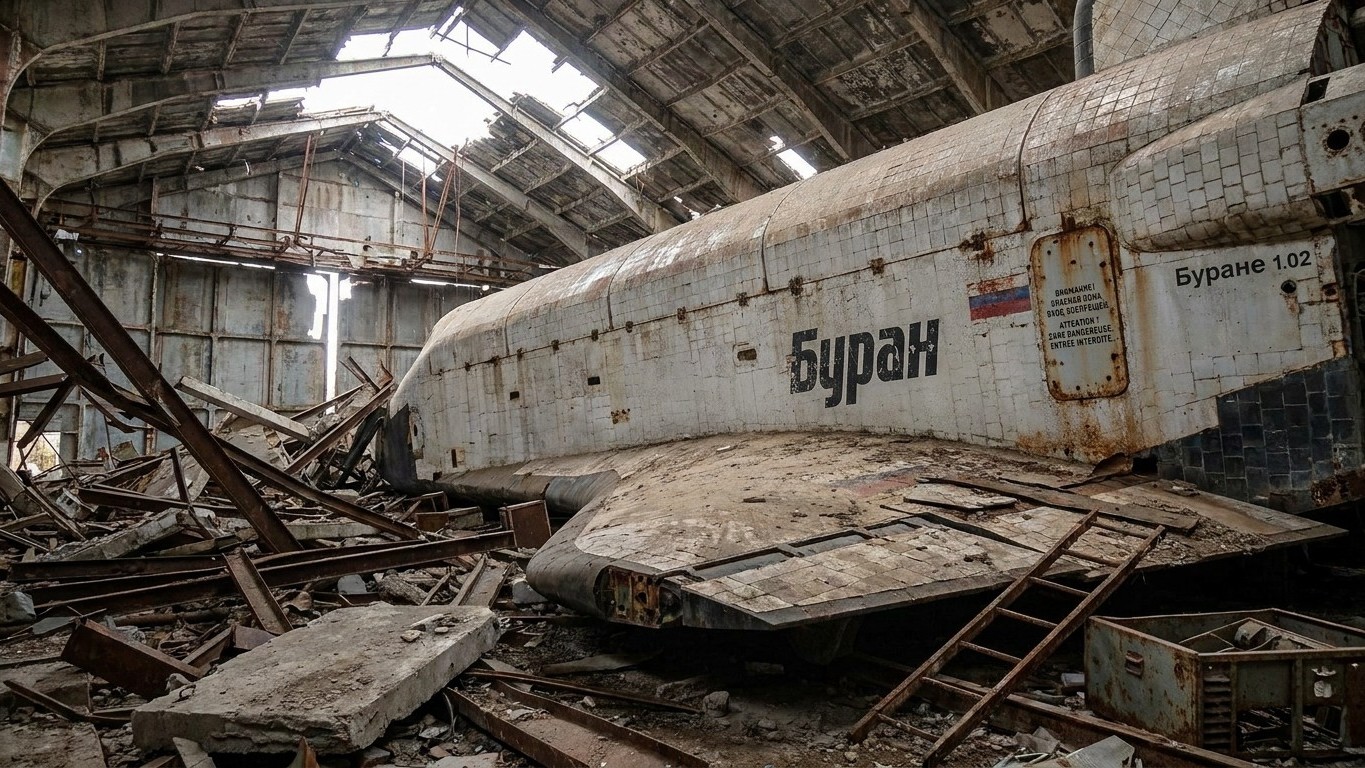
It weighs 105 tonnes, measures 35.4 meters in length, and has lain since May 12, 2002 beneath the ruins of a Baikonur hangar in Kazakhstan. This shuttle, named Bourane, flew only once in its life, on November 15, 1988. No one was aboard. And it is precisely here that the story tilts into the absurd: the most sophisticated machine ever devised by the Soviet space program was not destroyed by an explosion, a failed re-entry, or a Kremlin decision. It was crushed by a water leak.
Key takeaways
- A Soviet shuttle orbited solo in space, unmanned—a world first that has never been surpassed
- After fourteen years of neglect, a banal event sealed the fate of this technological masterpiece
- The craft that survived a reentry at 25 times the speed of sound did not withstand a simple puddle of water
An unmanned flight, a world first
On November 15, 1988 at 03:00 UTC (06:00 Moscow time), Bourane’s sole orbital launch takes place at 03:00 UTC from site 110/37 of the Baikonur Cosmodrome, propelled into orbit unmanned by the Energia rocket specially designed for it. No cosmonaut aboard, no life-support system installed: everything rests on the onboard electronics. A feat that the American shuttle could not claim, since it always required human crew to land.
The first unmanned flight was brief: two orbits, i.e., 206 minutes of flight, inclined at 51.6 degrees around the Earth. The return to ground occurred amid a weather storm: despite a crosswind of 61.2 km/h, it touched down only 3 meters off to the side and 10 meters along from its target. A MiG-25 flew alongside to monitor the descent, but it was the machine, alone, that piloted the landing. A performance that, even today, remains unique in the history of manned astronautics by winged craft.
In terms of size, the Soviet orbiter was no toy: Bourane measured 35.4 m in length, 16.5 m in height, a wingspan of 24 m. The initial mass reached 105 t, the payload that could be placed into orbit 30 t, and the return payload 15 t. It was capable of carrying more cargo than its American counterpart, since Bourane did not carry its own main engines: the Energia rocket provided all propulsion at liftoff.
What the rain killed, on a Sunday in May
After this single flight, Bourane was tucked away in Building 112 at Baikonur, resting on a mock-up of its Energia launcher. The program, however, was already flagging: no more flights planned, no budget, dwindling political interest. For fourteen years, the shuttle waited in the shadows. Then came May 12, 2002.
That day, at Baikonur, a region long reputed to be arid, heavy rain fell across Kazakhstan. The roof, saturated with water, grew heavy. The cause lay in a construction detail hidden for years: the hangar roof was lined with insulating foam designed to withstand wide temperature variations. This foam behaved like a sponge, meant to insulate against cold and heat, never to absorb rain. The result was immediate: the hangar roof collapsed under the weight of the water, killing seven workers who were trying to reinforce the roof and prevent its collapse, and completely destroying the Bourane space shuttle with its Energia launcher.
Other sources report eight victims: on May 12, 2002, a rainy Sunday at Baikonur, the roof of a hangar collapsed and permanently crushed Bourane, killing eight workers who were trying to repair the roof. These men were not astronauts or renowned engineers. They climbed onto a fatigued roof, unaware that the structure above them would suddenly give way. Their deaths sealed, without speeches or official ceremony, the fate of the only Soviet spacecraft to have left the atmosphere. It was thus not a space accident, but a construction accident. Perhaps that is the true shock of this story: the machine that survived a re-entry at over 25 times the speed of sound could not withstand a simple puddle of water.
The survivors of a sacrificed program
The Bourane program was not halted by this accident; it had already stalled long before. Bourane was frozen in 1990, then officially abandoned in 1993, two years after the dissolution of the Soviet Union. The reason was purely budgetary: in 1993, Russian space officials announced the termination of the Bourane and Energia programs. Space spending in 1994 represented only 0.23% of Russia’s post-Soviet national budget.
Of the five orbital demonstrators planned, only one had flown and a second was nearly complete. Ptichka was almost finished when funding for the program was cut. Its chances of liftoff were estimated at 95% in early 1993. It was to dock with the Mir station, autopilot, of course, but that mission never occurred. After the 2002 accident, this orbiter was moved to another Baikonur building and remains, owned by Kazakhstan, abandoned in a hangar. Another relic of the program fared somewhat better: the OK-GLI aerodynamic testing vehicle, equipped with four aviation jets for its atmospheric flights, is today on display at the Technik Museum in Speyer, Germany, after a stopover in Australia and then Bahrain.
Thirty-eight years after its sole flight and twenty-four years after its destruction, Bourane remains an almost unique case in the history of space exploration: a technology that nailed its technical challenge on the first try, but faded not in space, not in the fires of the Cold War or a failed re-entry, but under the weight of a puddle of water that no one thought to drain.
Sources: lorientlejour.com | clubic.com
