
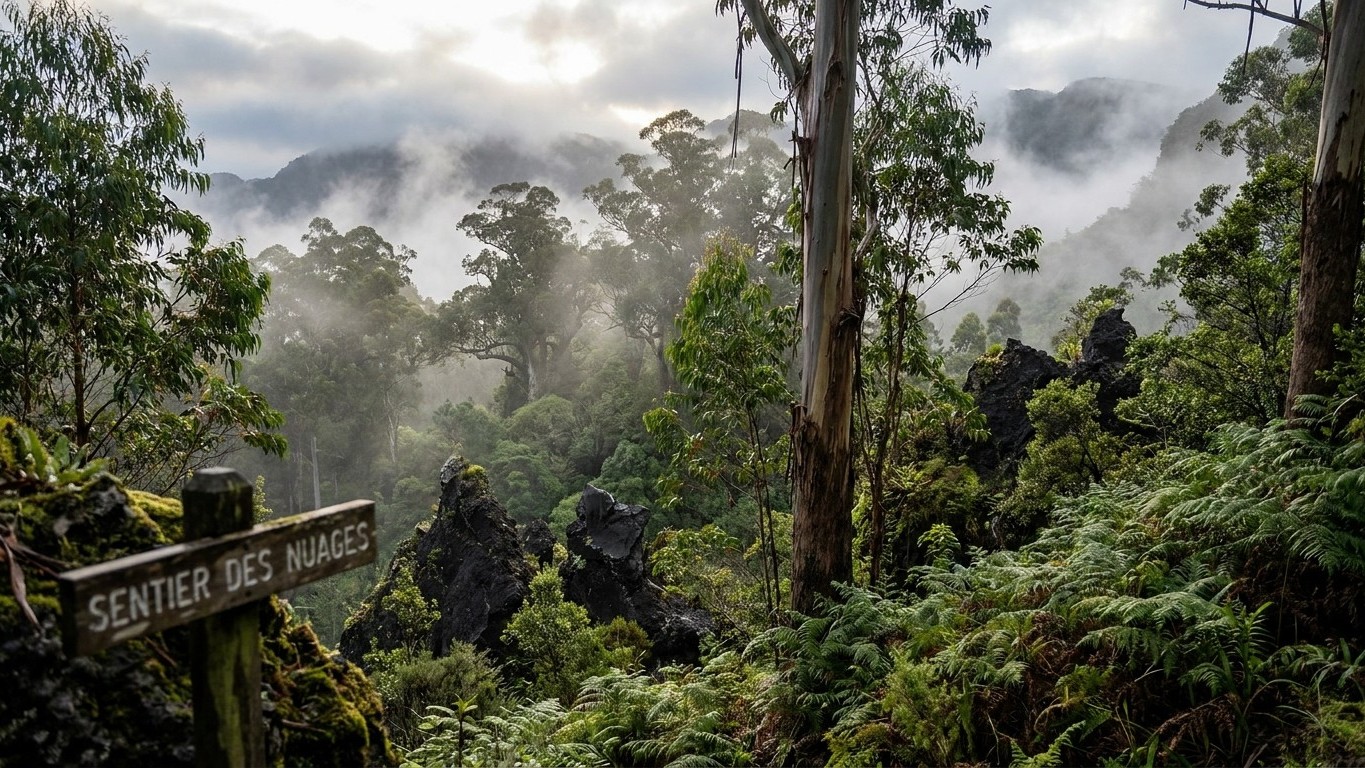
An arboreal-free volcanic island, arid and almost rainless: this was Charles Darwin’s impression when he first set foot on Ascension in 1836, that speck of basalt adrift in the South Atlantic. He noted the island was dry and bare, with sparse inner vegetation that fed only sheep, goats, rats, and a few cows—all non-native species brought by sailors. Today, the summit of the same island, dubbed Green Mountain, sinks under a cloud forest so dense that coffee and bananas are grown there. Between the two images lies a botanical experiment conducted from the greenhouses of Kew Gardens in London, one of the earliest well-documented cases of terraforming on Earth.
Key takeaways
- A sterile volcanic rock in the middle of the Atlantic becomes in a few decades a mountain cloaked in a cloud forest
- The bold experiment of a British botanist encouraged by Darwin transforms the local climate by drawing in marine moisture
- But the success hides a troubling secret: this “miracle” ecosystem threatens native species that science now seeks to save
The bold wager of a botanist encouraged by Darwin
Seven years after Darwin’s visit, another British naturalist arrived on the island: Joseph Hooker. Encouraged by Darwin, in 1847 he advised the Royal Navy, with the help of Kew Gardens, to launch a long-term plan to plant trees on Ascension, the idea being that the trees would yield more fresh water by capturing marine mist through condensation, ultimately removing the need to import drinkable water. It was also hoped that the soil would improve and become more productive.
The reasoning boiled down to a single sentence: trees would capture more rainfall, reduce evaporation, and create rich, loamy soils. A cinder, a pile of volcanic ash, transformed into a garden. The idea was not trivial for the era: a widespread belief, supported even by Darwin, held that any “unproductive” land within the British Empire should be transformed to feed its populations. Hooker thus did not merely invent a technique; he applied an imperial doctrine to the letter.
330 species, a decade of shipments from around the world
Hooker’s father was then in charge of the Royal Botanic Gardens at Kew. That family tie changed everything. For roughly a decade, Kew dispatched around 330 distinct plant species intended for establishment on Ascension Island. These plants had been carefully chosen to withstand the harsh conditions of this remote volcanic desert in the middle of the South Atlantic.
The Royal Navy ships did not merely depart from London. Each vessel carried a motley assortment of plants sourced from botanical gardens across Europe, South Africa, and Argentina. Norfolk pines for ship masts, banana plants, guavas, eucalyptus, bamboo: the list grew year by year, with little regard for ecological coherence. An ecosystem was assembled as one stacks crates on a dock, pulling from whatever could grow quickly and endure drought, regardless of geographic origin.
A rainfall that changes its rhythm, a summit that becomes damp
The results surpassed the two naturalists’ expectations. Before the terraforming began, it was said that few clouds passed over the island and that rain was rare; but once vegetation began to settle in during the planting decade, inhabitants noticed a climatic shift. A captain of the era even noted that it seldom went more than a day without a shower or mist on the mountain, according to archival records cited by the botanists who studied the phenomenon.
Two decades later, the bet appeared won. By 1850, the Royal Navy had brought dozens of species from Europe, Argentina, and South Africa; just twenty years on, Hooker and Darwin had proven correct, the plants having thrived, and they still flourish today. The island’s topography now reads like an improvised biogeography manual: near the coast, grasses, shrubs, and mesquites; higher up the slope, cacti and acacias enjoy increasing humidity; and above 600 meters, the island becomes a cloud forest shrouded in mist, made up of ferns, eucalyptus, bamboo, and evergreen trees, with crops like fruit trees, coffee, and ginger interspersed among the flora. The water-collection system installed by the military long ago became superfluous, as the island eventually produced its own humid microclimate, as chronicled in several scientific accounts of this transformation.
The downside of a botanical miracle
But this success comes at a price, and the payment is still being made today. Green Mountain’s ecosystem is far from natural: it is a patchwork of species from different continents that never coevolved yet have coexisted for a century and a half. An ecologist from John Moores University in Liverpool, who visited the island in 2003, recalled being struck by the improbable mix of plants that, under ordinary circumstances, should never share the same space in nature, according to remarks reported by the BBC.
The problem is that this artificial garden has proliferated at the expense of what originally existed. The rapid growth of the new species has displaced the island’s endemic plants. The ecosystem created by the British introductions has threatened several of Ascension’s remaining endemic species, so Green Mountain is now a national park where those species receive active conservation. Botanists have even recently rediscovered a local fern once thought extinct—the Ascension parsley fern—a signal that has shifted the gaze on this mountain: we speak not only of triumphant terraforming but also of saving a native flora crushed by its own remedy.
One lingering question remains for researchers: if an entire ecosystem can arise in a few decades from such a random assembly, what does it really teach us about the resilience of life? The British ecologist quoted earlier lamented that no team has seriously studied this open-air laboratory, even as NASA and several researchers view it as a potential model for greening other worlds someday, with Mars at the forefront.
Sources: mccarrison.com | nationalgeographic.com
