
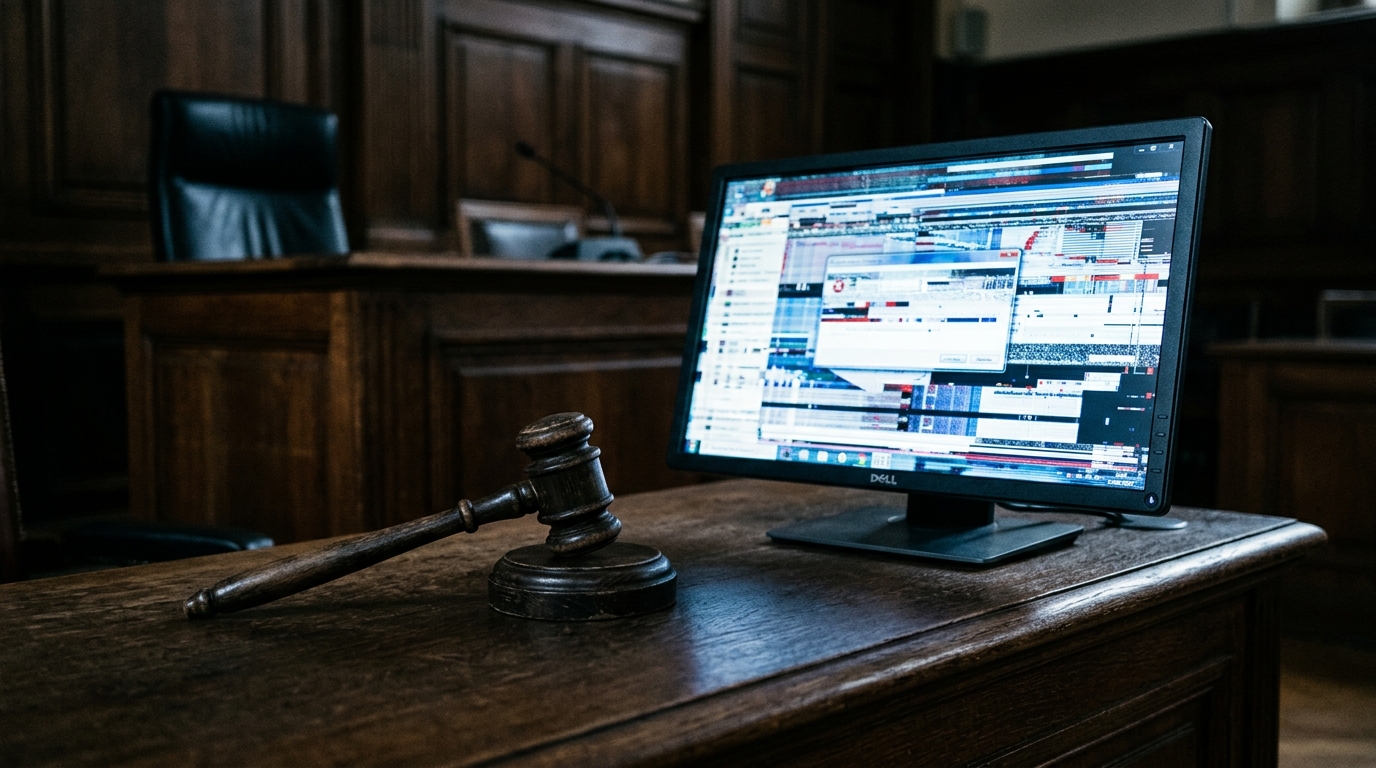
One might think that a single, even faulty, piece of software is merely a technical nuisance within a country’s day-to-day administration. A display error, a frozen screen, nothing particularly serious after all. Yet when this software handles the criminal cases of millions of people and costs taxpayers the equivalent of the annual budget of a mid-sized city, the matter deserves serious attention.
This is precisely the story of Cassiopée, this information technology tool intended to revolutionize the French court system and which, fifteen years after its launch, continues to unsettle judges and clerks with every update. In the summer of 2026, as the Lyhanna affair thrust the issue back into the media spotlight, it is time to understand how this project could swallow nearly 400 million euros while remaining, according to those who use it, one of the most capricious software programs in the French administration.
Cassiopée, the 400-million-euro software that was supposed to modernize justice
Back to the early 2000s. French justice is overwhelmed with paper files, procedures drag on, and the idea develops to create a single information system capable of tracking every criminal case, from the initial complaint to the final judgment. The project was launched in 2001, with the stated aim of radically simplifying the work of the courts. The initial budget? Barely 17 million euros. A figure that, in hindsight, almost invites a smile as it would be surpassed in the years to come.
After several years of testing in various pilot jurisdictions, the software was officially rolled out from April 2009 in the trials of the grande instance. Deployment accelerated gradually, and by May 2010, 115 courts were already equipped. On paper, the ambition was noble: centralize all criminal procedures, facilitate exchanges between jurisdictions, and finally provide a modern tool to an institution still largely dependent on paper and files. But in practice, the bill kept rising. According to a report from the Cour des comptes picked up by Le Canard enchaîné, the cost rose from 4.4 million euros in 2006 to 142 million euros in 2018. An article in L’Express went even further, estimating the total cost of the project at 385 million euros, an amount that, with the most recent developments, now exceeds 400 million.
Repeated outages that have paralyzed the courts for fifteen years
What stands out most in the Cassiopée story is not so much its astronomical cost as its ability to remain faulty year after year, regardless of the sums invested to fix it. In 2020, seven years after its initial development, the software was still not fully deployed across all the concerned jurisdictions. A delay that questions the very management of the project, as delays accumulate without any real sign that the underlying problems are truly resolved.
The apex of this tech saga is undoubtedly the lockdown period. According to an article in L’Express, justice was the only public service not operating normally during that exceptional time, apart from urgent criminal matters and immediate appearances. A paradox for an institution meant to guarantee the continuity of the rule of law, even in times of crisis. And this wasn’t the first alert: as early as 2017, the daily Libération already described Cassiopée’s daily use as problematic, pointing to repeated bugs that significantly increased the workload of clerks, already under pressure in most French jurisdictions.
Judges and clerks face a tool that has become their daily worst enemy
One must imagine the daily routine of those who operate this tool to grasp the scale of the problem. A union representative quoted by L’Express describes, in plain terms, the panic that sets in with every new software update. Some updates simply undo previous ones, while others block functions essential to handling cases. It’s a bit like, with each repair attempt, creating a new leak elsewhere in the system, never quite managing to seal the structure permanently.
This chronic instability carries a human cost that no financial report can truly quantify. Clerks, already understaffed in many jurisdictions, must cope with a tool that slows them down rather than helps. Judges, for their part, are sometimes forced to delay rulings or improvise with makeshift solutions to compensate for technical failures. In 2026, the Lyhanna affair brutally brought this reality back into the spotlight, with judges’ unions again criticizing the software’s erratic operation. According to franceinfo, these professionals today point to the obsolescence of a system designed in 2008 and the stark lack of human resources to operate it properly on a daily basis.
Fifteen years of quick fixes and still no durable solution in sight
In the face of this cascade of malfunctions, one might have hoped for a complete overhaul of the system. That is precisely the stated aim of the project Cassiopée 2, entrusted in 2025 for an additional 52 million euros. A detail bound to rile some: this new project was awarded to the Deloitte firm, already involved in the development of the initial project. A continuity that rightly raises questions about the actual ability of this new project to fix structural errors that are more than fifteen years old.
This dossier ultimately illustrates a problem far broader than a single faulty software. It raises questions about the governance of large public IT projects, often started with underestimated budgets and unrealistic deadlines, only to become financial sinkholes whose final bill far exceeds initial forecasts. How much longer will the French courts have to deal with a tool whose breakdowns now punctuate the country’s daily judiciary? The answer to this question will likely depend on the authorities’ ability to finally draw the real lessons from this costly experience.
