
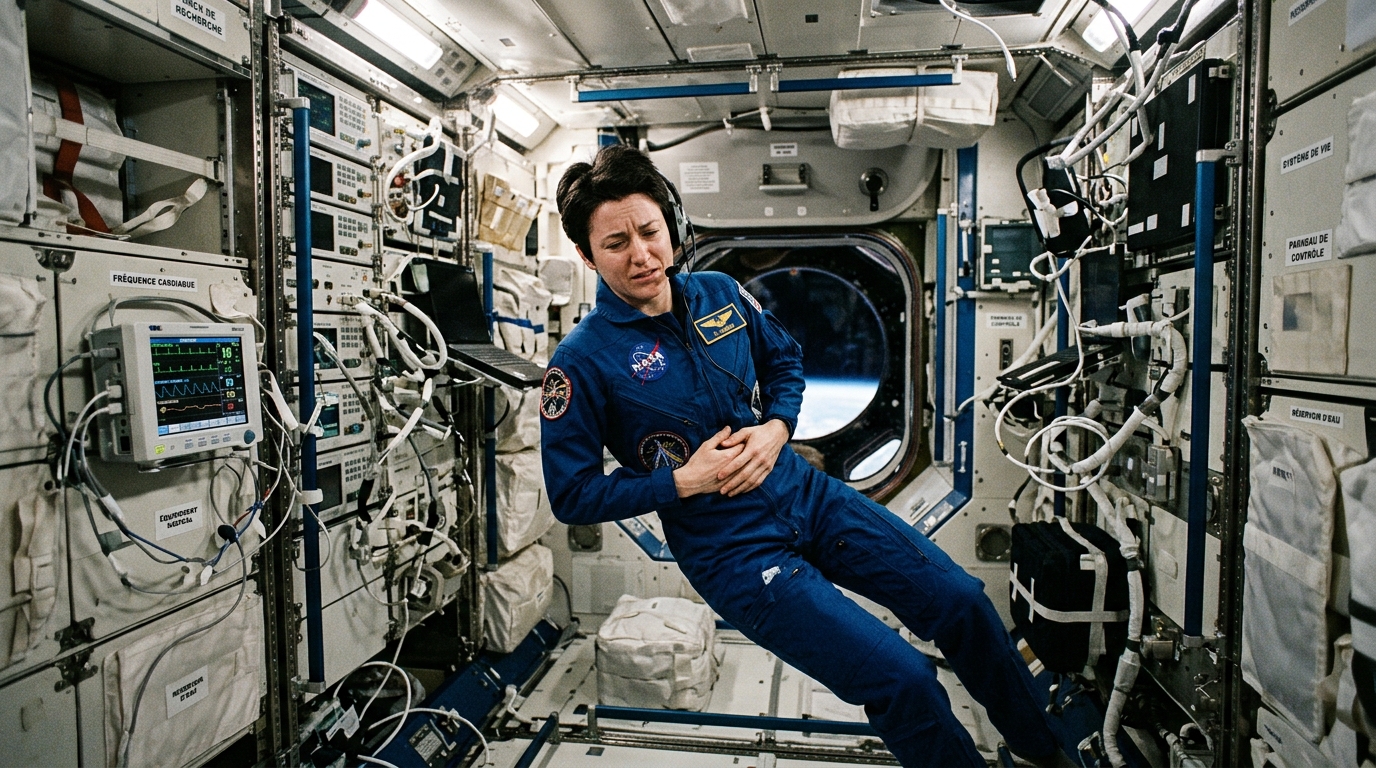
Imagine the scene: you float in orbit around Earth, surrounded by portholes offering a breathtaking view of our blue planet, and yet one of the most stubborn everyday concerns remains… going to the toilet as usual. This is neither a sensational anecdote nor a minor detail of space life: according to data gathered by NASA, six out of ten astronauts suffer marked intestinal troubles once in orbit. For a long time, this phenomenon was attributed to stress or environmental change. Today, a study supported by the American space agency, published in Nature Communications, finally provides a clear biological explanation for this ailment affecting almost all crews.
The figure that concerns NASA: six in ten astronauts affected
Constipation is not a mere temporary annoyance for International Space Station inhabitants. According to NASA observations, this digestive trouble appears from the first week of the mission and only disappears upon return to Earth. It is frequently accompanied by other equally uncomfortable symptoms: bloating, indigestion, and acid reflux. It is no accident that laxatives are routinely included in the medical kit aboard, including during recent missions like Artemis II. Faced with the scale of the phenomenon, researchers sought to understand what is really going on inside astronauts’ guts once they escape Earth’s gravity.
When gut bacteria change diet in weightlessness
To crack this mystery, more than 400 blood samples from 52 astronauts who spent more than two months aboard the ISS between 2006 and 2018 were analyzed in detail. This trove of data allowed the identification of 40 metabolites, those small molecules produced by our bodies that reveal what is really happening inside. The most significant among them all pointed to a single phenomenon: an increased bacterial fermentation of proteins in the intestine. In short, astronauts’ gut microbiota literally changes its dietary behavior once in orbit. On Earth, our intestinal bacteria primarily feed on complex carbohydrates, such as the fibers found in vegetables or cereals. But in weightlessness, they seem to turn away from that usual menu to focus on proteins, a metabolic shift that settles within the first weeks of flight and persists until return to the blue planet.
Gravity, less, transit more: the real culprit identified
The question remains as to why the bacteria change their behavior in this way. The most convincing lead concerns intestinal transit itself. Without gravity to assist the progression of food, the contents of the intestine move more slowly. This slowdown gives more time for fibers to be digested upstream, leaving less to nourish bacteria further along the digestive tract. The latter then turn to the available proteins, for lack of better options. This mechanism echoes a principle that NASA also explains in an accessible manner: digestion normally relies on peristalsis, those wave-like muscle contractions that push food forward regardless of gravity. But in microgravity, bodily fluids redistribute toward the upper body, the stomach literally floats, and the intestines, less compacted than usual, see their motility slow down. A simple change of position in space, in short, is enough to derail an entire biological chain.
A banal digestive disorder, a hidden risk for Mars missions
At first glance, constipation may seem a minor problem compared to the far more spectacular risks associated with space travel, such as radiation exposure or bone mass loss. Yet this chronic transit disorder could represent a hidden risk still largely underestimated for crew health. A prolonged imbalance of the gut microbiome is never benign: it can affect nutrient absorption, immunity, and overall well-being over time. Moreover, the next steps of space exploration are expected to be much longer than the six months typically spent aboard the ISS. A round trip to Mars could span several years, giving this digestive imbalance ample time to become entrenched, with consequences that are still difficult to measure precisely.
This finding now pushes researchers to factor in this hidden risk ahead of future long-duration missions to Mars and beyond. One thing is certain: as humanity prepares to venture farther into the solar system, it is sometimes the most subtle mechanisms of our biology, those rarely associated with space exploration, that prove decisive for the success of upcoming missions.
