
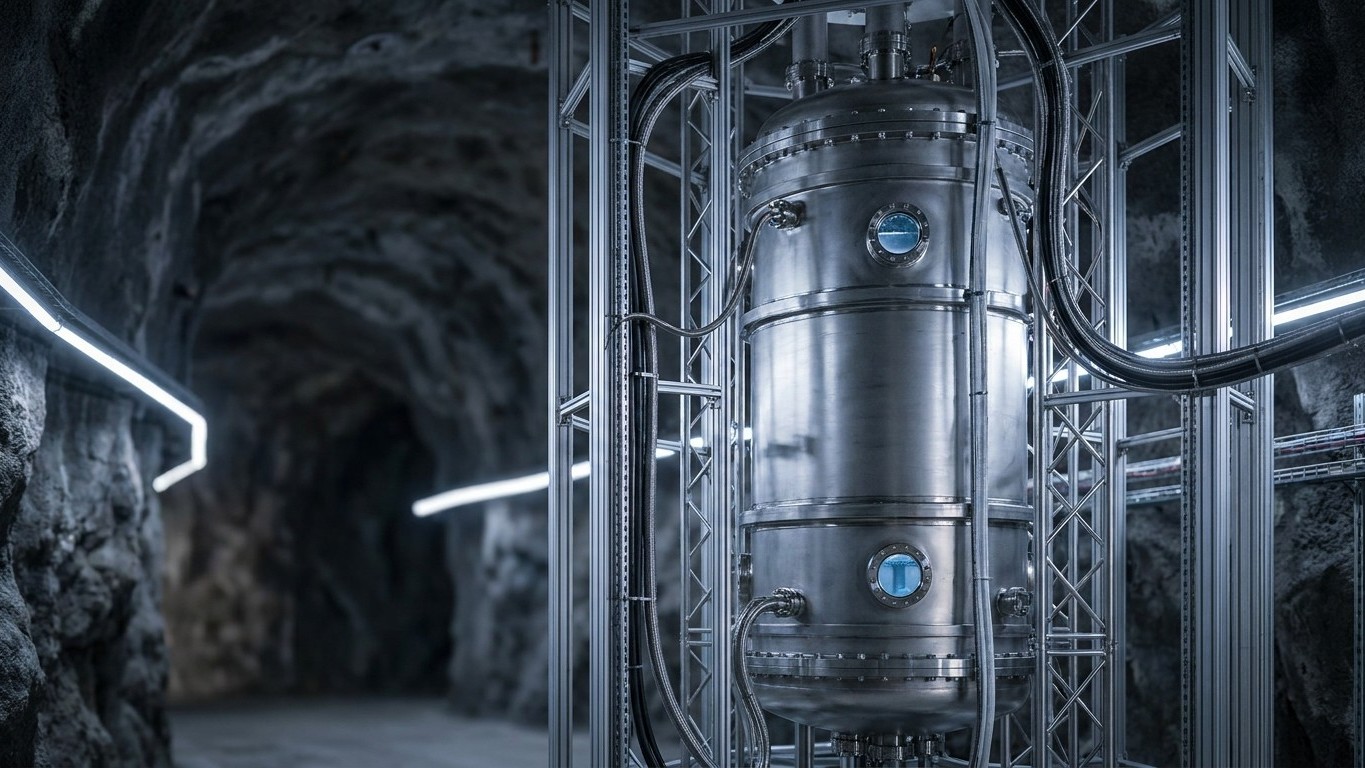
Two nested titanium vessels hold ten metric tons of liquid xenon, submerged in darkness since the LUX-ZEPLIN (LZ) detector officially finished construction on September 21, 2020. The experiment uses 10 metric tons of liquid xenon to hunt for interaction signals with theorized dark matter particles, the WIMPs. The site isn’t a brand-new laboratory built for the occasion: it is a former gold mine, transformed into a cathedral of particle physics.
Key takeaways
- Why drive a detector so deep underground to search for invisible particles?
- Does a century-old gold mine truly have what it takes to host cutting-edge physics?
- How can four years with no findings be considered a major scientific achievement?
Why descend so far underground
A dark matter detector does not hunt for a loud signal. It seeks the incredibly subtle: a hypothetical collision between an invisible particle and the nucleus of a xenon atom, akin, according to one of the project’s physicists, to digging almost five times deeper than anyone in the past to find a buried treasure, “something you don’t do with a million shovels, but by inventing a new tool.” The problem is that at the surface, billions of cosmic rays bombard every square centimeter of the planet continuously. These particles produce, by striking the atmosphere and rocks, a background din that would instantly drown the faint signal being sought.
The solution is almost brutally simple: stack rock above the detector. LZ is installed nearly a mile underground at the Sanford Underground Research Facility, and its depth provides natural shielding against the constant shower of cosmic rays at the surface. Concretely, at the level termed “4850 feet” by miners (4,850 feet, about 1,478 meters), physicists directly measured the residual muon flux, those cosmic particles the most penetrating. The total flux measured is (5.31 ± 0.17) × 10⁻⁹ muons per second per square centimeter, versus about one muon per second per square centimeter at the surface. At this depth, the site is a million times quieter than at the surface.
To compare sites situated in different rock types, physicists convert the real depth into “meters water equivalent” (m.w.e.), a unit that neutralizes density differences between rocks. At Homestake, the 4850 level thus corresponds to about 4.4 kilometers of water equivalent. In other words, you would have to submerge the experiment under 4,400 meters of fresh water to obtain the same level of protection against cosmic radiation that this thick dark rock in South Dakota naturally affords.
A century‑old gold mine recycled into a laboratory
Before hosting dark matter detectors, this hole in the Earth served a very different purpose: extracting precious metal. Until its closure in 2001, Homestake was North America’s largest and deepest gold mine, employing thousands and producing roughly 41 million ounces of gold and 9 million ounces of silver over 125 years of operation. The mine closed for purely economic reasons: gold was no longer profitable to mine at that depth.
It was precisely this depth that saved the site from oblivion. The site’s scientific story began with Ray Davis Jr.’s solar-neutrino experiment, built in the mid-1960s at the bottom of the Homestake gold mine, where a reservoir of 100,000 gallons filled with perchloroethylene was used to capture neutrinos from the Sun. That experiment earned Davis the Nobel Prize in Physics. After the mine closed, the property was given to the State of South Dakota, before becoming officially the Sanford Underground Research Facility (SURF), thanks in part to a $70 million gift from philanthropist T. Denny Sanford. LZ now occupies the Davis Cavern, at the very spot where Davis’s experiment operated, followed by the LUX experiment that preceded it.
Seeking nothing, methodically
LZ began delivering its first scientific data in 2021. From its initial measurement campaign in 2021, LZ achieved the world’s highest sensitivity to galactic WIMPs, starting from only 6% of the total exposure planned. A result that found nothing, but which immediately placed the experiment at the forefront of global competition.
The subsequent campaign, presented in August 2024, marked another milestone. The new results from the world’s most sensitive dark matter detector set the best limits ever obtained on WIMPs, analyzing 280 days of data: a fresh 220 days collected between March 2023 and April 2024, combined with 60 days from the earlier campaign. Then, in December 2025, an even larger analysis was published. The LZ detector completed the largest dataset ever collected by a dark matter experiment, with 417 days of measurements between March 2023 and April 2025, finding no evidence of WIMPs between 3 and 9 GeV. This latest campaign even yielded an unexpected bonus: the experiment extended its search to WIMP masses roughly between three and nine times the proton’s mass, while inadvertently capturing traces of solar neutrinos, a phenomenon researchers did not expect to see with this type of detector.
Not finding anything isn’t a failure here; it’s the method itself. Each run without a detection eliminates whole swaths of theories about the nature of dark matter, tightening the squeeze around the remaining hypotheses. The experiment continues to accumulate data and plans to collect 1,000 days of data before stopping in 2028, more than doubling the current exposure. By then, ten tonnes of xenon will keep waiting in the darkness and relative silence of an old gold mine for the improbable collision that could change everything.
Sources: llnl.gov | leadmethere.org
