
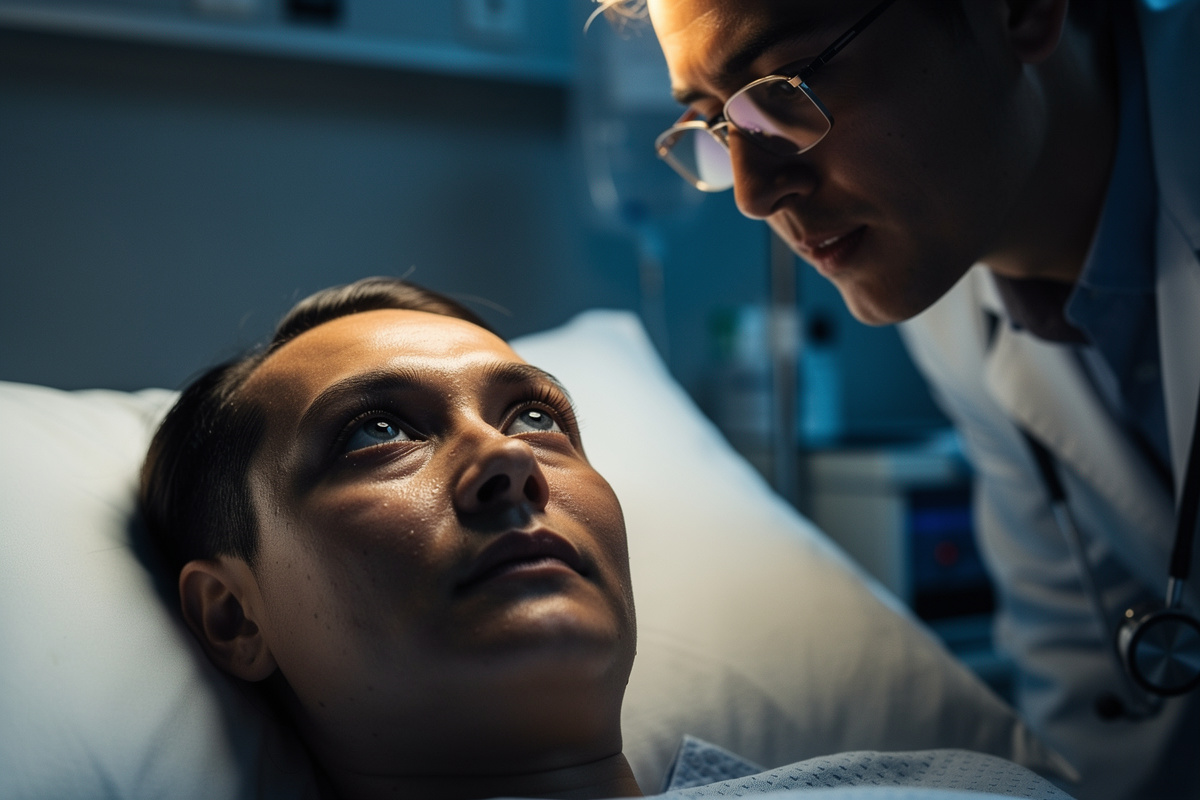
We often, perhaps a little too quickly, believe that the experiences reported by some patients who are revived after a cardiac arrest can be explained simply by a lack of oxygen to the brain or by the lingering effects of sedatives administered during intensive care. It is the spontaneous explanation that comes to mind, the one that reassures because it places the mystery into a familiar box of physiology. Yet this explanation, however appealing, does not hold up against data collected over more than a decade in ten Dutch hospitals. Doctors questioned survivors of cardiac arrest just after they woke, and what they collected resembles a scientific riddle more than a mere aftereffect of resuscitation.
344 patients, a single verdict impossible to explain
The scale of this study is striking first and foremost for its size: 344 consecutive cardiac arrest patients, all successfully resuscitated, were followed and interviewed across ten Dutch hospitals. Each person entering this protocol was met soon after regaining consciousness, before the account could fade or be reconstructed in memory. This methodological choice changes everything: unlike testimonies gathered years later, here researchers worked with fresh, raw data—nearly in real time relative to the event.
The ultimate finding can be summed up in one sentence that may startle: despite the breadth of the sample and the rigor of the follow-up, no simple, unambiguous explanation could be found to account for the most troubling narratives. Neither the medical profile, nor the treatments, nor even the patients’ psychology could predict which of the 344 survivors would return with a particular memory of this interlude of unconsciousness.
Ten hospitals, a strict protocol: how a Dutch researcher hunted down the inexplicable
This prospective study, begun in the Netherlands in 1988 and later published in the prestigious journal The Lancet in December 2001, was led by the cardiologist Pim van Lommel. At the time, no research of this scale had ever been conducted anywhere in the world on near-death experiences, or NDEs. The medical community largely possessed isolated accounts, collected after the fact, without a robust scientific framework allowing comparisons among patients.
The strength of the protocol rested on a detail often neglected elsewhere: the creation of a control group. It wasn’t merely about listening to those who reported something; it was about comparing their profile with that of patients who had endured the same cardiac arrest but did not retain any memory of the period of apparent unconsciousness. This systematic comparison across demographic, medical, pharmacological, and psychological data helped rule out biases that could distort interpretation. Later, a landmark trial known as AWARE adopted this same logic by exploring consciousness during resuscitation, confirming the scientific interest in a field that had long remained on the margins of medical study.
18% remember, 12% recount the indescribable
Of the 344 patients tracked, 62 of them, or 18%, reported an NDE during the interview conducted after their awakening. This figure is noteworthy in itself: roughly one in five survivors retains a conscious memory of a period when, clinically, the heart had stopped beating and the brain should have been deprived of the activity necessary for perception. But the most striking detail lies in a smaller subgroup: 41 patients, or 12% of the total, described what the researchers termed a “core” experience—a complete, structured narrative with the most characteristic elements of this kind of event.
What raises questions is not the existence of these accounts but their apparently illogical distribution. Two patients who endured a similar arrest, were resuscitated with comparable procedures and medications, could end up in completely opposite groups: one remembers nothing, the other recounts a vivid, coherent experience. This lack of predictability is precisely what pushed the researchers to search deeper for hidden factors that might explain the difference.
No link with medications, arrest duration, or personality: a hypothesis collapses
Perhaps the most perplexing result of the entire endeavor is that the study did not show that any physiological, psychological, or pharmacological factors were responsible for these experiences. Neither the exact duration of the arrest, nor the type of drugs administered during resuscitation, nor the patients’ prior psychological profile could distinguish those who would report an NDE from those who would not remember anything. In other words, the most intuitive explanations that would spring to mind for a hurried reader proved insufficient to account for the phenomenon.
Subsequent work continuing this line of inquiry has since explored other possibilities, notably a potential correlation between the electrocardiographic tracing observed during the arrest and the occurrence of an NDE. However, this hypothesis remains identified as requiring larger-scale studies before confirmation or dismissal. For now, the mystery persists: something distinguishes the 62 who remember from the other 282, yet this something eludes the conventional tools of medicine.
Two years, eight years later: transformed lives that no one predicted
The protocol did not stop at the initial interview. The researchers implemented a longitudinal follow-up, returning to patients two years later and again eight years later to observe possible changes in their lives. The overall finding is nuanced: cardiac arrest survivors, as a group, do not report a broad upheaval of their existence after the episode. Most resume the trajectory of their daily lives without dramatic transformations.
But among those who had reported an NDE, something different emerges: changes of meaningful significance in certain specific aspects of their lives, without a complete, uniform upheaval. It is not a total life reversal, but rather a shift in priorities, a redefinition of values, eight years after an event that, in theory, should have left no conscious trace behind it.
Then remains the question, left unresolved since the Lancet publication: why does only a minority of survivors experience such an event, and why do those individuals appear to return changed? Neither medicine nor psychology currently has a definitive answer. Perhaps that is precisely what makes this riddle so captivating: it sits exactly at the boundary between what science can measure and what it has not yet managed to explain.
Source : van Lommel P., van Wees R., Meyers V., Elfferich I. — Near-death experience in survivors of cardiac arrest: a prospective study in the Netherlands.
