
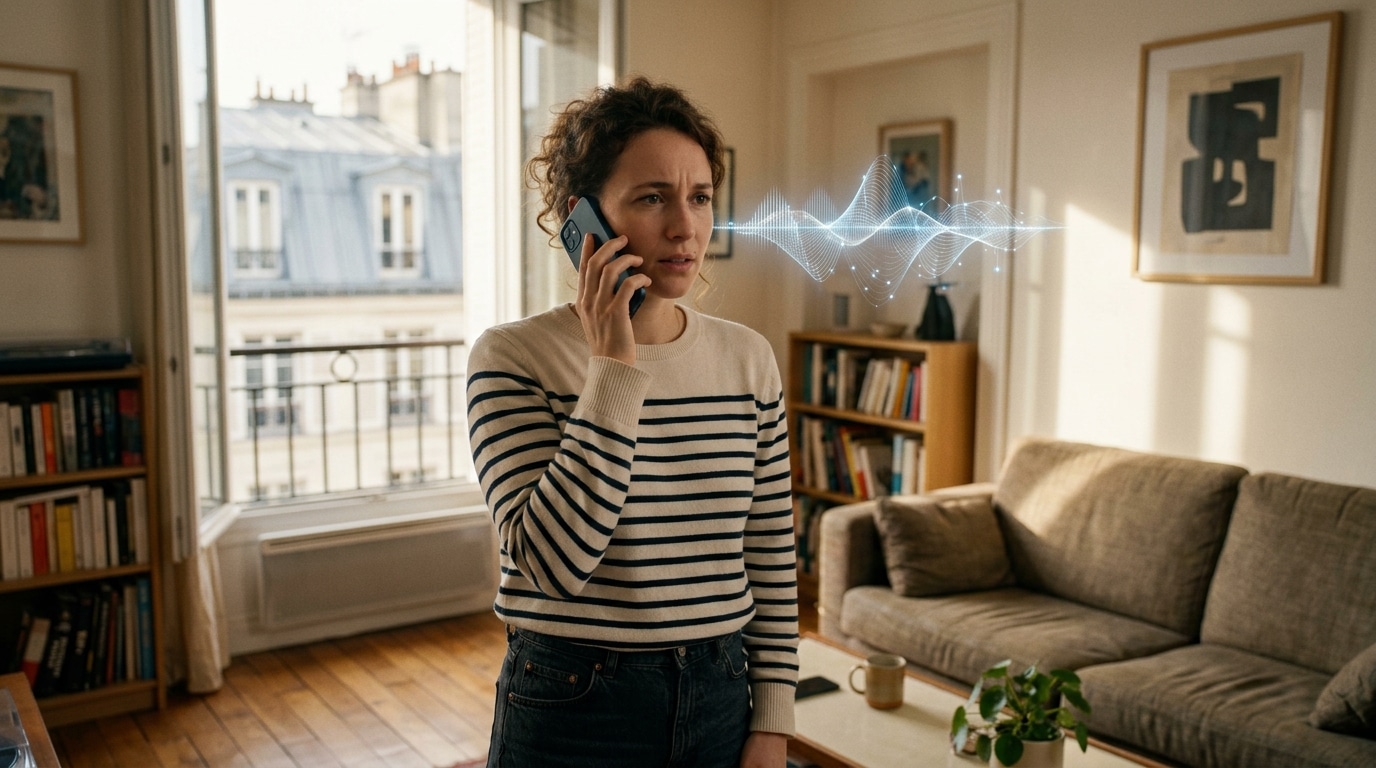
A simple voicemail left on an answering machine, a video shared among friends, a few words spoken during a business call: these are now all that some tools need to reconstruct a voice that is almost identical. What used to belong to cinematic fantasy, worthy of a spy movie where an agent fools a security system with a makeshift recording, has slipped quietly into our connected daily lives. The voice, which we believed to be as personal as a fingerprint, proves to be far more vulnerable than we imagined. And the worst part is that the amount of material required to copy it is ridiculously small. Understanding how this feat works is already a first step toward protecting yourself.
Three seconds of audio, and your voice no longer belongs to you
For a long time, people believed that mimicking a voice required lengthy recordings, hours in a studio, and software reserved for cinema professionals. Reality has radically changed. Today, a few seconds of speech are enough for a system to generate a striking replica of your timbre, your intonation, and even your small hesitations. Three seconds is the length of a banal sentence left on an answering machine or a video clip posted on a social network.
What makes this so dizzying is that this raw material is everywhere. A voice message sent to a loved one, a fleeting story, a wedding speech recorded on video: so many fragments that circulate freely. We have, unwittingly, become the providers of our own vocal signature. And once captured, it can be manipulated in ways that very few people still suspect.
How the machine learns to speak like you in real time
To grasp the mechanism, imagine a musician able to listen to a few notes of an unknown piece and immediately replay an entire concerto in the same style. Voice cloning systems operate on a similar principle. From a short sample, they extract the voice’s unique characteristics: pitch, texture, rhythm, the way they roll certain syllables or mark silences.
The real leap forward hinges on one word: real time. It’s no longer merely about pre-recording a fake message. Some tools now allow you to speak into a microphone and instantly output someone else’s voice, with barely perceptible delay. In other words, an individual can carry on a full conversation by borrowing your voice, answering questions, adapting to the tone of their interlocutor, improvising. This is precisely what makes falsification so frightening during a live phone call: the victim thinks they are conversing with someone alive and familiar, while everything is artificial.
From a fake call from your boss to the grandchild scam: the uses that worry us
Abuse scenarios unfold easily. The most well-known in France remains the fake relative scam, often called the “grandchild scam.” An elderly person receives a call: the voice, that of their grandchild, seems panicked, urgently requesting money to get out of trouble. Until now, these scams relied on gullibility and a somewhat wooden performance. With voice cloning, the illusion becomes nearly perfect.
The corporate world is not spared. Imagine receiving a call from your supervisor, whose voice you recognize without hesitation, asking you to make an urgent transfer or to disclose confidential information. This is sometimes referred to as CEO fraud, now boosted by these technologies. The same psychological levers remain: urgency, authority, trust. Except that the weapon, it has moved to a new level.
What you can do, right now, to avoid becoming a target
In the face of this threat, vigilance remains your best ally. A few simple habits can make all the difference:
- Be wary of any urgent request for money or sensitive information, even if the voice sounds familiar.
- Agree on a secret password with your loved ones to use if you doubt an unusual call.
- Call the person back on their usual number before acting, instead of staying on the line.
- Limit the public diffusion of your voicemails and videos where your voice is clearly audible.
- Ask a question that only the real interlocutor would know the answer to.
None of these measures is foolproof, but their accumulation seriously complicates the scammers’ task. The essential is to never let emotion override prudence, because that is precisely where these frauds operate.
The human voice, this intimate marker of our identity, is no longer the impenetrable barrier we once imagined. The same technologies that promise fascinating advances—from automatic dubbing to assistance for people who have lost their speech—also open the door to troubling misuses. A question remains that goes far beyond the technical: at a moment when a voice can be copied in a few seconds, how will we relearn to trust what we hear?
