
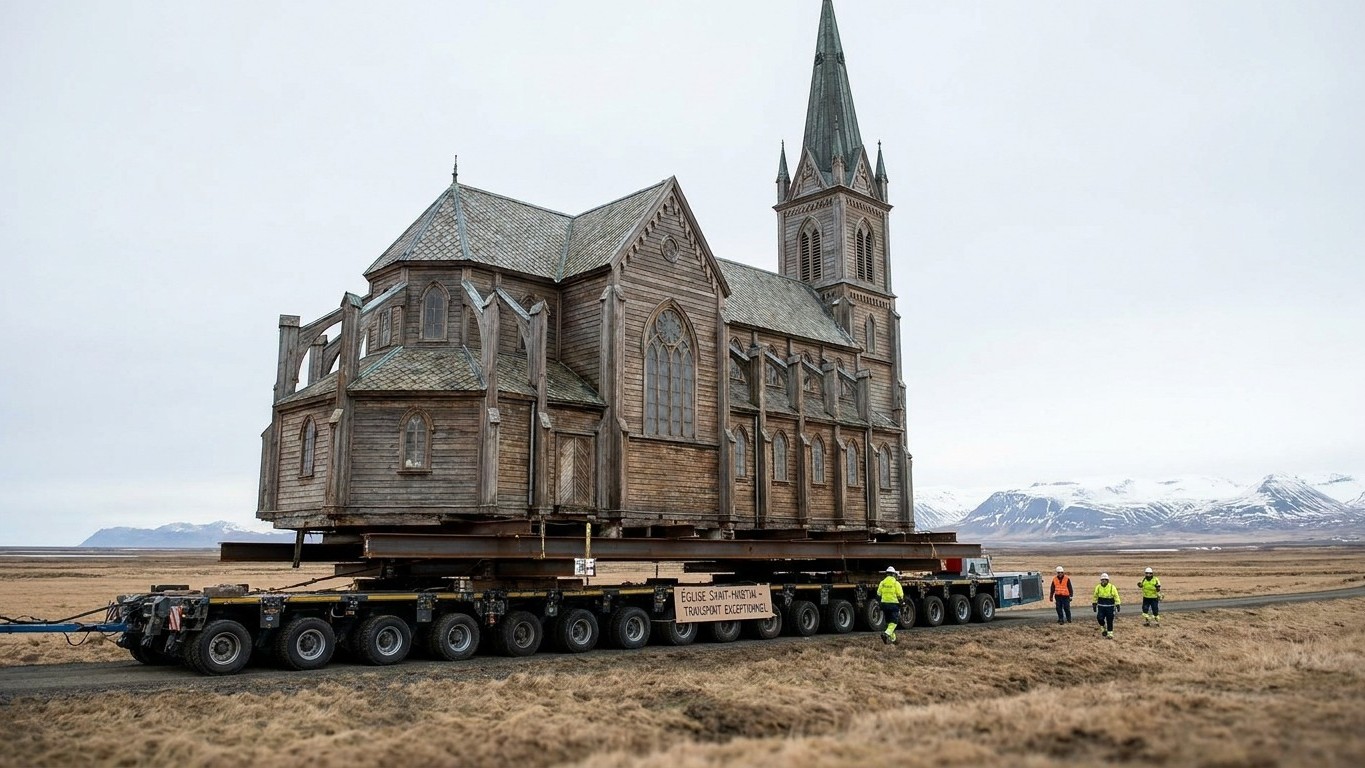
Five kilometers at less than one kilometer per hour, over two whole days: this is the speed at which Kiruna’s wooden church crossed its town, in August 2025, carried by a convoy of several hundred wheels. That day, it wasn’t just 672 tons of timber and neo-Gothic steeples that moved. It was the emblem of a unique urban relocation in the world: an entire town in Swedish Lapland forced to flee, meter by meter, from the mine that sustains it and which, digging ever deeper, makes it collapse upon itself.
Key takeaways
- An entire town relocated stone by stone to enable a mine to continue its operation
- Kiruna’s historic church traveled five kilometers in two days on a giant convoy
- A paradox: the mine that destroys the town is also the one that sustains it
A mine that devours the ground beneath the inhabitants’ feet
Kiruna, with about 18,000 residents in the urban center of a municipality that totals 22,454 as of June 30, 2025, owes its existence to a ore deposit. The state-owned mining group LKAB (Luossavaara-Kiirunavaara AB) has been extracting here for more than a century what is billed as the world’s largest underground iron ore mine. The problem is that this ore body does not stop neatly at the city’s edge: it runs straight beneath the historic center. And the deeper the galleries go, the more the ground gives way. As mining activities expanded with the aim of digging ever deeper, the company now extracts at a depth of 1,365 meters; the soil stability beneath Kiruna has weakened, increasing the risk of collapse in certain zones.
Cracks appeared in walls, sidewalks split, entire streets had to be closed. Swedish law is unequivocal on one point: mining cannot operate beneath inhabited areas. LKAB is not allowed to drill under occupied buildings. The only option left to continue exploitation without breaking the law was to empty the city’s subsoil—literally—by relocating residents and their buildings farther away.
Twenty years of preparation, a new city center rises from the ground
The project is no improvisation. The relocation of Kiruna’s city center, church included, has been in the works since 2004. Two decades of plans, geotechnical studies, and negotiations between the municipality and the mining operator preceded the first excavators actually starting to move buildings eastward. To reach a new depth of 1,365 meters, and prevent Kiruna from being swallowed, authorities began moving buildings toward a new city center, at a safe distance from the mine.
This new town did not stay as a mere mock-up. The new city center was officially inaugurated in September 2022, with its town hall, shops, and gleaming new housing, about three kilometers from the historic route. About twenty buildings have since followed the movement. Since then, around two dozen buildings have been relocated and a new downtown has been established, recently reported by the New York Times. Among them, Kiruna’s relocation, including 23 cultural monuments already moved, allows mining to continue while preserving the city’s architectural heritage. Some wooden houses were transported whole on trailers, others dismantled and rebuilt piece by piece, board by board, exactly as before. The project, however, is far from finished: local authorities say relocation operations began nearly twenty years ago and should continue at least until 2035.
The church that crossed the town in two days
The centerpiece of this extraordinary project is obviously Kiruna’s church relocation, completed in August 2025. Built between 1909 and 1912 by architect Gustaf Wickman and gifted to the town by LKAB in 1913, it is regularly cited among the country’s most beautiful buildings, blending Neo-Gothic influences with Sami inspirations, the indigenous people of the region. It was impossible to demolish it to rebuild elsewhere: it travelled intact, on a special convoy designed by Mammoet, at a speed of about 0.5 km/h, after interior consolidation and protection or removal of some elements, including the altar.
The operation, conducted on August 19 and 20, 2025, involved months of preparatory work. The church was raised 1.3 meters off the ground, placed on steel beams themselves laid on 56 lines of wheels, before beginning its five-kilometer journey to its new plot, between the new town center and the cemetery. The bill, entirely borne by the mining operator, is dizzying: 500 million Swedish crowns, about 45 million euros. A colossal sum for a single building, but pale in comparison to the mine’s economic stakes. Nearly ten thousand spectators lined the route, and Swedish television even broadcast the event live for several hours, in the pure Scandinavian slow TV tradition. Although it reached its destination, the church will not reopen to the public until late 2026 to finalize the connections and interior restoration.
Saving the town to keep destroying it
That is the paradox of Kiruna. This is not an urban planning project chosen by residents seeking a more pleasant living environment. It is an economic survival condition imposed by geology and by the interests of a mining operator that weighs heavily in Sweden’s economy. Without the mine, the town simply has no reason to exist: it was born from it in the early 20th century, and it still lives today off its direct and indirect jobs. The subsoil that threatens to swallow it is also the one that keeps it alive. So the town moves, patiently, building by building, so that the mine can continue to dig where its historic center stood just yesterday.
The stakes, moreover, appear to be growing. LKAB, which extracts iron ore at a depth of 1,365 meters, announced in 2023 that it had discovered Europe’s largest known deposit of rare earths, right beside Kiruna’s mine. Materials strategic for electric vehicle batteries and Europe’s industrial independence from China. This suggests that the ballet of Swedish buildings on trailers is far from over.
Sources: franceinfo.fr | infochretienne.com
