
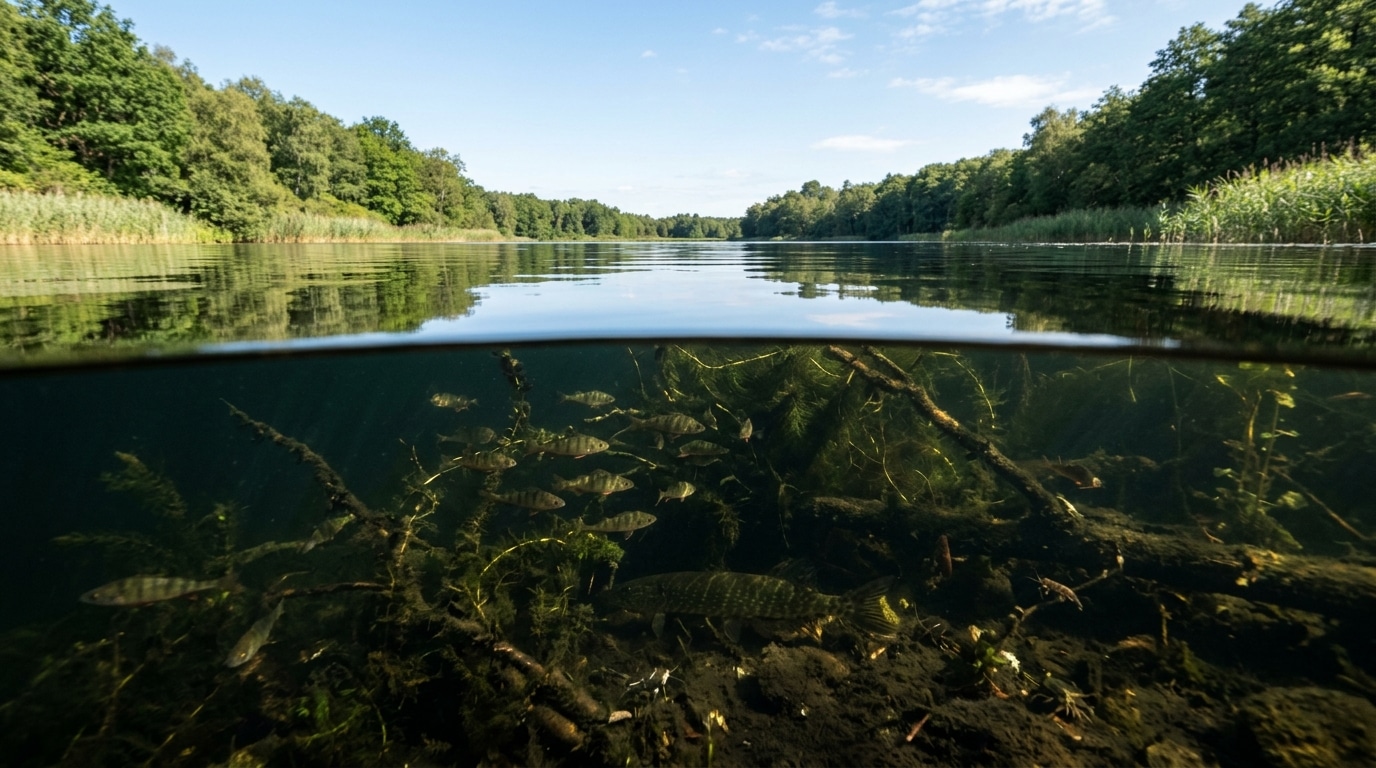
Imagine a mountain lake in the heart of summer. The surface gleams under the sun, a few boats drift serenely, swimmers savor the warm, reassuring water. Nothing seems to move, the air filled with absolute calm. And yet, beneath this apparent stillness, an invisible phenomenon is quietly preparing, lurking in the depths. Hidden from sight, several metres below the surface, the lake patiently stores enormous quantities of greenhouse gases. What looks like peaceful stillness is, in fact, only a fragile truce, a temporary lull before a true release. For in the heart of these waters a fascinating mechanism unfolds, intimately connected to climate and the seasons.
Under the calm surface, an invisible boundary separates two worlds
During the summer, most temperate-region lakes experience a phenomenon that is discreet yet crucial: thermal stratification. Under the sun’s influence, the surface layer heats up and becomes lighter, while the colder, denser water remains trapped deeper down. Between the two lies an invisible boundary, a kind of thermal ceiling known as the thermocline.
This separation acts like an airtight lid. The two worlds hardly mix: above, warm, oxygenated, living water; below, cold, dark water increasingly isolated. This partition, which can endure for many months, turns the lake bottom into a closed space where substances accumulate slowly, only to resurface one day. The longer the stratification lasts, the more pronounced the contrast between these two realms becomes.
At the bottom of the lake, carbon accumulates out of sight
In the depths cut off from the surface, a distinctive chemistry takes hold. Fallen leaves, algae, and all organic matter sinking to the bottom are gradually decomposed by bacteria. Decomposition, however, consumes oxygen. And because the thermocline prevents oxygen from replenishing from above, the deep layer, the hypolimnion, eventually becomes completely oxygen-deprived: it becomes anoxic.
It is under these conditions that the lake turns into a genuine gas reservoir. Without oxygen, the organic matter generates carbon dioxide (CO₂) and methane (CH₄), two potent greenhouse gases. They accumulate in the depths, dissolved in the cold water that traps them like an unopened soda bottle. The longer the stratification period, the more the reservoir grows. The productivity of surface waters, the duration of isolation, and the disappearance of oxygen together determine the magnitude of this invisible stock that swells all summer long.
When autumn overturns everything: the mixing that releases CO₂
The summer calm is only a pause. As temperatures fall with autumn, the surface water cools and becomes denser. The thermal boundary weakens, then gives way. This is the moment of turnover: the column of water mixes from top to bottom, often aided by wind and storms. The lid pops off, and everything sleeping in the depths rises abruptly to the surface.
That upheaval triggers a true burst of emissions. In a matter of days, the lake releases much of the CO₂ and methane it had patiently stored for months into the atmosphere. These turnover episodes, relatively brief and isolated, can concentrate the majority of a season’s gas releases. In other words, the greatest release does not come at the height of summer, when the water seems dormant; it occurs when the system flips. The tranquil appearance hid a pressurized reserve.
What these lakes reveal about tomorrow’s climate
This mechanism gains particular resonance in the era of climate disruption. Warming tends to strengthen and prolong thermal stratification: the lid forms earlier, lasts longer, and becomes more airtight. As a result, the oxygen-free layers extend, organic matter is degraded more extensively there, and the amount of CO₂ produced at depth increases. The reservoir fills up more than ever before.
And when the turnover finally arrives, often driven by more frequent storms, the release is even more massive. This cycle is evident not only in the deep lakes of temperate regions but also in tropical waters or shallow bodies where intermittent mixing triggers repeated bursts. On a planetary scale, countless lakes could see their emissions amplified, adding a new weight to the global carbon balance.
Thus, behind the postcard image of the tranquil lake lies a mechanism far more dynamic than one might imagine. By storing carbon throughout the summer to release it as the seasons change, these waters become surprising climate actors. The next time you gaze at the lake’s quiet surface, perhaps you’ll think of all that is quietly preparing itself in the depths. And perhaps these discreet giants deserve our full attention?
