
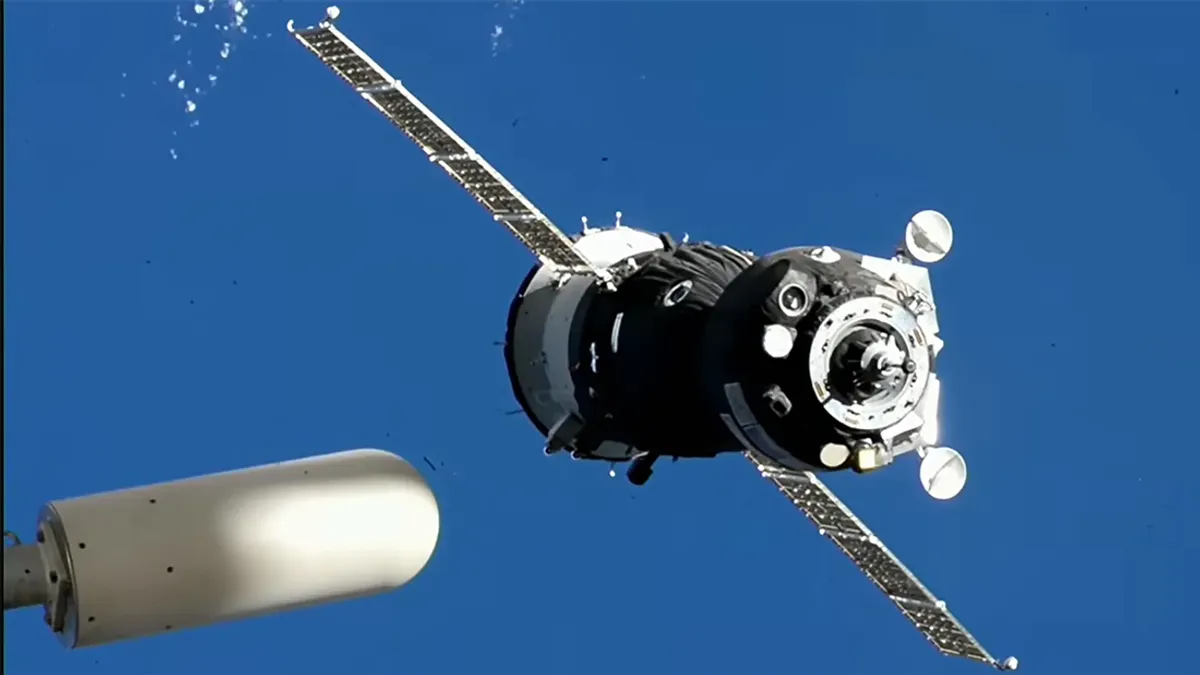
In 1975, as the world celebrated the historic handshake between the Apollo and Soyuz crews, a military secret lingered in the shadows of the void. A few months earlier, the Soviet Union had covertly tested a war weapon aboard its Saliout 3 station. This little-known chapter of the Cold War reveals a desperate, technically intricate attempt to militarize Earth’s orbit, marking, to date, the only time a cannon fired in space.
An Orbital Bomber Cannon
In January 1975, after the departure of the Saliout 3 crew, Soviet controllers initiated a test firing. The weapon employed was a 23-millimeter aircraft cannon, normally used by the Tupolev Tu-22 Blinder bomber.
Rather than aiming to shoot down enemy satellites—far too swift and distant—the Soviets fixed their concern on a more terrestrial danger: boarding. In the paranoia that defined the Cold War era, the station was designed to defend against any attempt at capture or forced inspection by hostile forces, effectively converting the scientific outpost into an armed orbital bunker.
The Space Physics Dead End
Integrating such a weapon into the vacuum of space posed clever, yet nearly absurd, challenges. Because the cannon was rigidly attached to the hull, the only way to aim at a target was to rotate the entire structure of the spacecraft, making each shot extremely slow and imprecise.
The second problem was mechanical: recoil. In space, every action triggers an equal and opposite reaction. When fired, the force released threatened to send Saliout 3 spinning out of control. Even with the station’s corrective thrusters firing in unison, the vessel experienced noticeable destabilization, underscoring the extreme difficulty of turning a spacecraft into an artillery platform.
A Relic of Soviet Paranoia
With hindsight, this test stands out as a major tactical failure. The weapon was unusable with an on-board crew, unable to target real threats, and devoid of any deterrent value since its existence was kept secret.
This cannon has never served beyond feeding the mythology of the “defensive” station. To this day, it remains the only witness to an active space-combat attempt. This dark interlude reminds us of the fragility of international cooperation, yet also highlights the technical absurdity of militarizing space, which, fortunately, never led to operational consequences.
