
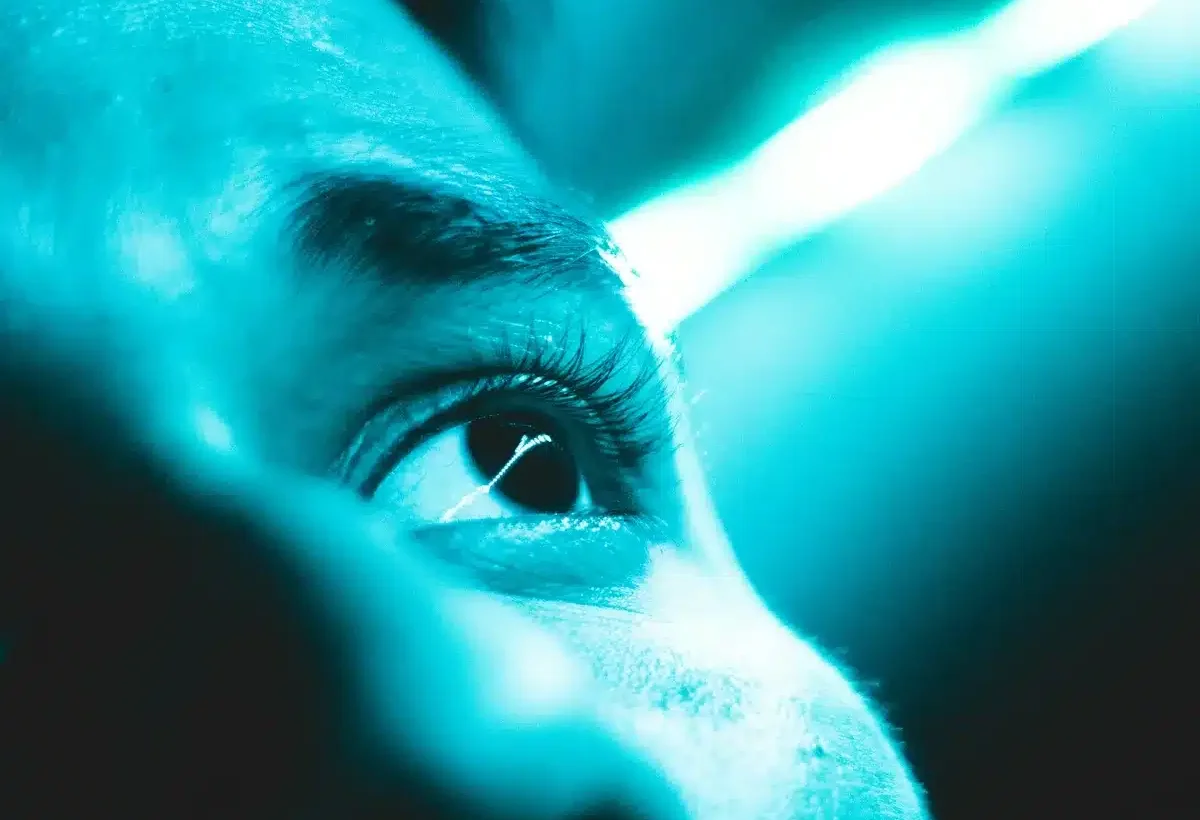
What if human beings have not yet seen all the colors that light can offer them? A team of researchers from the University of California, Berkeley has crossed an unsuspected sensory boundary: thanks to a revolutionary technology called Oz, five people were able to perceive a color entirely new to the human eye, never observed under natural conditions. They named it olo — a blue-green shade of unprecedented saturation, which some described as more intense than a laser.
A color beyond the human spectrum
Human vision relies on three types of photoreceptor cells called cones, distributed across the retina: S-cones (sensitive to short wavelengths — blue), M-cones (medium wavelengths — green) and L-cones (long wavelengths — red). These three sensor types combine their signals to form the full range of colors we can perceive. But under natural conditions, it’s impossible to activate a single cone type without stimulating the others, because their sensitivity spectra overlap widely.
That is what the researchers aimed to challenge. They asked themselves: what if we could target precisely one type of cone… what would we see?
The Oz project: a technological feat
The answer came from an experimental system as bold as it was intricate, named Oz — a nod to the famous green glasses of the Wizard of Oz, which distorted perception in the Emerald City. Oz uses an ultra-precise map of the retina, paired with microdoses of targeted laser light, to stimulate only one type of cone at a time, and nothing else.
To do this, the researchers first captured detailed videos of each participant’s retina, then employed an advanced imaging technique called adaptive optics optical coherence tomography (AO-OCT). With it, they could pinpoint the exact locations of the L-, M- and S-cones on the retina — a unique arrangement for each individual.
Once this mapping was established, Oz delivered ultra-localized light pulses targeting only the M-cones, keeping the others in the dark. The result: the emergence of a completely new visual experience. An unknown color, indescribable by our usual words.
Welcome, olo
They named it olo — a nod to its coordinates in a three-dimensional color space: (0,1,0), where only the M-cones are activated. The name also reflects its strangeness, its otherworldly beauty.
According to participants’ accounts, olo sits somewhere between blue and green, but with an intensity that feels almost unreal. “Imagine the light from a green laser pointer… then increase the saturation to the point that the laser seems dull in comparison,” explained James Fong, a co-author of the study and a computer science PhD student at UC Berkeley.
What makes olo so remarkable isn’t merely its color — it’s that it did not exist in any known human perception before this experiment. It is not derived from mixing wavelengths, but from targeted hacking of the neural code that enables the brain to interpret light.
A window into tetrachromacy, and beyond
This feat, reported in Science Advances, opens a suite of fascinating possibilities. First, it could revolutionize our understanding of vision: by simulating or bypassing the natural limits of our visual system, researchers can explore unknown territories of perception. The ultimate goal? “A programmable control of every photoreceptor in the retina,” the authors say.
Oz could also serve as a simulator for color blindness, or even better: enable certain people to discover a new dimension of colors, by compensating for the absence or dysfunction of some cones. In the longer term, the technology could also be used to study or reproduce tetrachromacy — that rare ability, found in some women, to perceive a fourth range of colors thanks to a fourth type of cone.
Limitations and future
Currently, the experiment remains highly experimental: participants had to fixate on a slightly off-center point so that the laser would reach the correct retinal area — at the center, the cones are too small to target with precision. Moreover, only a small portion of the retina has been mapped.
Expanding this mapping, and enabling the user to move their eyes freely, represents a major technical challenge that the team is now trying to tackle.
As for the idea of someday seeing olo on our phone or TV screens? “Highly unlikely,” says James Fong. The system currently relies on a high-precision laser optics setup, far beyond the capabilities of consumer devices.
But that does not detract from the significance of the achievement: researchers have shown that our perceptual limits are not fixed. And with a bit of ingenuity, even our most fundamental senses can be surpassed.
