
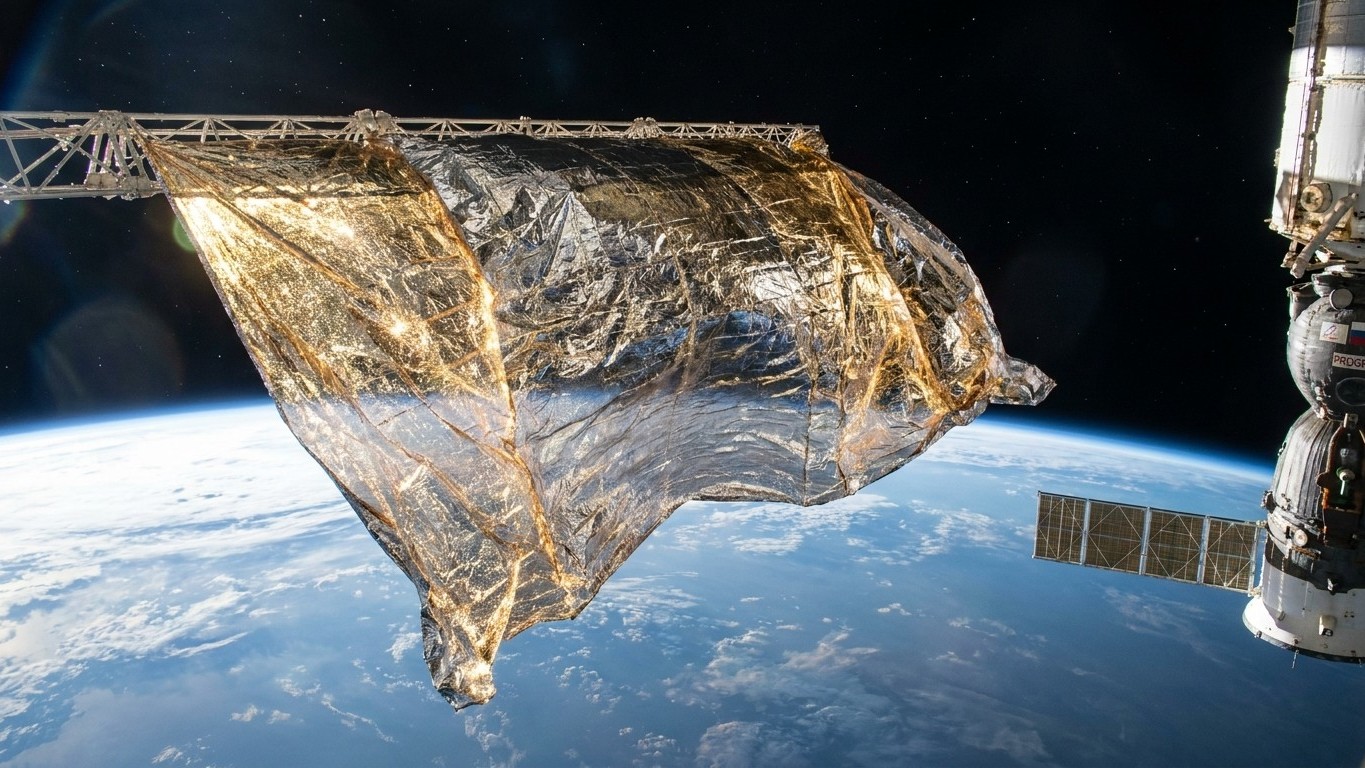
One February night in 1993, a bright point streaked across the European sky at eight kilometers per second. It was neither a meteor nor a spy satellite, but the Sun’s reflection reflected by a 20-meter-diameter mirror deployed from a Russian spacecraft undocked from the Mir space station. The experiment was called Znamya 2, and it would remain the only successful demonstration of a project as ambitious as it was ultimately abandoned: to illuminate the Earth artificially from orbit.
Key takeaways
- A legendary Soviet engineer imagines the unthinkable: lighting the Earth from space with a giant mirror
- The first attempt succeeds, but hardly anyone sees it due to clouds
- The second mirror catastrophically fails just before it could shine, destroying six years of work in a few seconds
An engineer from the Apollo–Soyuz program behind the project
The man behind this idea was Vladimir Syromyatnikov, a respected figure in Soviet astronautics. Named Znamya, which means “banner of victory” in Russian, this mirror was designed by Vladimir Syromyatnikov, one of the country’s most prominent aerospace engineers, affectionately nicknamed the “Big Cheese,” who had become famous for developing the docking system of the historic Apollo–Soyuz mission in 1975. The concept wasn’t born to illuminate anything in particular: the project had initially been conceived as a solar sail, before Syromyatnikov redirected the proposed hardware toward a use as a space mirror.
The ambition extended far beyond a laboratory experiment. Behind Znamya lay a broader plan for a whole constellation: ultimately, the program envisaged a series of satellites placed on sun-synchronous orbits, each carrying 200-meter mirrors capable of illuminating an area of several tens of square kilometers with a brightness close to one hundred times that of the full Moon. A late-Soviet engineer’s dream, intended to save electricity in polar regions or extend the daylight hours for agricultural work in Siberia.
February 4, 1993: the night Europe saw a second Moon pass
The device rode aboard the Progress M-15 cargo spacecraft, launched from Baikonur in October 1992 to supply Mir. Three months later, with its logistical mission complete, the vessel detached from the station and moved about 150 meters away before starting to rotate. This rotation was essential: the mirror, a simple Mylar sheet with no rigid frame, could only deploy under the influence of centrifugal force. The craft began to spin to permit the deployment, by centrifugal force, of the reflector that had been fixed in a folded position near the docking port.
The bet paid off. In the early hours, just before sunrise, a softly illuminated bright patch about 5 kilometers in diameter crossed the Earth’s surface at eight kilometers per second, starting from the south of France, crossing Switzerland, Germany, the Czech Republic, Poland, and then fading into the dawn light in Belarus. The brightness of this patch rivaled that of the full Moon—a fleeting but real glow projected by a mirror as large as a six-story building. The snag? The weather did not cooperate. Unfortunately, the sky was overcast that day, and there were few ground witnesses. A technical feat celebrated by engineers, yet almost invisible to the general public it was meant to dazzle.
Six years later, the dream unravels on an antenna
Buoyed by that partial success, the program aimed higher. Znamya 2.5, launched in October 1998 aboard Progress M-40, carried a reflector 25 meters in diameter, with a clear objective: to produce a bright spot seven kilometers in diameter, with brightness between five and ten full Moons. The rendezvous was set for February 4, 1999, almost six years to the day after Znamya 2’s triumph.
But the mechanism jammed right at deployment. Shortly after the unfoldment, the mirror snagged on an antenna of the Progress and tore itself apart. After several futile attempts by Russian mission control to free the mirror from the antenna, Znamya 2.5 was deorbited and burned up on re-entry. A membrane only a few microns thick, unable to withstand even a minor snag, had just ruined six years of preparation in a matter of minutes. The mood in Moscow that evening was far from celebratory. A mission-control official, cited by the British press at the time, reportedly summed up the situation with a rueful line: “We forgot the old rule of Russian space programs: do something first and boast about it only afterward.”
The failure sounded the death knell for the program. The project, which consisted only of these two experiments (Znamya 2 successful and Znamya 2.5 failed), plus a Znamya 3 never built, was abandoned by the Russian Federal Space Agency after this deployment fiasco. That third mirror was supposed to mark an impressive scale jump, with a diameter reportedly between 60 and 70 meters according to some sources. It never moved beyond the drawing board.
A Soviet dream resurfaces in the private sector
It’s hard not to read this as a broader lesson in space engineering: the difference between a prototype that works once in calm conditions and an industrial system capable of withstanding the unexpected. A misstep of a few centimeters was enough to turn six years of hopeful effort into debris that burned up in the atmosphere in a matter of hours. Yet the concept never truly died: carried by private players in the New Space era, the idea of orbital mirrors to redirect sunlight toward targeted areas on Earth has resurfaced in recent years, in a form that is technologically far more sophisticated than the simple six-meter Mylar sheet tested above Europe on that February night in 1993.
Sources: msn.com | lanature.ca
