
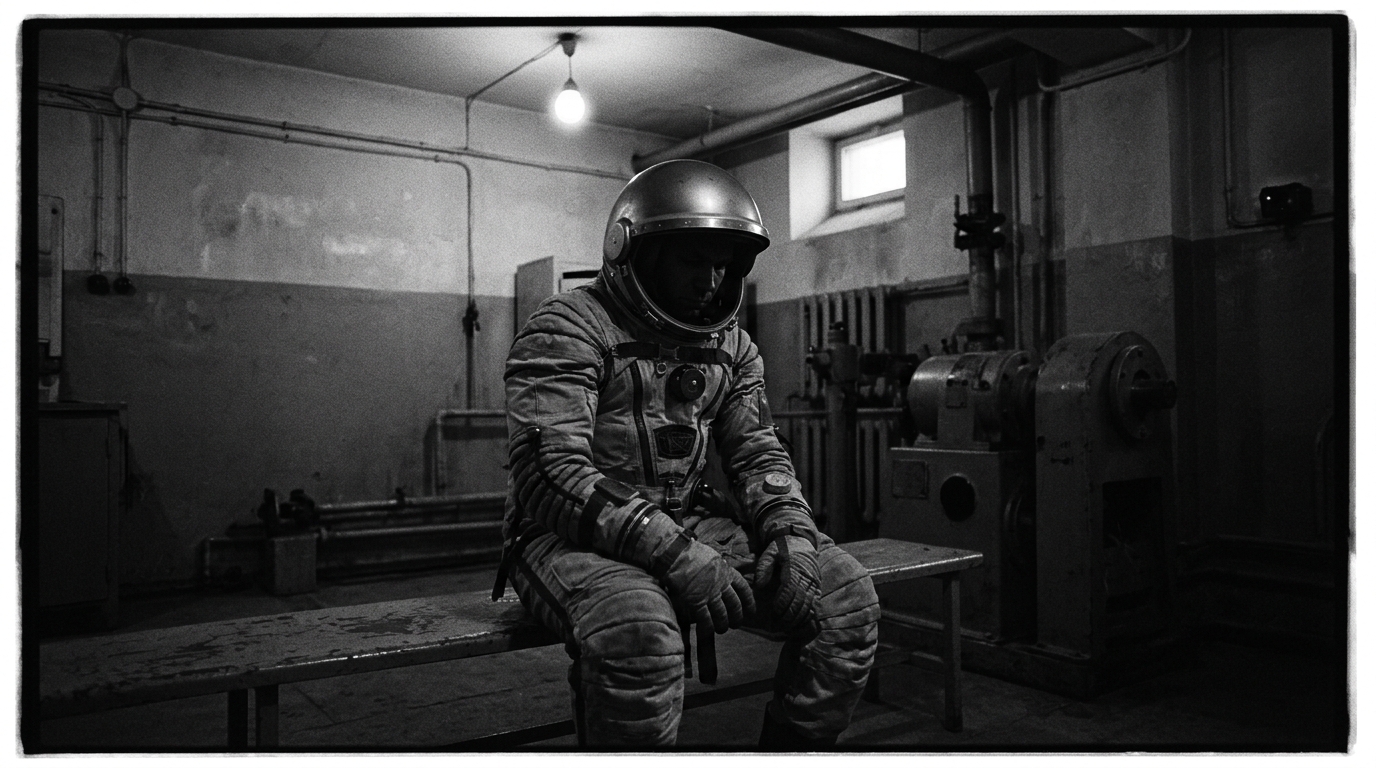
Imagine a sealed chamber where merely scratching a match would be akin to handling dynamite. It is precisely in such an environment that the Soviet space program experienced its first human tragedy, a disaster so embarrassing for the regime that it chose to bury it rather than own up to it. While the world celebrated Yuri Gagarin’s feats and lauded the USSR’s technical superiority, a 24-year-old man was fading away in total anonymity, the victim of an absurd and preventable accident. His story, sealed in the Kremlin archives for a quarter of a century, reveals a far less glorious facet of the space race, that of human sacrifices hushed up in the name of propaganda.
A Fatal Accident Erased from Soviet Archives for Twenty-Five Years
Valentin Bondarenko had everything to become the new Soviet hero. Born in 1937 in Kharkiv, this talented fighter pilot was among the twenty men chosen in 1960 to join the very first group of cosmonauts in history. The youngest of the batch, he was affectionately nicknamed Valentin Junior or also Tinkerbell, in reference to his liveliness and his infectious enthusiasm. He was one of those men who dreamed of treading the stars, just weeks after his comrade Gagarin had become the first human to travel into space.
But Bondarenko would never see the infinity of the cosmos. He died on the ground, in a training chamber at the Institute of Biomedical Problems in Moscow, during an exercise intended to simulate living conditions in orbit. A death so embarrassing for the regime that it was simply erased from the official records, as if the man had never existed.
A Simple Slip of Attention Transformed into a Lethal Trap
The program called for fifteen days of complete isolation in a low-pressure chamber, a test of endurance designed to assess the psychological and physiological resilience of future cosmonauts. The atmosphere in this experimental capsule was deliberately enriched with oxygen, with a concentration exceeding 50%, far beyond the 21% found in the air we breathe daily. An invisible, silent atmosphere, but terribly flammable.
On the tenth day of this ordeal, as Bondarenko had just removed the medical sensors attached to his skin, he attempted to clean himself with a cotton pad soaked in alcohol. An innocuous gesture repeated hundreds of times by anyone. Except that in this oxygen-saturated room, no gesture is innocuous. By carelessly throwing the pad onto a heating plate used to prepare tea, he sparked a fire that spread at a furious rate. Panic-stricken, he tried to smother the flames with his suit, but it caught fire in turn instantly. In a matter of seconds, he found himself surrounded by a blaze that no external intervention could stop, the chamber being hermetically sealed. Bondarenko would die eight hours later, in a state of shock, with rescue attempts unable to save him.
The Kremlin’s Complete Silence for Twenty-Five Years
Rather than acknowledging the tragedy, Soviet authorities chose the path of absolute denial. Bondarenko’s name was removed from all official documentation, his very membership in the cosmonaut corps became a state secret. His relatives were forced to remain silent, and the official narrative continued to celebrate Soviet space exploits as if no shadow hung over the program.
This concealment peaked in 1971 when American astronaut David Scott laid a small sculpture on the Moon named Fallen Astronaut, accompanied by a plaque listing the names of the departed spacemen. Bondarenko’s name does not appear there, simply because his death remained completely unknown to the rest of the world. It would take until 1986, twenty-five years after the events, for the Soviet archives to finally reveal the truth about this tragic accident.
Why This Tragedy Changed the Rules of Space Exploration
What makes this story especially troubling is its striking resemblance to another tragedy that occurred six years later, this time on the American side. In 1967, the Apollo 1 crew perished under the same circumstances: a fire inside a sealed capsule saturated with pure oxygen. The similarities are so evident that they have fueled numerous speculations among space historians. If the Soviets had shared the exact circumstances of Bondarenko’s death with their American counterparts, could NASA have avoided the Apollo 1 disaster and saved three more lives?
This question remains without a definitive answer, but it illustrates how secrecy and the fevered race for space supremacy could cost dearly in human lives on both sides of the Iron Curtain. Today, a crater on the far side of the Moon bears Bondarenko’s name, a belated but symbolic tribute to the man whose dream ended before it could even begin.
The story of Valentin Bondarenko reminds us that behind every major technological advance lie sometimes carefully concealed human tragedies. His death, absurd and preventable, could have served as a valuable lesson had it been made public in time. It raises today a question that goes far beyond the Cold War: how many tragedies remain, or have remained, hidden in the name of national ambitions and the pride of great powers?
