
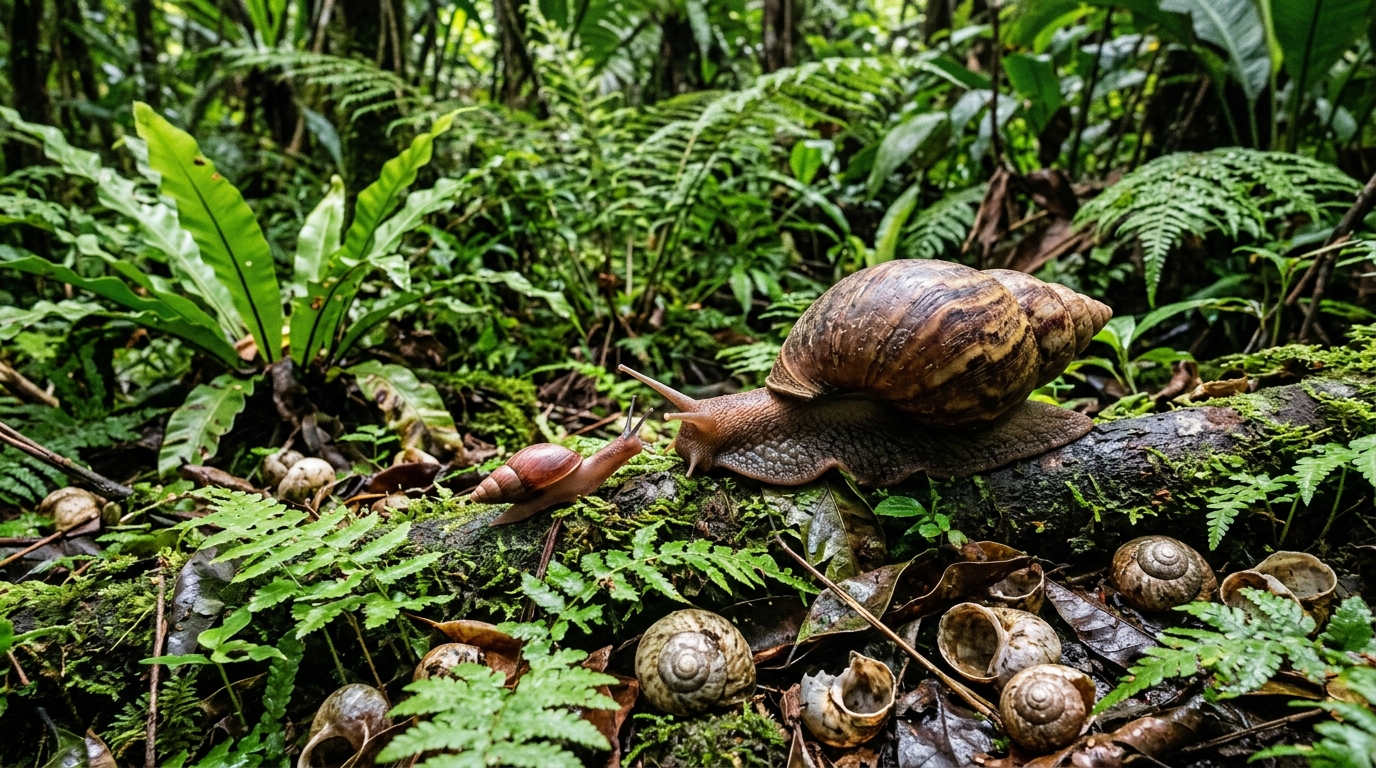
In 1977, French Polynesia imported a carnivorous snail to protect its crops from an African invader. This decision would trigger one of the worst extinction catastrophes ever recorded on such a small territory: more than 50 species of Partula, endemic snails found nowhere else on Earth, disappear in just a few years. How could a simple biocontrol operation, meant to safeguard local plantations, have turned into an ecological disaster of such magnitude? The tale of Euglandina and the Polynesian Partula remains, to this day, one of the most striking examples of the drift that can occur when humans believe they can correct nature with nature itself.
The Giant Snail That Devoured Moorea’s Plantations
Everything begins in the 1970s, when the Polynesian authorities introduce Achatina fulica, a notably large African terrestrial snail, with the aim of making it an additional food resource for local populations. The intention is commendable, but the outcome proves catastrophic: this mollusk, lacking natural predators on the Polynesian islands, multiplies at a dizzying rate. It quickly colonizes gardens, staple crops, and agricultural zones, sowing panic among residents who watch their yields ravaged by this unexpected invasion.
Faced with this uncontrolled proliferation, the authorities search for a rapid solution. Thus arises the idea of relying on a natural predator to eliminate Achatina. On paper, the logic seems flawless: release an adversary capable of hunting the giant African snail, without harming the rest of the ecosystem. In practice, reality would prove to be very different.
A Predator Released Without an Instruction Manual
In 1974, scientists introduced to Tahiti the Euglandina rosea, also known as the rosy wolf snail, a carnivorous mollusk renowned for its fierce appetite toward its own kind. The species was then released on Moorea in 1977, and gradually spread to other islands starting in 1980, always with the hope of eradicating the African Achatina. The problem is that no one had truly anticipated the predator’s real behavior once released into the wild.
Contrary to expectations, the Euglandina did not merely target Achatina, which is too bulky and tough to be an easy prey. It turned its attention to far more vulnerable targets: the Partula, these small arboreal snails endemic to Polynesia, with delicate shells and peaceful habits. Introduced without sufficient preliminary scientific trials, this rushed biocontrol would trigger an unprecedented, brutal chain collapse.
The Silent Carnage That Erased the Partulas from the Map
History records that it was indeed Euglandina rosea that wiped out the Partulas of Moorea, island by island, species by species, in a progression as methodical as it was ruthless. On Moorea itself, seven out of eight species vanished forever. In Tahiti, four to five out of eight fared the same. The phenomenon did not stop there: the 33 species recorded on Raiatea, the four on Huahine, the six on Tahaa, and the single species on Bora Bora were all simply exterminated.
What makes this extinction particularly chilling is its speed. In just a few years, lineages of snails that had inhabited these islands for millennia were swept away by a single predator released without a proper risk assessment. The rosy wolf snail showed no discrimination between pests and protected species: it hunted anything that could be a easy prey, turning Polynesian forests into veritable fields of ruin for land mollusks.
Fifty Species Erased: The Toll of an Ecological Mistake
According to figures compiled by the IUCN in 2022, of the 51 Partula species evaluated, 45 are presently considered extinct in the wild. Of the more than 70 Partulidae species originally recorded, fewer than 20 managed to survive. This disaster remains, even today, one of the best-documented cases worldwide of the disastrous impact of poorly controlled biocontrol.
Thankfully, all is not lost. Since the 2000s, international programs, notably coordinated by the London Zoo and France’s Thoiry Park, have raised in captivity several species that disappeared from the wild. In 2019, two species, Partula rosea and Partula varia, were even reintroduced into French Polynesia after a 15,000-kilometer journey from the British zoos of Chester and Whipsnade. But not all attempts meet with a happy ending: Partula pearcekellyi was officially declared extinct by the IUCN in June 2024, its sole habitat having been invaded by the rosy wolf snail as early as 1990.
This Polynesian catastrophe remains a priceless lesson for all future biocontrol decisions: introducing a living organism to battle another, without rigorous assessment of consequences, sometimes amounts to opening Pandora’s box whose effects are only measured after the harm is done. The Partulas, for their part, continue to survive thanks to captive-breeding efforts, fragile symbols of biodiversity once thought irretrievably lost. It remains to be seen whether humanity will draw the lessons from this story before attempting, elsewhere, another experiment of the same kind.
