
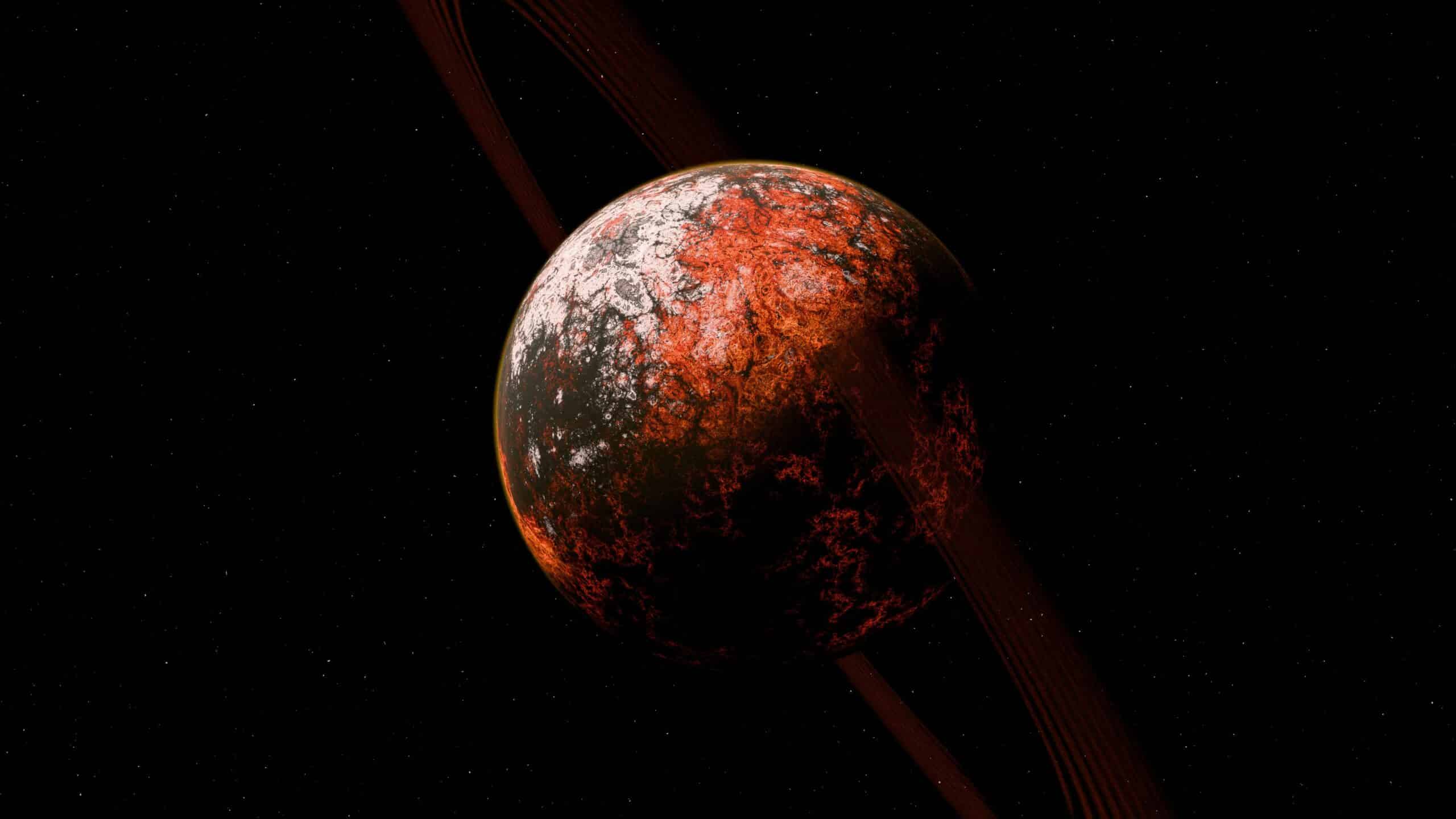
And what if certain mass extinctions were triggered not by direct impacts, but by the mere close approach of planetary-mass objects? A theoretical physicist at the University of Rome proposes a bold hypothesis: the gravitational tides produced by these flybys could have generated planetary tsunamis, volcanic eruptions, and climatic upheavals. A speculative theory — but supported by intriguing geological clues.
What you will learn
- Why the major extinctions without craters or iridium anomalies remain unexplained — and what this hypothesis proposes
- What a fossil coral clue suggests about a sudden disruption of Earth’s lunar orbit at the end of the Devonian
- How planetary-mass objects in the outer Solar System could threaten Earth in the future
Unexplained Extinctions
The extinction of the dinosaurs 66 million years ago has a well-documented cause: the Chicxulub impact, leaving an iridium anomaly and a crater of 180 kilometers in diameter. But other mass extinctions remain without a satisfying explanation.
The greatest of all, at the Permian-Triassic boundary 251 million years ago, wiped out between 80 and 95% of living species. No impact crater has ever been dated to this event, no characteristic iridium anomaly identified. The cause remains open.
Daniele Fargion, a theoretical physicist at the University of Rome, proposes a hypothesis in a preprint presented at a conference in June 2025: planetary-mass objects from the outer reaches of the solar system could have skimmed past the Earth, without striking it — and their tidal effects would have been enough to trigger planetary-scale catastrophes.
The Tides of a Planetary Flyby
The outer Solar System potentially harbors thousands, or even tens of thousands, of objects the size of a dwarf planet on elliptical orbits. Gravitational perturbations can send some toward the inner Solar System. A flyby — far more likely than a direct collision — would exert substantial tidal forces on Earth.
According to Fargion, such passages could have triggered planetary tsunamis lasting for years, major volcanic eruptions from crust deformation, marine regressions, meteor showers, and major climatic perturbations. The combination of these effects would fit well with the geological signatures associated with several mass extinctions.
A Clue in Fossil Corals
The most concrete argument from Fargion comes from fossil corals. These organisms record in their rings the number of days per year — and show that the length of the Earth day gradually lengthens through geological eras as the Moon’s tidal forces slow Earth’s rotation.
But at the end of the Devonian — a period of a major mass extinction — this slowdown abruptly halted. For Fargion, that indicates that the Earth-Moon distance suddenly increased at that moment. A collision could not produce this effect — too instantaneous. But a gravitational flyby of a planetary-mass object could.
A Speculative but Testable Hypothesis
Fargion extends his reasoning to the Fermi paradox: if such planetary flybys regularly decimated life on Earth, complex life could be intrinsically unstable and short-lived in the universe — which would explain in part why we do not detect any extraterrestrial civilization.
It should be noted that this article is a preprint not peer-reviewed, and its geological correlations remain to be confirmed independently. But the author’s final recommendation is pragmatic: monitor deep space to identify distant planetary-mass objects — and develop protective strategies tailored to this scenario, different from those envisaged against classical asteroids.
