
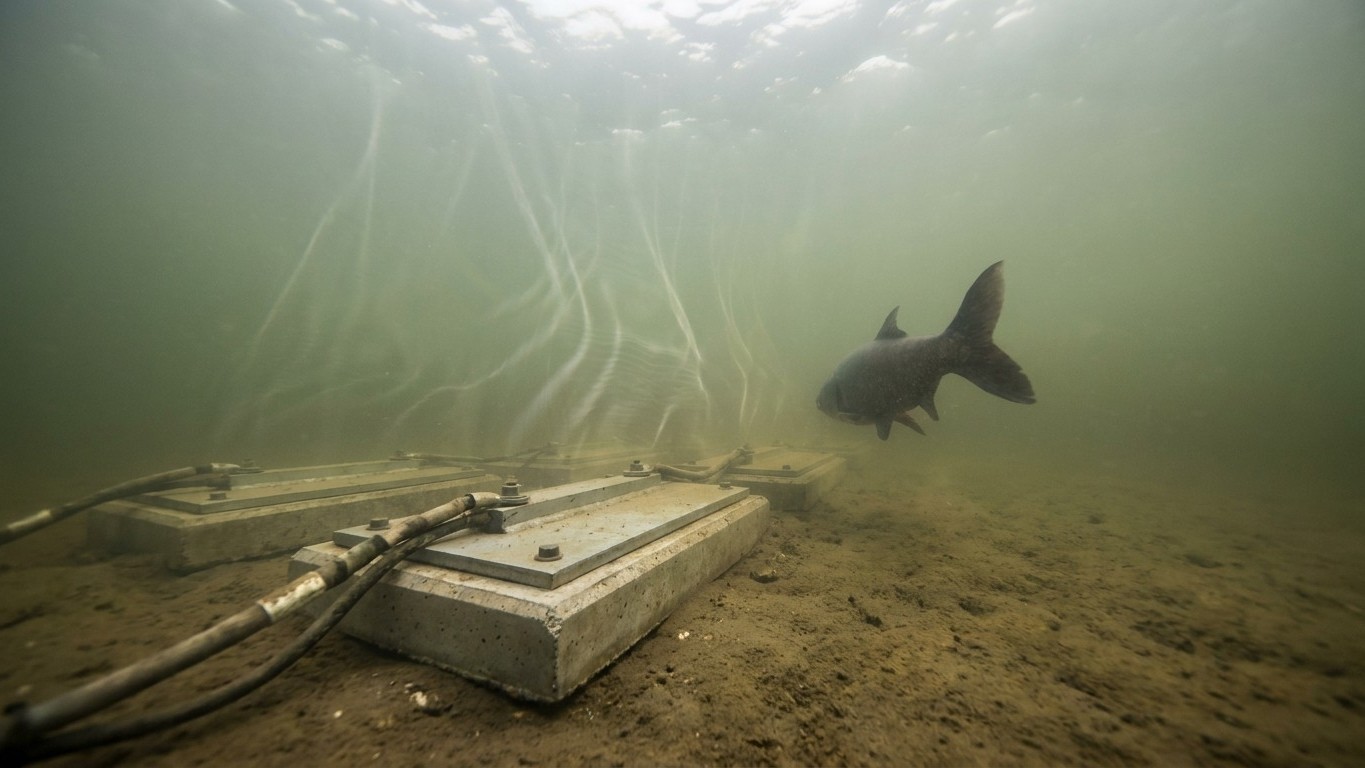
Under the murky surface of the Chicago Sanitary and Ship Canal, in Romeoville, Illinois, the water is perpetually electrified. No chemical pollution, no sunken wreck in the canal bed: what blocks passage to Lake Michigan is an electric field generated day and night since 2002 by the U.S. Army Corps of Engineers. Its target? Asian carp, these invasive fish capable of wrecking a lake ecosystem in a matter of years.
Key takeaways
- An invisible electric current has been continuously electrifying a canal for 22 years — but why?
- A historic barrier failed to stop 100% of intruders, revealing a critical flaw in the system
- A $1.15 billion megaproject will create a multi-layer water fortress — but political tensions threaten the timeline
An Inverted River, an Artificial Boundary
To understand why Washington maintains such a singular setup, one must go back to 1900. That year, Chicago engineers reversed the course of the Chicago River to push the city’s wastewater away from Lake Michigan, its main source of drinking water. The Chicago Sanitary and Ship Canal was built in 1900 to allow Chicago to dispose of its wastewater without polluting Lake Michigan, and it remains the only water link between the Great Lakes and the Mississippi system. An engineering feat praised at the time, but which, unintentionally, opened a navigable waterway between two basins that had never communicated.
The treatment of wastewater eventually made the canal habitable for fish, exposing the route to the threat of invasive species, notably the round goby toward the Mississippi and the Asian carp toward the Great Lakes. The problem gained national prominence in the 1990s, when these carp from Asia, introduced in the American South to clean breeding ponds, began to colonize the Illinois River en masse, which flows directly into the canal.
A Current That Makes the Water Impassable
Closing the canal to navigation? Politically impossible. Millions of tons of goods pass through it every year. The chosen solution was therefore technological. Facing the rise of these fish in the Illinois River during the 1990s, the Army Corps of Engineers completed in 2002 the construction of a demonstration electric barrier near Romeoville.
Technically, the installation operates like an invisible fence. The electric barrier creates in the canal water high-power pulsating direct-current electric fields. Fish that enter this field experience electrical stimuli that act as a repellent: the further the fish advance, the more uncomfortable the sensation becomes, until they are immobilized or deterred from continuing. Not lethal, in principle, but sufficiently unpleasant to drive away an entire school before they reach the critical point.
The initial installation proved insufficient against the scale of the challenge. Following the success of this demonstration barrier, Smith-Root was tasked with designing and building a permanent barrier, split into two parts, whose construction began in 2006. The site today comprises three barriers with electrode sections 155 feet long installed at the bottom of a 27-foot-deep channel, and a fourth, more powerful barrier has even been added. All of which makes Romeoville one of the most substantial electric deterrence facilities ever built on a commercial waterway.
The system is not foolproof, however. In June 2017, a second live Asian carp was found beyond the canal’s three electrical barriers near Romeoville, the first having been discovered in 2010. These incidents remind us that the barrier dramatically reduces risk but does not eliminate it entirely, which explains why the Army Corps of Engineers recently tested its operating limits. The agency conducted a series of comprehensive tests on the system to better understand its operating bounds and to evaluate the effects of a potential voltage increase if needed to control the transfer of invasive carp.
Romeoville Will Soon Not Be Alone
Twenty-four years after it began operation, Romeoville’s electric barrier is set to become one link in a far more elaborate defense chain. About thirty miles upstream, near Joliet, work on the Brandon Road Interbasin Project is progressing. This project, located where the Illinois navigable channel narrows before feeding into Lake Michigan, has been identified by federal scientists as the most effective site to block the upstream movement of invasive carp from the Mississippi basin.
The future site will combine several technologies. Once completed, an array of deterrents will stop the fish’s movement, including a new electric barrier, an underwater sound system, a curtain of air bubbles, and a flushing lock in a specially designed channel. Romeoville’s historic electric barrier will continue to operate in parallel with the new system, creating multiple successive lines of defense.
The price tag matches the ecological stakes: the project is estimated at $1.15 billion, with a phased commissioning schedule through 2030 according to the Army Corps of Engineers. Federal funding and contributions from Michigan and Illinois have, however, given rise to real political tensions in the spring when the Trump administration decided to transfer project management from the Rock Island district to Detroit, accusing Illinois of being “an unreliable partner, behind on its payments,” a claim the state governor, J.B. Pritzker, strongly disputed.
The economic stakes go far beyond the folklore of an electric fence in an industrial canal. If Asian carp established themselves in the Great Lakes, they could supplant native species and seriously harm both the ecology and the economy tied to the region’s $20 billion annual fishing and boating activity. A figure that gives this invisible current another dimension: it literally protects the economic balance of an entire watershed shared by eight U.S. states and two Canadian provinces.
Sources: icrcc.fws.gov | smith-root.com | michigan.gov
