
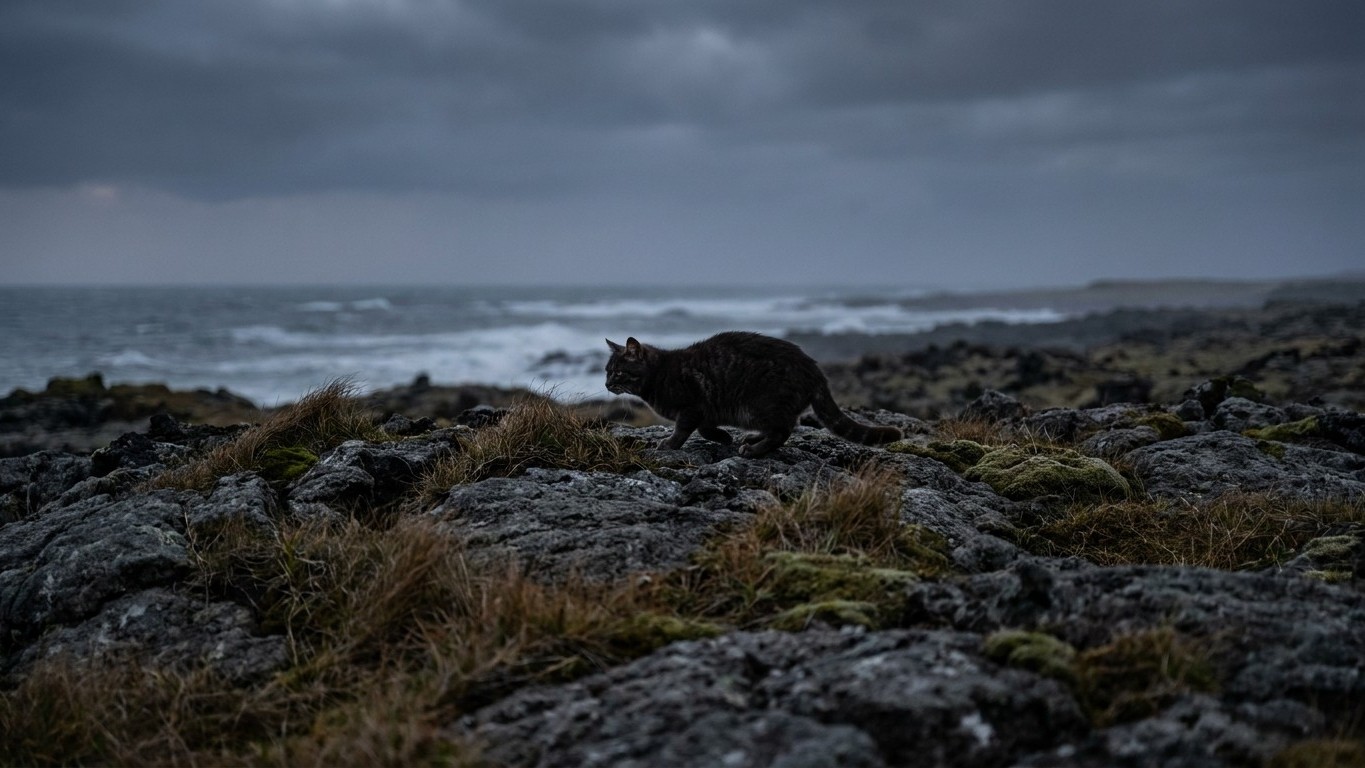
Five cats. That was all it took to transform a subantarctic island into a deadly trap for hundreds of thousands of seabirds. In 1949, on Marion Island, a wind-swept speck of land south of the Indian Ocean where no tree grows, staff at the local meteorological station brought these felines for a decidedly practical reason: to rid their buildings of mice. The mice had slipped into the station’s base after being inadvertently introduced a century earlier by sealers. In 1949, this invasion posed a problem for the small station, so the chosen solution was to introduce a natural predator to eliminate them. No one at the time could foresee what this seemingly minor act would unleash.
Key Takeaways
- How five domestic cats became devastating predators
- The exact toll, in bird lives, of this unfortunate introduction
- The unexpected paradox uncovered after the cats’ eradication
A Vertiginous Population Explosion
Without a natural predator to regulate them, without rivals, and without disease to curb their spread, the cats found on this isolated land a providential environment. The initial five individuals multiplied at a vertiginous pace: barely three decades later, no one knew how to eradicate roughly 3,400 cats from a wild, remote island. The figure is confirmed by several scientific sources: in 1949, five domestic cats were brought to Marion Island to combat a mouse invasion at the station, but the cats multiplied rapidly and by 1977 there were already about 3,400 cats living on the island, feeding on petrels rather than mice.
The detail changes everything. These feral felines gradually abandon rodents—too small and too difficult to catch in sufficient numbers to feed a population this large—in favor of a far more accessible prey: petrels that nest in burrows dug right into the soil. On an island without trees, where vegetation consists only of tufted grasses and mosses, these seabirds have no high refuge to escape predators. They go out at night, follow their burrows by scent, and fall directly under the paw of cats that have learned to stalk these nocturnal forays.
What Those Nights Cost, Measured in Birds
The annual tally marks the scale of the catastrophe. According to the most cited scientific estimates, including a study published in Polar Biology, the introduced predators are among the principal threats to seabirds nesting on oceanic islands, and by the 1970s around 2,000 cats killed nearly 450,000 seabirds each year, sharply reducing the populations of burrow-nesting petrels. Other work, published in Antarctic Science, puts forward a nearly identical figure: before their eradication in 1991, the cats killed about 450,000 petrels annually, greatly lowering the densities of petrels nesting on the island.
One species paid a heavy price. The common diving petrel, a small seabird that digs its burrows among coastal grasses, vanished entirely from the island, a direct victim of predation that had become widespread. It would be until 2015, twenty-four years after the last cat left, for the species to timidly recolonize a portion of the island—the Goodhope Bay area—in a breeding zone of barely a hectare.
Fourteen Years to Erase a Mistake
Faced with the scale of the carnage, the South African authorities who administer the island launched an eradication program in 1977 that would stretch over fourteen years. The first weapon chosen was biological: cats carrying the feline panleukopenia virus, an extremely contagious and deadly disease for the species, were deliberately released onto the island. In 1977, researchers released 96 cats infected with the virus around the island. The outbreak spread rapidly among the cats, halving their population within eighteen months.
The virus alone was not enough to finish the job. Teams then turned to systematic hunting and trapping, complemented by the use of poisons. The eradication program reduced the number of cats to about 600 by 1982, after which hunters tracked down the last survivors night after night across a treacherous volcanic terrain swept by constant rains. Perseverance paid off: the project succeeded and in 1991, only eight cats were captured over a twelve-month period. The very last feline was captured in July of that year, ending forty-two years of uninterrupted predation. Marion Island remains, to this day, the largest island in the world from which cats have been eradicated successfully.
The Paradox That No One Had Anticipated
Removing a predator from an island ecosystem can sometimes open the door to another, more insidious problem. The mice, liberated from their sworn foe, took advantage of the vacancy left by the cats to proliferate at an unexpected pace. The mouse population surged following the eradication: in the twenty years that followed, the number of mice on Marion Island grew by about 430%. Even more alarming, these rodents, once confined to seeds and insects, began attacking albatross chicks living in their nests, a behavior previously undocumented and first recorded in the early 2000s.
The petrels, for their part, continue to struggle to recover fully from four decades of carnage. Researchers have found that, two decades after the cats left, the densities of occupied burrows had risen by only 56%, far less than the fourfold increase predicted by ecological models. A project named Mouse-Free Marion now aims to eliminate the mice in turn, at an estimated cost of $25 million. The story of this tree-less island serves as a stark reminder of a simple, often-forgotten lesson: on an isolated ecosystem, every introduced species leaves an imprint that can take a half-century, or more, to fade.
Sources: polarjournal.net | mousefreemarion.org | polarjournal.ch
