
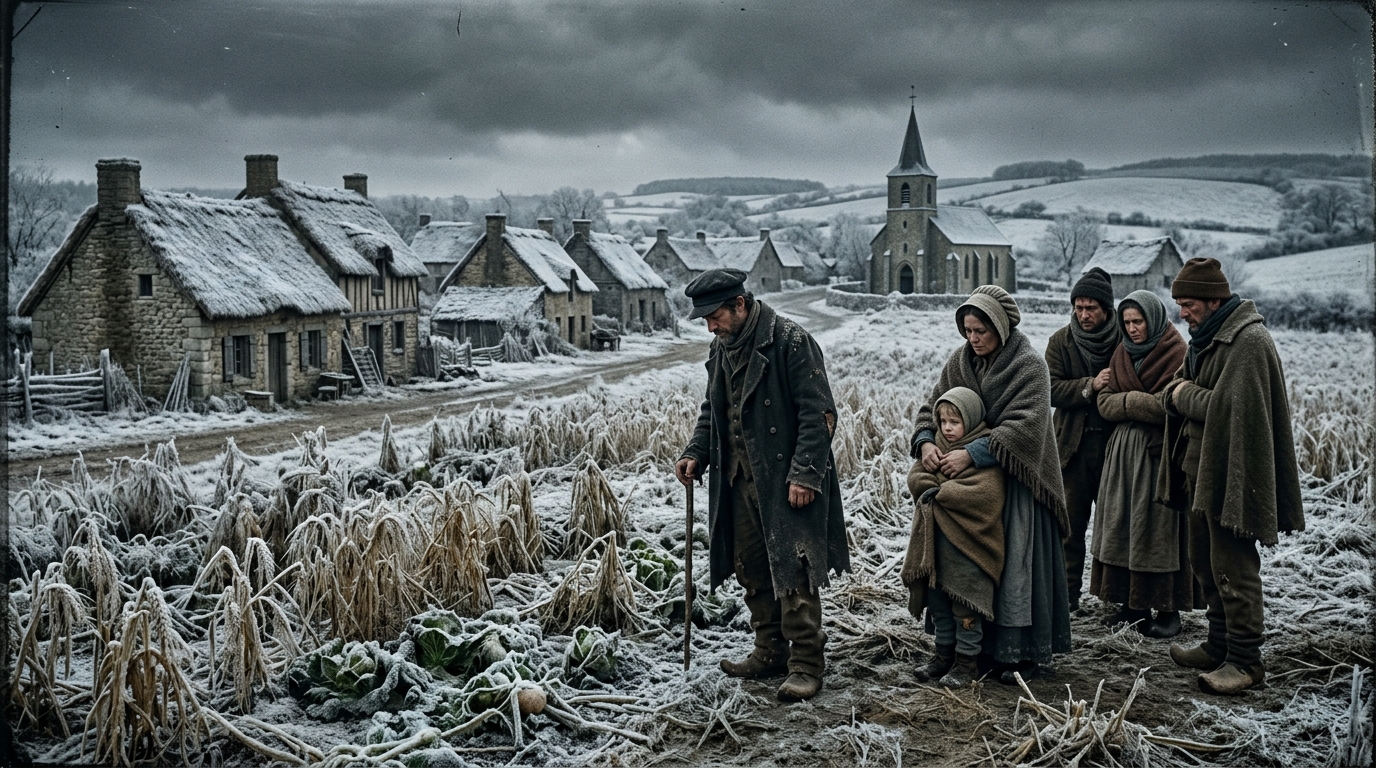
The history of our planet is punctuated by catastrophes that, in a matter of hours, have upended human societies. Among them, volcanic eruptions hold a special place: they act like giant switches, capable of darkening the sky thousands of kilometers away. Yet, if there is an event that deserves a prime position in our history books, it is definitely the Tambora eruption, in April 1815. This Indonesian volcano, whose name remains largely unfamiliar to the French public, caused the deadliest natural disaster in modern history, and its consequences literally deprived Europe of its summer the following year.
A volcano at the other end of the world plunged Europe into darkness
It is hard to imagine that an event on a small Indonesian island could starve farmers in Alsace or Bavaria. Yet that is precisely what happened. On April 10, 1815, Mount Tambora, located on the island of Sumbawa, erupted with unprecedented violence, seven times greater than that of the famous Krakatoa which would strike the region sixty-eight years later. In just a few hours, the extreme heat and the incandescent clouds killed 71,000 people on the island, a grim toll that would alone make this eruption one of the most devastating ever recorded. But that was only the beginning of a chain reaction that would spread across the globe.
The explosion that erased a mountain from the map
To grasp the scale of the phenomenon, one must look at the raw numbers. Tambora expelled in a matter of days more than 150 km³ of material into the atmosphere, with a plume of ash rising to more than 40 kilometers high, almost four times the cruising altitude of a commercial airliner. Such a massive energy release could not leave the landscape unscathed: the mountain, which previously topped 4,000 meters, literally collapsed inward, toppled by its own blast. Today, the summit of Tambora no longer exceeds 2,580 meters, a nearly 1,500-meter loss that bears witness to the monstrous power of the explosion.
A cloud of ash that fed an entire continent
The real danger of Tambora did not reside solely in its destructive breath, but in what it released into the sky. The eruption injected about 60 million tonnes of sulfur into the stratosphere, a mass that then traveled across the Northern Hemisphere, carried by atmospheric currents. Locally, on the neighboring islands of Sumbawa, Lombok and Bali, the consequences were terrible: between 49,000 and 90,000 additional people died from hunger and disease in the months that followed, as crops were wiped out by ash and the toxic compounds released, including nearly 100 million tonnes of chlorinated compounds and 70 million tonnes of fluorinated compounds. Globally, historians estimate that the total death toll from Tambora, combining direct deaths and cascading consequences, lies between 100,000 and 200,000 people.
The summer that never came and the winter that refused to end
It is in 1816 that Europeans truly grasped the magnitude of the tragedy at play, without even realizing a volcano at the far end of the world was responsible. Particles suspended in the stratosphere reduced global sunlight and drove average temperatures down by as much as 3 degrees below normal. The result: snow fell in July in several temperate regions, including the U.S. state of Vermont, while the skies over Europe remained stubbornly gray. In France, Germany and Switzerland, cereal and potato harvests were devastated, triggering famines that historical estimates attribute to between 65,000 and 200,000 deaths on the European continent alone. China was not spared either, with severe frost damage and unusual snowfalls even in the southern part of the country. Facing this agricultural disaster, waves of migration formed, pushing families from Western and Central Europe to try their luck in the Americas, just as residents of the U.S. East Coast moved toward the Midwest in search of gentler lands.
When cold and hunger gave birth to a literary monster
In the midst of this climatic chaos, an episode remains strikingly engraved in cultural memory, even though its volcanic origin is often overlooked. The British novelist
What Tambora reveals about our vulnerability to climate today
More than two centuries after this catastrophe, while we enjoy the heat of summer without worrying about a sky that could darken suddenly, Tambora still serves as a valuable warning. It reminds us that a single geological event, localized on a relatively small territory, can destabilize global agriculture, trigger mass famines, and redraw migration flows across a continent. Our globally integrated food system, even more interconnected than in the nineteenth century, remains just as exposed to a brutal climate shock, whether volcanic in origin or not. Interestingly, this episode—foundational for understanding the links between volcanism and climate—remains largely absent from French school curricula, even as it sheds a new light on our own fragility in the face of nature’s whims.
Tambora thus remains a striking example of how the Earth can, in an instant, redraw the maps of human history thousands of kilometers from the initial point of impact. Between the direct deaths from the eruption, the famines that followed, and the artistic creations born from this chaos, this episode deserves to be told far beyond specialist circles. So, the next time the sky grows a little too overcast for your taste, perhaps you will think of that forgotten volcano that, for a time, dimmed the sun over an entire planet.
