
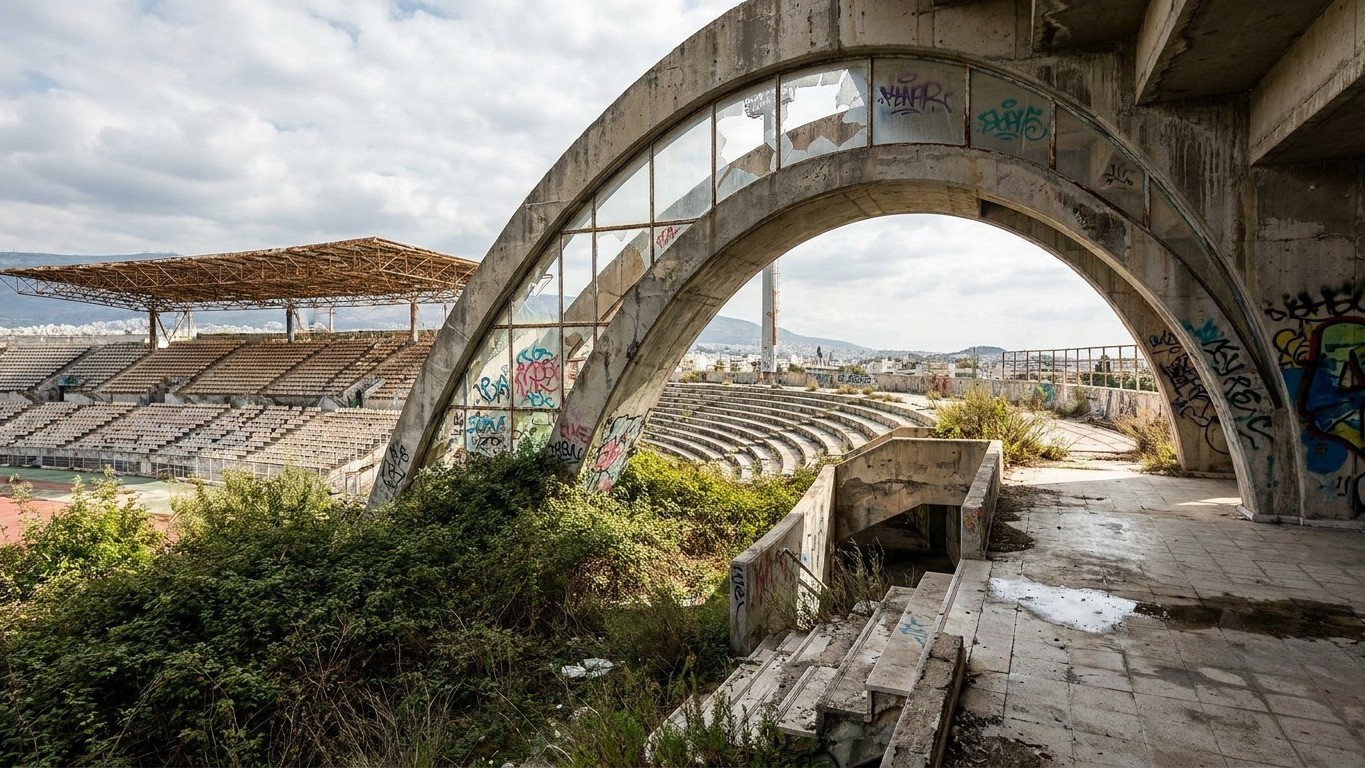
Sixteen days of competition, two decades of repayment. Athens hosted the Summer Olympics in 2004, an achievement hailed around the world, but the bill continued to drain the Greek state coffers long after the flame had been extinguished. The total cost is estimated between 9 and 11 billion euros, with some experts even pointing to a higher figure. According to certain estimates, the real cost for the country would have hovered closer to 14 billion euros. Twenty years after the closing ceremony, a portion of these brand-new facilities no longer welcomes anyone, save for frogs and weeds.
The paradox is cruel. In order to build this Olympic showcase, Greece borrowed heavily, convinced that the whole world would then come to fill the stadiums. Despite a Games that were popular and successful, Athens 2004 left a lasting imprint on Greece: as the country went through the financial crisis of the late 2000s, the debt incurred to finance the Games weighed heavily on Greek taxpayers. A written question submitted to the French National Assembly sums up the unease: the Athens 2004 Olympic budget was underestimated, and the 2 to 3 percent rise in the country’s external debt is attributed to the cost of these Games. Two to three percentage points of public debt for sixteen days of competition: that is the bill left to future generations.
À retenir
– How sixteen days of competition generated two decades of repayments for the Greek state
– Ultramodern stadiums turned into ruins: the paradox of the Hellinikon complex
– 50 million euros per year in maintenance for facilities that no one uses
Sommaire
– Empty stadiums, frogs as the sole spectators
– An ongoing maintenance bill that never stopped running
– A few seconds of life, many missed opportunities
Empty stadiums, frogs as the sole spectators
The Hellinikon complex, built on the site of the former Athens airport, stands as the emblematic symbol of this patrimonial fiasco. The hockey and baseball stadiums were left to rust and rot, while the slalom rivers for canoe-kayak dried up. Softball, a sport nearly unknown in Greece and already removed from the Olympic program, never found an audience again: on the southern site dedicated to this discipline, only a few stray weeds remain on the dry field.
The Olympic Village, intended to later house modest families, fared no better. Eight years after the Games, an American journalist described the training pool of the village as the haunt of a very particular fauna: there remains a group that adores the athletes’ training pool in the old Olympic village in northern Athens—the frogs—apparently thriving on the debris floating on the surface of the murky, half‑filled pool. The beach-volleyball center at Faliro, which could have hosted nearly 10,000 spectators, fared no better. It now stands as a decrepit white elephant, a symbol of a financial disaster that paralyzed the Greek economy for two decades, once capable of attracting almost 10,000 spectators in 2004. Broken windows, graffiti, rubble—an abrupt contrast with the images of the opening ceremony broadcast worldwide.
An ongoing maintenance bill that never stopped running
Owning twenty-two brand-new sports facilities is one thing; maintaining them is another matter entirely. To keep the entire set of installations in reasonable condition, the Greek state and its capital must spend, every year since the Games, 50 million euros on maintenance of the Olympic sites. A budget that Greece, hit hard by the sovereign debt crisis from 2010 onward, could not sustain. The result: buildings that degraded even faster than expected, due to lack of dedicated tenants and limited resources.
Even the main Olympic stadium, one of the few successes of the program since it still houses the AEK Athens football club and the national team, did not escape the wear of time. Its iconic roof, designed by architect Santiago Calatrava, had to be closed for safety reasons after twenty years without proper maintenance. The Greek prime minister himself acknowledged, in defending this temporary closure, that the structure had not been maintained for two decades.
A few seconds of life, many missed opportunities
All is not lost in the Greek Olympic record, and it would be unfair to claim so. Of the twenty-two new sports facilities built for the Athens 2004 Games, fourteen remain in use. The Agios Kosmas sailing center now operates as a private marina, the International Broadcasting Centre has become one of the busiest shopping centers in Athens, and part of the Olympic Village was ultimately sold off as private housing. Some venues even found unexpected post-Games uses: for instance, the Galatsi Olympic Hall was reopened in 2016 to welcome Afghan and Syrian refugees fleeing civil war, out of necessity rather than ambition.
But for eight of the facilities out of twenty-two, the story ends abruptly at the end of the summer of 2004. Three venues remain wholly unused: the Phaleron Olympic beach volley stadium, the Nikaia weightlifting hall, and the Goudi Olympic Complex. Lacking a preconceived urban planning strategy, Greece ended up with an extraordinary sports heritage that it neither had the means to exploit nor a clear plan to repurpose. Attempts to reconvert facilities—such as turning the judo hall into an arts academy or the weightlifting hall into a university residence—have remained unrealized.
Greece’s story has since become a textbook case cited by every prospective host—from Tokyo to Paris to Los Angeles—by urban planners. The lesson is straightforward: it is better to plan the use of a stadium for the thirty years following the event than for the sixteen days of competition itself. Athens, for its part, continues to grapple with this very particular paradox: hosting the world’s grandest sports celebration while bearing, every year since, the financial burden of stadiums that no one wants anymore.
Source: sources: questions.assemblee-nationale.fr | slate.fr | demotivateur.fr
