
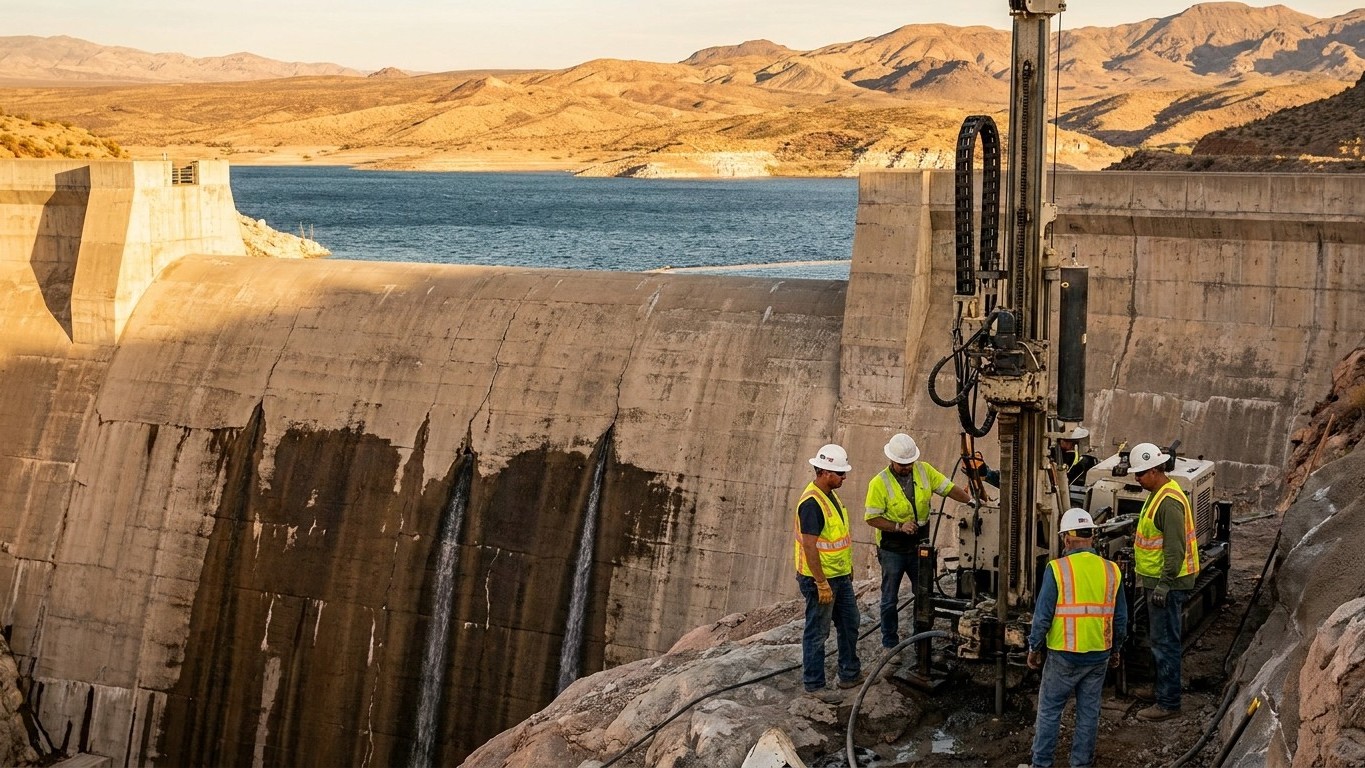
An earth dam built on rock salt and gypsum, two rocks that dissolve when they come into contact with water. This is the paradox of the Mosul Dam, in northern Iraq, long regarded as one of the most closely watched structures on the planet. Since it was commissioned in 1986, teams have continuously injected cement beneath its foundations to fill cavities that keep forming. Halting this work, even for a few days, would amount to playing with the lives of 1.5 million people.
Key takeaways
- A dam built on the worst possible soil: soluble gypsum that crumbles when in contact with water
- For 38 years, cement weighing as much as several aircraft carriers has been poured into its foundations
- A rupture would unleash a 54-meter wave potentially killing 1.5 million people
A Dam Built on Ground That Slips Away
The project began in 1980, under Saddam Hussein, and was completed six years later. Constructed starting in 1980 and commissioned in 1986, it can reach a peak output of 1,000 MW and supports irrigation for downstream regions along the river. The issue is that the engineers of the time chose to situate this colossal structure on karst terrain, riddled with gypsum, anhydrite and limestone layers.
These rocks share a troublesome trait: they dissolve when exposed to water. The dam’s foundation rests on alternating layers of limestone and gypsum. Infiltrations caused by gypsum dissolution were observed, and after the reservoir was filled in 1986, new leakage points were identified. The problem has never been a temporary anomaly but a structural feature of the site, present from the very first water impoundment.
The mechanism is almost mechanical, in the literal sense. The Mosul Dam is particularly vulnerable to this process because the foundation soil contains a high concentration of soluble gypsum. As water seeps through the gypsum, the soil dissolves and cavities form, which can eventually lead to a total collapse. Under tens of meters of earth and concrete, the reservoir water is gnawing away at the rock that supports the entire structure.
Injecting Cement, Never Stopping
Facing this perpetual dissolution, only one defense has been found: continuously injecting a cement-bentonite mixture into the underground galleries of the dam to fill voids as they appear. After the reservoir’s first filling in 1986, maintenance protocols were set up to address persistent infiltrations through the gypsum karst foundation, which dissolved rapidly and formed cavities in contact with reservoir water. These protocols rely on ongoing drilling-and-injection operations conducted from a dedicated drilling gallery beneath the main embankment to seal cracks, joints, and voids.
The scale of the project is dizzying. Piezometric observations continued and led to repeated applications of standard and large-scale drilling-and-injection measures as repair work, with grout volumes used between 1986 and 2014 totaling 95,657.43 tonnes. Nearly 100,000 tonnes of cement injected in less than thirty years—the weight of several aircraft carriers sunk within the bowels of a single structure. And the work continues.
What alarms experts most is not the magnitude of the operation but its permanent nature. This ongoing process has raised concerns about the dam’s safety. Recent studies have shown that drilling-and-injection can at best be considered a temporary fix. It is now clear that if drilling-and-injection must continue, a long-term solution must be found to prevent the consequences of a dam failure. This must be done as quickly as possible, as the dam shows increasing signs of weakness. One report after another agrees: for forty years, we have been sealing without ever curing.
The World’s Most Dangerous Dam
That assessment is not new. As early as 2006, the U.S. Army Corps of Engineers warned the structure was the “most dangerous dam in the world,” according to reports at the time. The situation deteriorated further when the Islamic State took control of the area in 2014, prompting the departure of part of the technical staff and damaging maintenance equipment. Many of the 1,500 employees stationed there fled, and extremists damaged much of their gear.
A Swedish professor who followed the initial construction summed up the stakes in a 2006 interview: “It will be worse than dropping a nuclear bomb on Iraq,” said Nadhir al-Ansari, from the Environmental Engineering Department at Luleå University in Sweden, who inspected the original build. In 2016, fears peaked as the United States issued an official call for international mobilization through its ambassador to the UN to prevent a humanitarian catastrophe of massive proportions that could be caused by a Mosul Dam collapse.
The worst-case scenario was quantified with chilling precision by engineers. If the dam were to fail, water would surge at 551,000 cubic meters per second, creating a 54-meter-high wave. When it reached Mosul 1 to 4 hours later, the surge would still stand at 14 meters; then, 3 to 4 days later, upon reaching Baghdad, 400 kilometers south, it would be about 10 meters high. The human toll could reach 1.5 million victims, with at least 500,000 dead. A 14-meter wave hitting Mosul would be roughly the height of a five-story building crashing into Iraq’s second-largest city and would continue on to the capital, 400 kilometers away.
Consolidation Work, but No Definitive Solution
Facing the urgency, Iraq eventually awarded a rehabilitation contract in 2016 to the Italian firm Trevi, renowned for its work on complex foundations. The works stretched over several years, until an official ceremony in 2019 marked the end of this consolidation phase. In mid-June 2019, a transfer of authority ceremony took place at the site between the United States Army Corps of Engineers and the Iraqi Ministry of Water Resources. The project cost about $532 million, of which $410 million was paid to Trevi by the Iraqi government. The project even earned industry praise, as in 2022 the rehabilitation program received the Outstanding Project Award from the Deep Foundations Institute.
Yet this technical accolade does not alter the nature of the problem. The gypsum and anhydrite layers still exist beneath the dam, and nothing has removed them. Researchers are now exploring alternatives to conventional cement, deemed ill-suited for such friable rock. The choice of gypsum-rich rocks is due to their resistance to cement grout and prevents the formation of a solid physical bond (adhesion) between them. Chemical polymers, capable of bonding more effectively to the soluble rock, are being tested in laboratories to try to permanently seal what has stubbornly refused to stay sealed for forty years.
Sources: ncbi.nlm.nih.gov | french.peopledaily.com.cn | letemps.ch
