
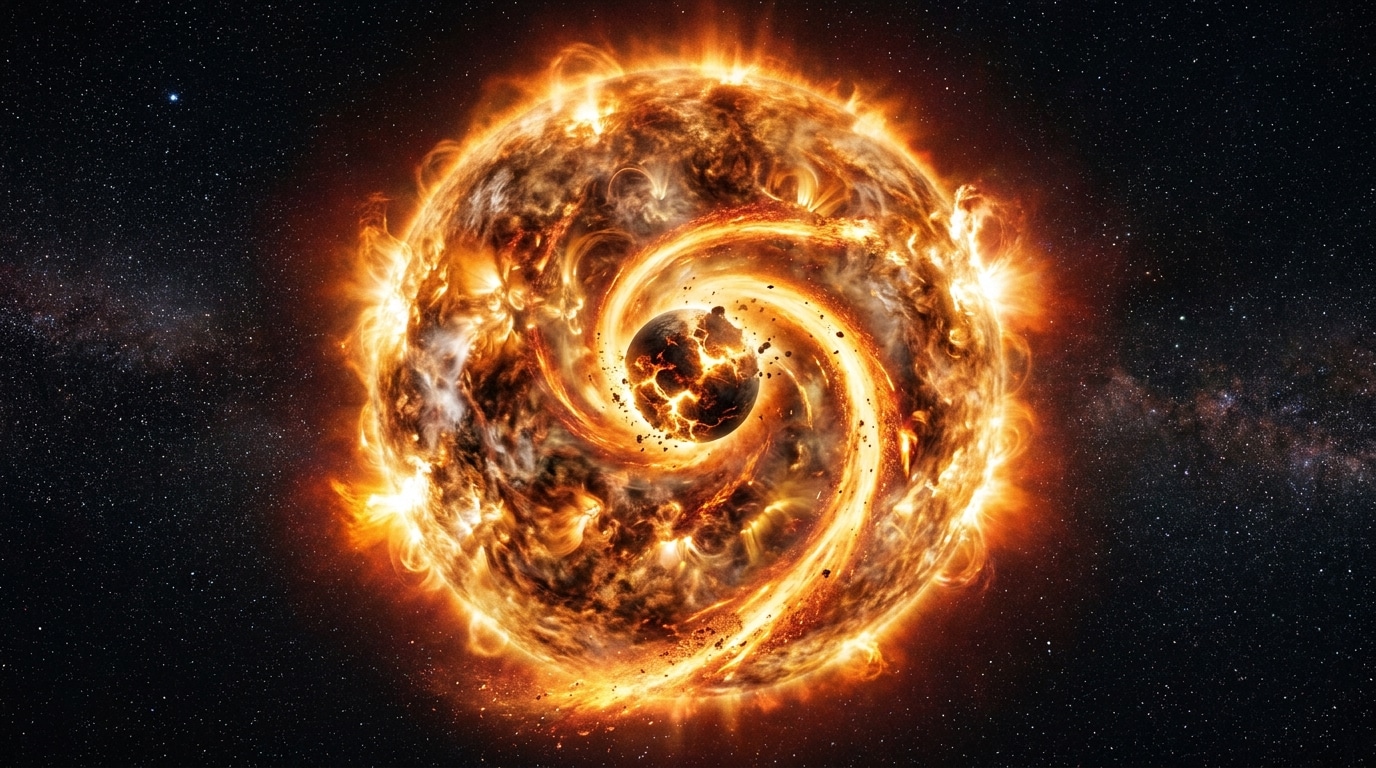
A solitary point of light, adrift 1,300 light-years from Earth, betrays a cosmic banquet. By examining the glow of the star TOI-5882, astronomers detected an unmistakable chemical anomaly that cannot be ignored. The most plausible conclusion can be summed up in a single word: this star has devoured one of its own planets, and it still bears the mark.
This kind of discovery carries a vertiginous thrill. It opens a window onto the violent endings that some worlds face, and perhaps onto the distant fate of our own solar system. Here is how a star becomes predatory, and how scientists catch it red-handed.
When a star becomes predator of its own worlds
We often imagine a star as a peaceful beacon at the heart of its system. The reality is far harsher. The astronomers have a precise term for the moment a star swallows one of its worlds: engulfment.
The most surprising aspect is the speed of the phenomenon. One might picture a long, drawn-out demise spanning thousands of years. In truth, it unfolds in weeks, even days. A planet tilts, dives toward its star, and vanishes in a time that is almost instantaneous on cosmological scales.
In the case of TOI-5882, a complicating factor comes into play. A massive brown dwarf, a kind of failed star occupying an uneasy space between star and gas giant planet, orbits nearby. Its presence likely destabilized the doomed world’s orbit, nudging it toward its fatal plunge. A gravitational shove that sealed the planet’s fate.
The trace of the crime: metals that should never have been there
A swallowed planet does not vanish without leaving a trace. It literally contaminates its star. This is where the investigation becomes enthralling: the meal is read in the chemical makeup of the star, as a lasting clue on the crime scene.
The principal clue bears a simple name: lithium. This light metal is far more abundant in planetary matter than in stars. When a star swallows a world, it thus absorbs a hefty dose of lithium. On TOI-5882, the observed concentration is abnormally high, which immediately raises the attention of researchers.
The mechanism rests on a fascinating technical detail. Each star possesses a convective zone, an outer layer that stirs the material. If this zone is sufficiently thin, the rocky material swallowed does not dilute too much. The result: the metallicity of the atmosphere climbs noticeably, and the signature of the feast remains legible long after the drama.
Decoding the stellar menu: the tools of detective astronomers
How does one read the composition of a star located 1,300 light-years away? The answer lies in a formidable technique: spectroscopy. By dissecting the star’s light, astronomers obtain a genuine chemical ID, where each element leaves a distinctive signature.
But a single signal is not enough. To be sure of their conclusion, researchers compared TOI-5882 with dozens of similar stars. The verdict was clear: its profile stood out distinctly. It was this careful comparison that transformed a mere hunch into a solid conclusion.
Not every star is a good candidate for this kind of inquiry. Many are unsuitable because the traces of a planetary meal fade away or become indecipherable. TOI-5882 is exceptional: it belongs to the class of stars with 1.0 to 1.4 solar masses, the sweet spot where swallowed metals remain detectable. Beyond lithium, aluminum, calcium and vanadium count among the best indicators of such a feast.
One caveat remains. Some comparison stars also exhibited surprisingly high lithium levels, without evidence of engulfment. This suggests that other, still poorly understood processes could enrich a star in lithium. Caution remains essential.
And if the Sun faced the same fate for Earth?
It’s hard not to draw a line from this story to our own corner of the galaxy. TOI-5882 is a solar-type star, a cousin of our Sun. What happened to it is not some exotic scenario reserved for distant, strange stars.
In a very distant future, our Sun will swell into a red giant. Mercury, Venus and perhaps Earth could then be engulfed, leaving a chemical imprint in the solar atmosphere. The scene observed on TOI-5882 thus offers an unprecedented glimpse of what our cosmic neighborhood might become.
This prospect is enough to send a shiver down the spine, but it is not imminent: we are talking about timescales of billions of years. That interval is enough to soothe any worry for now. In the meantime, each predator star detected sharpens our understanding of these planetary destinies.
By devouring one of its worlds, TOI-5882 has sealed its fate within its own light. A cosmic meal engraved in its atmosphere, deciphered by astronomers thanks to a handful of revealing metals. One question remains: how many other stars, around us, silently carry the trace of a vanished world?
