
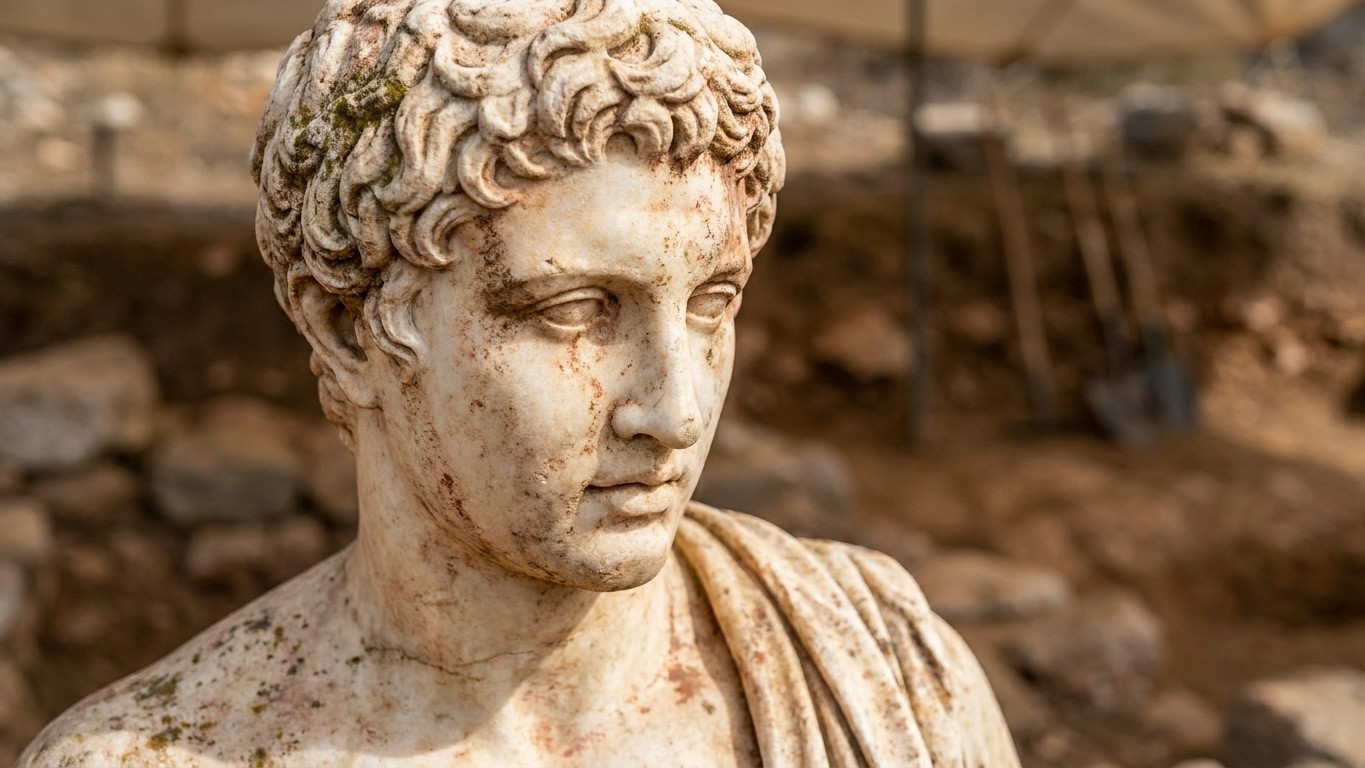
Under a Roman road dating back almost two thousand years, Turkish archaeologists have just unearthed a marble statue measuring more than two meters in height, itself dating back 2,500 years. The site is Sardis, in the province of Manisa, to the west of Turkey. A city renowned for a king whose name became synonymous with absolute wealth: Croesus.
Standing at 2.2 meters, the statue depicts a young man and has been dated to between 470 and 450 BCE. The discovery was announced in early August by Turkey’s Minister of Culture and Tourism, Mehmet Nuri Ersoy, who wrote on social media that the sculpture, dated between 470 and 450 BCE, ranks among the scarce surviving examples of monumental marble statuary from this period. In itself, such survivals are extraordinarily rare: most Greek sculptures from this era have reached us broken into pieces, worn by time, or completely lost.
Key Takeaways
- A monumental Lydia statue unearthed buried beneath the cobbles of a Roman street for two millennia
- The figure wears garments of a unique style never identified elsewhere: a Greek-Persian hybrid
- The Romans unintentionally preserved this masterpiece by recycling it as crude paving material
A statue transformed into a simple paving stone
The most astonishing aspect is not the scale of the work, but the place where it lay. The statue had been repurposed during Roman times as paving material for a colonnaded street at the city’s entrance. Placed face down beneath the pavement, the sculpture remarkably preserved the features of its face and a large portion of its carved details for centuries. It was the Romans themselves, centuries after its creation, who inadvertently saved this Lydian masterpiece by recycling it as a crude sidewalk tile.
The result of this forced entombment is almost ironic: deprived of light and of direct trampling for two millennia, the statue emerged in a state of preservation that leaves specialists speechless. Archaeologists found the sculpture in two large sections, though its feet and several small fragments were missing. An ancient puzzle, almost complete, found by chance beneath the paving stones treaded by thousands of Romans without suspecting what lay beneath.
A Young Man, a Quince, and a Garment Mystery
The statue does not portray a king or an identifiable deity, but a young man holding a quince in his right hand, perhaps as an offering to a god or goddess. This detail is as intriguing as it is informative: according to the excavation team, this feature could provide new evidence about religious practices and cultural exchanges in Sardis during the Achaemenid Persian period, when the city served as the capital of the western satrapy of the empire.
What further unsettles researchers is the figure’s attire. The figure wears a Greek-style cloak over a tunic, along with another garment marked by horizontal lines—a combination not seen in any other known work from Greece or Anatolia for this period, and which could reflect a local Lydia cultural tradition. Not fully Greek, not fully Persian: an hybrid garb that may well be the signature dress of a yet poorly understood Lydian elite.
Archaeologist Hector Williams, who has worked at the site for decades, does not hide his excitement. He calls it one of the most distinctive sculptural pieces to have emerged from excavations in western Turkey in recent decades, adding that specialists in Greek sculpture will have a field day.
Sardis, the City That Invented Money
It is hard to discuss Sardis without mentioning Croesus, the king whose fortune gave birth to a well-known expression. Sardis was the legendary capital of the Lydian kingdom, a civilization so closely tied to wealth that the phrase “rich as Croesus” remains in use today. Yet gold is not Sardis’s only claim to fame: historians credit the city with the site where the world’s first coinage was minted, in the 7th century BCE, an innovation that transformed trade across the ancient world.
The kingdom’s downfall did not spell the end of Sardis. On the contrary, the city became the capital of Lydia in the 7th and 6th centuries BCE, when a dynasty of kings—from Gyges to Croesus—conquered western Anatolia, invented the first coins, and forged treaties with major civilizations of Mesopotamia, Egypt, and Greece. Then came defeat: Lydia flourished until 546 BCE, when Cyrus the Great conquered Sardis, after which the city became the capital of the western satrapy of the Achaemenid empire, before passing through Greek and then Roman hands.
Excavations at this site are not new. The city was first excavated between 1910 and 1914 and has been the subject of an ongoing expedition since 1958. One thing is certain: Sardis has yet more to reveal, as each campaign seems to uncover another fragment of a three-thousand-year history woven by Lydians, Persians, Greeks, Romans, and later Christians.
Next Step: the Manisa Museum
The statue has not yet disclosed all its secrets. Before it can join the display cases, it must first pass into the hands of restorers. Once conservation work is complete, the statue will be exhibited at the Manisa Museum. A logical trajectory for a work that, after serving as a mere paving stone for centuries, is finally set to reclaim the status it deserved from the outset: that of a work of art in its own right.
One question continues to gnaw at archaeologists: what did this statue look like before it fell, and who might have decided, in Roman times, to sacrifice such a rare piece to fill a hole in a street? The answer may lie in a trivial detail: recycling a statue that had become obsolete or damaged probably cost far less than extracting a new block of marble. A form of ancient circular economy, applied without regard for the history it trampled.
Sources: QuebeC News | Daily Sabah
