
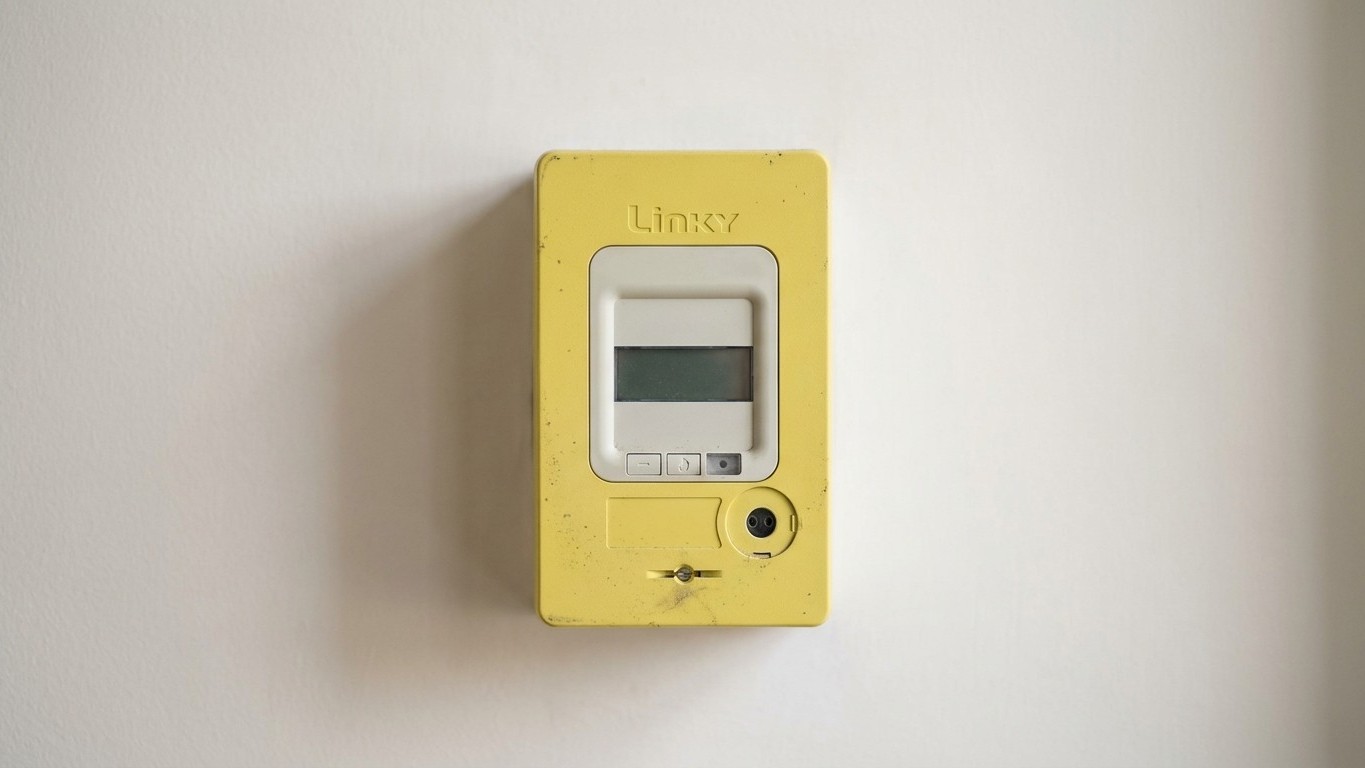
Five point seven billion euros. That is the total bill for deploying Linky meters in France, and it has already been paid, down to the last cent, by the 35 million households that saw it appear on their wall. Not by the state, not by Enedis from its own funds: by you, tucked into your electricity bill, without even a dedicated line to tell you so.
Key takeaways
- Who really paid the 5.7 billion for the Linky rollout in France?
- The yellow box promised savings: what happened after eight years?
- Did Enedis reap the true benefits of this colossal investment?
A project billed to users, under conditions that mainly favor Enedis
The figure comes directly from the Court of Auditors itself. In its public annual report released in February 2018, the institution estimates the total effective cost of implementing the meters at 5.7 billion euros, a sum equivalent to about 130 euros per meter, passed on to future bills. The verdict of the financial magistrates rests on a single line that struck a chord: “a costly arrangement for the consumer, but advantageous for Enedis,” with the network operator emerging as the big winner while households bear the losses.
The financing mechanism explains this imbalance. To avoid a sudden spike in bills during deployment, the Energy Regulatory Commission set up a cash advance system: Enedis advances the costs and will be reimbursed, with interest (set at 4.6%), when the system bears fruit. A generous rate, which the Court deems precisely excessive. It highlights a double bonus for Enedis, including a “tariff deferral at excessive cost,” which should trigger an extra charge of about one billion euros to users over the long term. A written question submitted to the National Assembly sums up the calculation bluntly: users, in addition to repaying the entire program, will provide Enedis with a benefit of 500 million euros.
In practical terms, this money flows through TURPE, the tariff for the use of public electricity networks, that invisible line which alone accounts for roughly one third of your bill. No one ever sees the word “Linky” written on their consumption statement. And yet, every kilowatt-hour billed has, for years, contributed to repaying this pharaonic project.
Promised savings that never truly lived up to expectations
The yellow box was supposed to lower households’ bills. It was the key argument at the project’s launch: better real-time knowledge of one’s consumption should drive households to adjust usage, shift laundry to off-peak hours, and hunt down energy-hungry devices. On paper, the reasoning held. In practice, the Court of Auditors notes a wide gap between promise and reality.
The problem is that these savings rest almost entirely on active consumer engagement, via an online portal that must be visited voluntarily. By the time of the report, the account-opening rate among users with a Linky meter was particularly low (1.5%). Of every hundred households equipped, barely one and a half would look at their detailed consumption curve. The remaining 98.5% paid for a feature they never used.
The Court does not mince its words on this point: “The gains that meters can deliver to consumers are still insufficient. Yet it is they who justify the scale of the investment,” lament the magistrates. A sentence that sums up the paradox of the project: a 5.7-billion-euro device built on the expectation of a behavioral change that almost no one activated. Parliamentary questions from the era echo the same finding: the benefits did not appear to justify such an investment, while the report noted mediocre economic profitability limited to the distribution portion.
Where is the yellow meter in 2026, nearly a decade later
The rollout, for its part, is now nearing completion. Launched in December 2015, it aimed for 35 million households equipped by the end of 2021. This target has long since been surpassed: the installed base within the Enedis-served territory stands at around 38 million meters, i.e., a coverage rate close to 97% of French homes. Only a handful of dwellings remain, often isolated or hard to access, still using the old electromechanical meter.
For these late adopters, the situation is becoming increasingly uncomfortable. Households that still lack a Linky are now exposed to manual-reading fees of about 5.33 euros per month. A tactic, for Enedis, to push the final percentages of a project that should have been completed long ago.
On the substance, the debate about the profitability of the system for households remains wide open. Some newer analyses put the final cost slightly below the initial 5.7 billion budget, down to around 4.6 billion euros thanks to deployment savings. But the financing mechanism has not changed: it is still electricity bills, via TURPE, that bear the cost. The yellow meter today enables switching providers in 24 hours and accessing differentiated tariff offers based on hours of consumption, something that did not exist with the old equipment. Still, to reap a real benefit on one’s bill, you must open your tracking account, compare offers, and change your consumption habits, exactly what the vast majority of French people still have not done, eight years after the alarm was raised in the report.
Sources: fournisseurs-electricite.com | ohm-energie.com | assemblee-nationale.fr
