
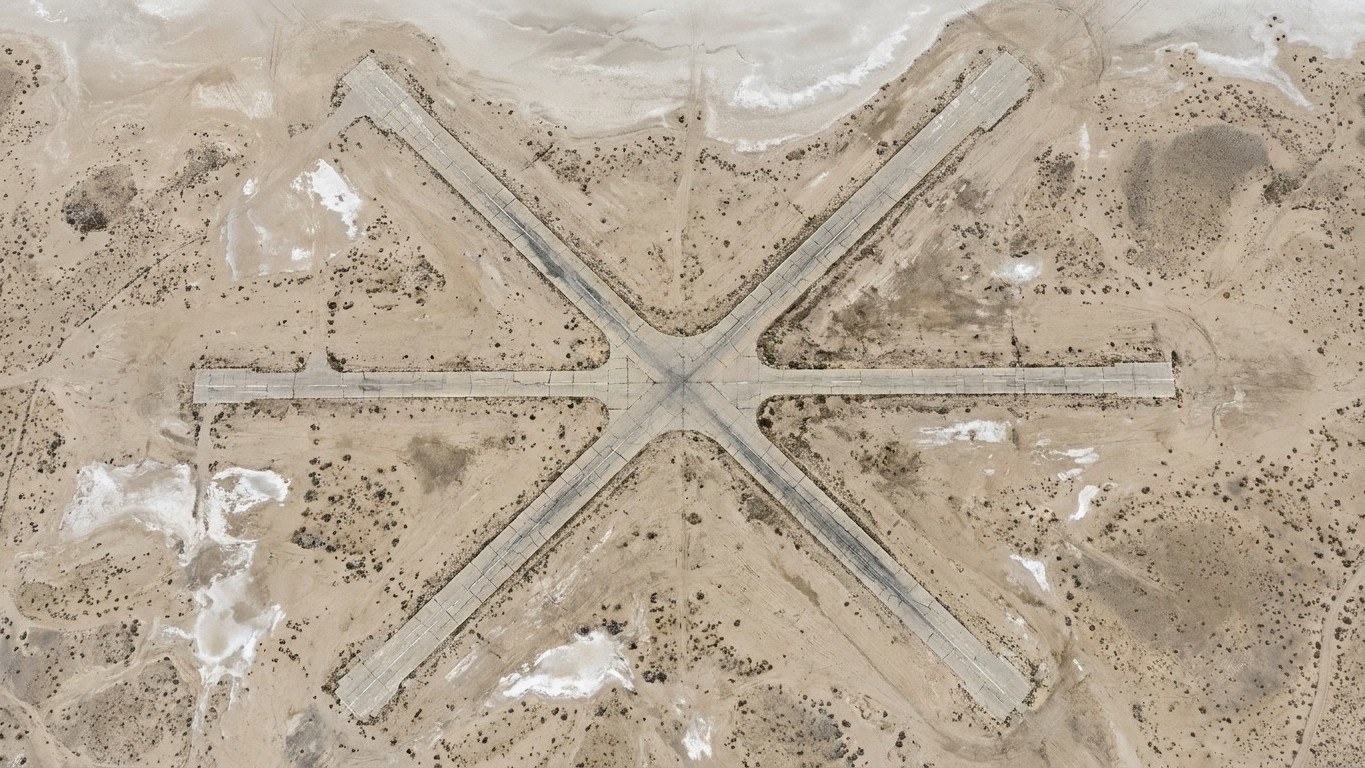
Seen from above, the shape immediately captivates the eye: four concrete strips converge toward a central point, like the arms of a star drawn with a ruler across a barren desert. They are the remains of Barkhan airfield, on the former Vozrozhdeniya Island in the Aral Sea. No aircraft has landed there since 1992. Since then, sand has patiently crept over these runways that the USSR had intended to be unlike any other.
À retenir
- Why did the USSR build a star-shaped airfield in the heart of a desert island?
- What grave secret justified erasing an entire town from official maps?
- How did geography itself contribute to the swallowing of this abandoned base?
An airfield designed for a wind that never stops
The Barkhan story begins at the end of the 1940s, when the Soviet Union decided to turn this isolated island, lost in the middle of the Aral Sea, into a strategic site. In 1949, a four-runway airfield was built three kilometers west of Kantubek, with runways laid out like a windrose because the island constantly faced strong and shifting gusts. The airstrip was named “Barkhan.” The name, literally meaning “dune” in Russian, perfectly suits the barren landscape swept by gusts.
This architectural choice was not about style. A constant wind blew over the island, giving aircraft the option to land on any of the four runways depending on the weather and wind direction. The result was a star-shaped configuration that had no parallel. Barkhan was the only airfield in the entire Soviet Union to boast four runways, a record that nobody ever boasted about, given how much of the island’s story remained secret.
Aralsk-7, the city the map did not show
This airfield did not serve just any fishing village. It supplied Kantubek—also known as Aralsk-7—a closed city erected to house scientists and military personnel working on one of the Cold War’s most secret programs. All fishermen and local residents were evacuated, the fish-processing plant shut down, and a military unit with 800 soldiers stationed on the island, along with a small town for the scientists and their families named Aralsk-7, comprising 15 three-story buildings, a cultural club, a mess hall, shops, a stadium, and a power station.
Officially, microbiology was studied there. In reality, the island served as a full-scale testing ground for biological weapons: plague bacteria, anthrax, and tularemia. In the 1990s, Soviet defectors, including the former head of the program, Ken Alibek, revealed the dangers of the island, with documents showing that spores of anthrax and the bacilli of bubonic plague were being turned into weapons and stored. The most chilling episode remains the 1971 outbreak: smallpox escaped, infecting a 24-year-old researcher aboard a ship located about 15 kilometers from the shore, who in turn infected ten people in Aralsk, Kazakhstan, including three who died. The affair stayed secret for more than thirty years.
Shortly before the collapse of the Soviet bloc, authorities attempted to wipe out the most compromising evidence. In 1988, between 100 and 200 tons of anthrax slurry were mixed with bleach, transported by barge, and dumped into pits on the island. A makeshift decontamination operation carried out in haste would have consequences far more enduring than anyone anticipated.
1992, the hasty departure and a sea in retreat
The program ended abruptly with the dissolution of the USSR. The Soviet program had already slowed before the collapse; the Aralsk-7 military laboratory closed in November 1991 and Kantubek’s population was evacuated within weeks. An agreement documented by the Arms Control Association places the final abandonment of the site by the Soviets in 1992. Overnight, an entire town emptied out, leaving buildings, equipment, and civil infrastructure untouched.
What makes Barkhan’s disappearance even more singular is that it was not solely about human abandonment. Geography itself turned against the island. Vozrozhdeniya expanded as the waters receded, its surface increasing nearly tenfold during the 1990s, and by 2001 the former island had become a peninsula connected to the mainland. The Aral Sea, once the fourth-largest inland body of water, dried up due to the large-scale diversion of rivers to irrigate cotton fields—the Soviets’ “white gold.” The ghostly island no longer requires a boat to be reached: one can now walk from the Kazakh or Uzbek shore across a seabed that has become a desert of sand and salt.
What remains today
For almost three decades, Kantubek’s buildings drew metal thieves and urban explorers, often without protection against potentially contaminated ground. Uzbek authorities eventually decided to act. By 2021, Aralsk-7 and the lab complex three kilometers away had been completely demolished by Uzbek authorities; today only foundation traces and the cross-shaped bands of Barkhan’s airfield remain.
American and Soviet, then international, scientific expeditions followed in the 1990s and 2000s to assess lingering danger. American researchers were invited in the 1990s to examine the biological agents buried on the island, revealing that some spores and dangerous bacteria survived despite decontamination attempts; later expeditions in 1997, 1999, and 2002 continued these investigations. Today there is little left to plunder or to visit: only the four star-shaped runways of Barkhan continue to carve their pattern in the sand, visible in satellite imagery, the last cartographic marker of a town that the USSR had erased from its own official maps for nearly forty years.
Sources: thedarkatlas.com | advantour.com
